
Graphene coating is not automatically better than ceramic coating: the exact formulation, surface preparation, application, and maintenance determine which coating suits your car. In a graphene coating vs ceramic coating comparison, neither label guarantees longer protection, freedom from water spots, or resistance to rock chips.
- Graphene coating vs ceramic coating has no category-wide winner; compare documented performance and care requirements.
- Ceramic coating suits owners seeking easier cleaning, but it does not replace paint correction or impact protection.
- Graphene-labelled coatings need product-specific evidence before claims of better durability or fewer water spots deserve weight.
- Klean Detail offers ceramic coating and paint correction for car owners in Oak Lawn, Illinois.
Is graphene coating better than ceramic coating?
No. A graphene label alone does not establish better paint protection than a ceramic label. Compare the actual products and installation plans, not an ingredient name presented as a performance result.
The categories also overlap. A coating advertised with graphene can use ceramic-forming chemistry, so the choice is not necessarily graphene instead of ceramic. You need the manufacturer's technical information to understand what is actually being applied.
| Decision point | Ceramic coating | Graphene-labelled coating |
|---|---|---|
| Best for | Owners seeking a protective coating with clear application and maintenance instructions | Owners considering a specific formulation whose documented benefits match their needs |
| Main benefit to assess | Easier cleaning and water-repellent surface behaviour | The same benefits, plus any substantiated formulation-specific improvements |
| Main limitation | Does not eliminate washing, water spotting, or paint damage | The graphene label does not establish superiority |
| Existing swirls | Requires separate correction if you want them removed | Requires separate correction if you want them removed |
| Rock-chip protection | Not a substitute for impact-protective film | Not a substitute for impact-protective film |
| Decision evidence | Technical instructions, preparation scope, and care requirements | The same evidence, with support for graphene-specific claims |
If your main concern is how protection performs after installation, start with how long ceramic coating lasts. A useful comparison connects the initial application to the washing and maintenance you will actually do.
Why this matters
Choosing a coating by its headline ingredient can distract you from the work that determines the finished result. A coating does not remove embedded contamination, repair damaged clear coat, or polish away swirls simply because it contains a particular additive.
For your 2026 decision, separate appearance improvement from surface protection. Paint correction addresses suitable defects through controlled polishing; a coating protects the prepared surface and changes how it interacts with water and contamination.
That distinction matters when you approve the work. If you expect scratch removal but authorize coating alone, the disagreement starts before the installer opens the bottle.
Ceramic coating: best for documented care requirements
Ceramic coating is a sensible choice when its application requirements and maintenance needs fit your ownership routine. Evaluate the specific coating rather than assuming every ceramic product performs alike.
Automotive ceramic coatings generally create a thin protective layer on the finish. Their practical appeal is a surface that is easier to clean and that repels water, not a paint surface that becomes impossible to damage.
The advantages are straightforward:
- A coated surface can release dirt more readily during appropriate washing.
- Water repellency can make rinsing and drying easier.
- A coating can help preserve the appearance of properly prepared paint.
The limitations are just as important. You still need safe washing, prompt attention to contamination, and care that follows the coating manufacturer's instructions. Abrasive washing can mark the finish, and water left to evaporate can leave deposits.
Ask what preparation is included and what the installer expects you to do afterward. A clear answer about maintenance is more useful than a broad promise that your car will stay clean.
Graphene-labelled coating: best for a supported specific benefit
Choose a graphene-labelled coating only when the actual product offers a documented benefit that matters to you. The presence of graphene-related material is not, by itself, proof of better automotive performance.
Graphene is a carbon material; pure graphene is a single atomic layer. That scientific description does not tell you how a bottled automotive coating behaves after application, because the finished formulation contains more than the named additive.
A graphene-labelled coating can still be a reasonable option. It needs the same scrutiny as a ceramic coating: suitable preparation, clear application instructions, defined cure requirements, and realistic maintenance guidance.
The drawback is the temptation to transfer properties of an individual material directly to the finished coating. A claim about graphene itself does not establish the scratch resistance, water-spot resistance, or durability of a product applied to your car.
For a 2026 comparison, ask what was measured, how it was measured, and whether the result applies to the coating being offered. Skip a category-wide upgrade claim that cannot answer those questions.
Why coating results vary
The difference between two finished cars can come from the work and care around the coating, not just the coating chemistry. These factors belong in every comparison:
- Paint condition: Swirls, oxidation, repairs, and damaged clear coat affect the starting point and the appropriate preparation.
- Surface preparation: Contamination and polishing residue must be addressed according to the coating's application instructions.
- Application conditions: Temperature, humidity, working time, and removal technique need to match the product's requirements.
- Curing conditions: Water exposure and washing must follow the manufacturer's directions after installation.
- Vehicle exposure: Outdoor parking, mineral-bearing water, road contamination, and environmental fallout create different care demands.
- Maintenance technique: Wash tools, cleaning chemicals, drying habits, and abrasive contact influence the finish over time.
These factors explain why a coating name cannot predict your result on its own. Compare the installation and ownership plan as carefully as the bottle.
Do not treat preparation as an optional detail added after you choose the coating. It is part of the protection decision from the start.
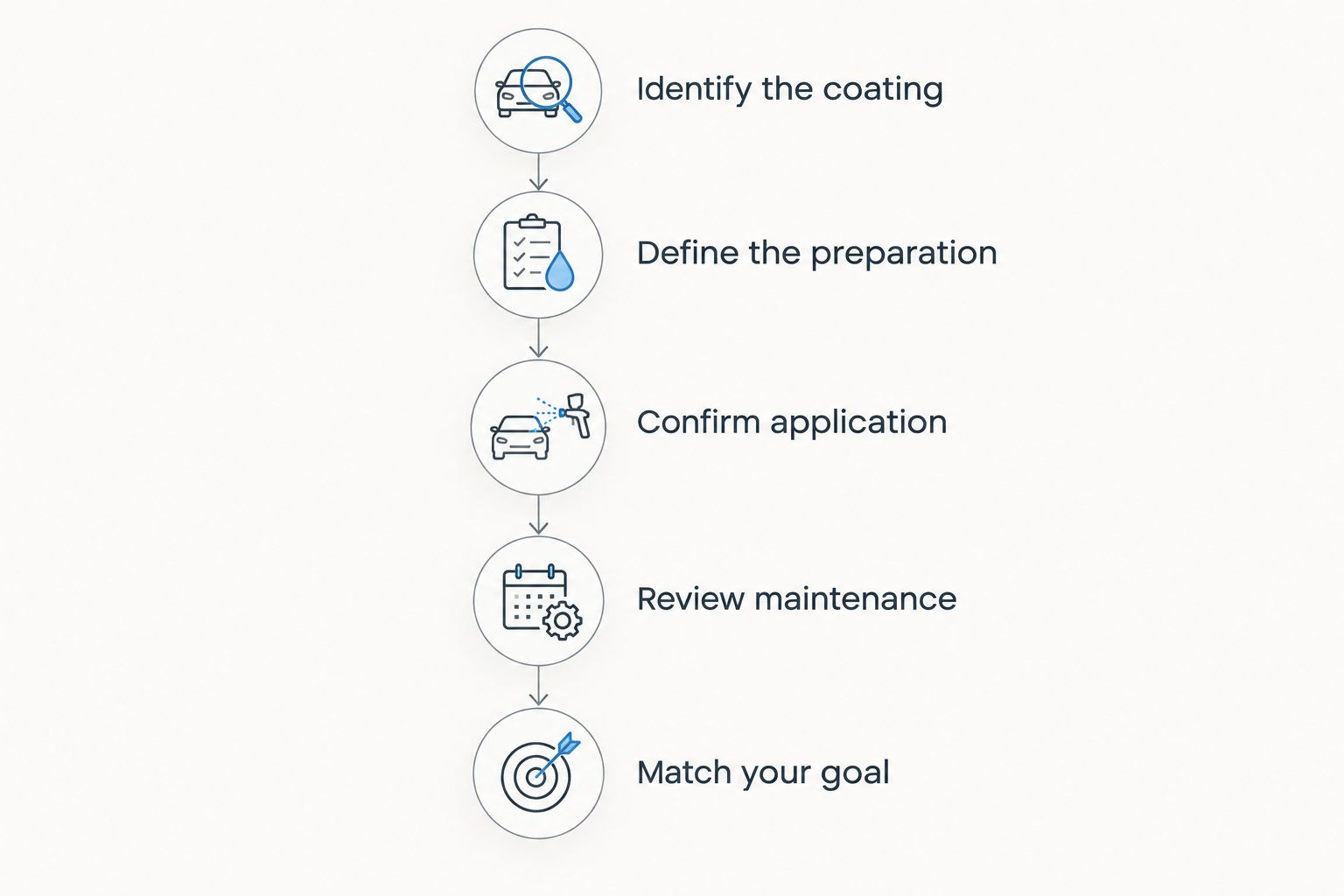
How to compare coating proposals in 2026
Use the same questions for each proposal. Otherwise, you risk comparing a coating-only application with a service that also includes substantial cleaning and paint correction.
Identify the coating
Ask for the exact manufacturer and product name, then request the corresponding application and maintenance instructions. Ceramic and graphene are category descriptions, not complete specifications.
Make sure the written proposal identifies what will be applied. A product name gives you something concrete to evaluate if the verbal explanation and care sheet differ.
Define the preparation
Ask whether the work includes decontamination, polishing, or both, and which visible defects the installer expects to address. Cleaning paint and correcting paint are different tasks.
Discuss the finish under suitable inspection lighting before authorizing the service. You should understand which defects are being corrected and which will remain.
Confirm application and curing
Request the instructions governing water exposure and the first wash. Follow the actual coating's directions rather than a general timetable found in an unrelated guide.
Also establish who handles any application defects discovered at collection. Uneven residue and missed areas are installation concerns, not evidence that a different coating category was needed.
Review maintenance
Ask which wash methods and chemicals are appropriate, how to manage mineral deposits, and whether maintenance products are required or optional. Get those answers before you commit.
Choose a plan you can realistically follow. A coating whose care requirements conflict with your regular washing routine is a poor match, regardless of its label.
Match your goal
Decide whether your main problem is difficult cleaning, visible swirls, mineral spotting, or stone impacts. Those problems do not all call for the same treatment.
Ask the installer to explain how the proposed work addresses your particular concern. If the answer returns only to the coating's ingredient name, the proposal has not answered your question.
Does graphene coating prevent water spots better?
Graphene coating is not automatically more resistant to water spots than ceramic coating. Water-spot performance needs evidence for the specific formulation under relevant conditions.
Water repellency and freedom from mineral deposits are different things. A surface can bead water strongly and still develop spots when mineral-bearing droplets evaporate.
For your 2026 care plan, focus on prompt drying and the coating manufacturer's instructions for removing contamination. Do not use a strong cleaner simply because someone describes it as safe for coatings in general.
Ask the installer how to distinguish deposits sitting on the coating from damage that needs further assessment. Repeatedly scrubbing a stubborn mark risks creating another problem without resolving the first.
Does either coating stop scratches or rock chips?
Neither graphene coating nor ceramic coating makes automotive paint scratch-proof or chip-proof. Both remain thin surface treatments, not substitutes for material designed to absorb road impacts.
Be careful with hardness language. A 9H pencil-hardness reference is not a Mohs mineral-hardness rating, and neither label proves that road debris cannot damage a coated panel.
If you are worried about stone impacts, discuss paint protection film as a separate protection option. If you are worried about existing swirls, discuss appropriate paint correction before the coating is applied.
The useful question is not whether a coating sounds hard. It is whether the proposed treatment addresses the damage you want to prevent or correct.
Should you switch from ceramic to graphene coating?
Do not replace a functioning ceramic coating solely to obtain a graphene label. Assess the current finish, cleaning behaviour, contamination, and maintenance history first.
Reduced water beading alone does not identify the cause of a change. Surface contamination can alter how water behaves, so the next step is assessment and appropriate cleaning rather than an automatic replacement.
If the current coating needs removal or renewal, compare the replacement products on their own merits. Ask what preparation is required and how the new maintenance instructions differ from your existing routine.
For 2026 renewal decisions, your car's condition should drive the work. A new category name is not evidence that the existing protection has failed.
Where professional assessment fits
Klean Detail is best suited to Oak Lawn car owners seeking professional ceramic coating and paint correction. Its services also include paint protection film, window tinting, and full vehicle detailing.
The benefit of a professional assessment is matching the service to the paint concern. The limitation remains: professional ceramic coating does not remove every defect or replace impact protection.
When discussing your car with Klean Detail, identify the problem first. Bring up difficult cleaning, existing swirls, water spots, or road-impact concerns rather than asking for the newest coating category by default.
Ask for the preparation scope and care instructions in writing. That gives you a practical basis for deciding whether the proposed work matches your expectations.
Discuss your paint protection goals
Ask about ceramic coating, paint correction, and paint protection film for your vehicle.
FAQ
What's better for my car, graphene coating or ceramic coating?
Neither category is automatically better for your car. Compare the specific coating, preparation scope, curing instructions, and maintenance requirements against your goals.
Is graphene coating a type of ceramic coating?
A graphene-labelled coating can use ceramic-forming chemistry, so the categories can overlap. Check the actual product documentation rather than treating the labels as mutually exclusive.
Will graphene coating stop water spots on my car?
Graphene coating does not guarantee freedom from water spots. Mineral-bearing water can leave deposits as it evaporates, so drying and appropriate cleaning still matter.
Can ceramic coating remove the swirl marks already on my paint?
Ceramic coating does not remove existing swirl marks. Suitable paint correction addresses defects before coating, subject to the condition of the paint.
Does graphene coating mean I won't need to wash my car?
Graphene coating does not eliminate washing. Follow the coating manufacturer's maintenance instructions and use washing methods that avoid unnecessary abrasion.
Should I remove my ceramic coating to upgrade to graphene?
Do not remove a functioning ceramic coating solely for a graphene label. Have the current surface assessed and compare any replacement on documented product benefits.
Can Klean Detail help me choose paint protection in Oak Lawn?
Klean Detail offers ceramic coating, paint correction, and paint protection film in Oak Lawn, Illinois. Discuss your paint condition and protection goals to identify the relevant service.
One last thing
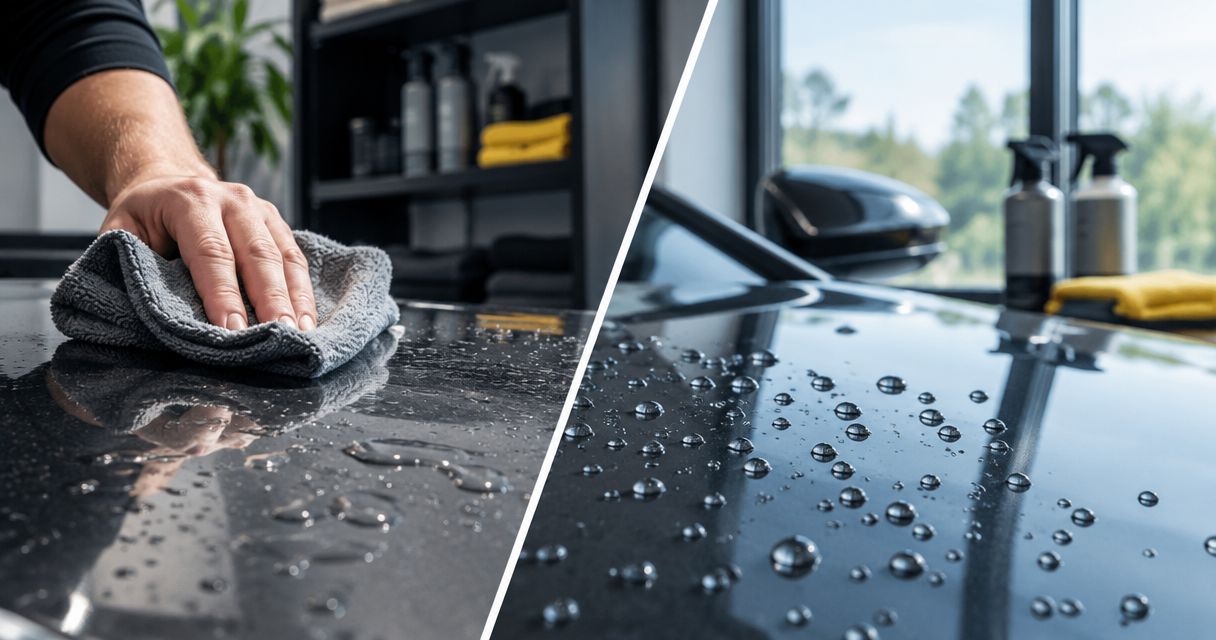
A water-beading demonstration is not a complete coating test. It shows how water behaves on that surface at that moment; it does not establish long-term durability, resistance to mineral deposits, or protection against road impacts.
Before choosing, ask one final question: what will I need to do to keep this result? A clear, product-specific answer tells you more about ownership than the word graphene or ceramic on its own.


