
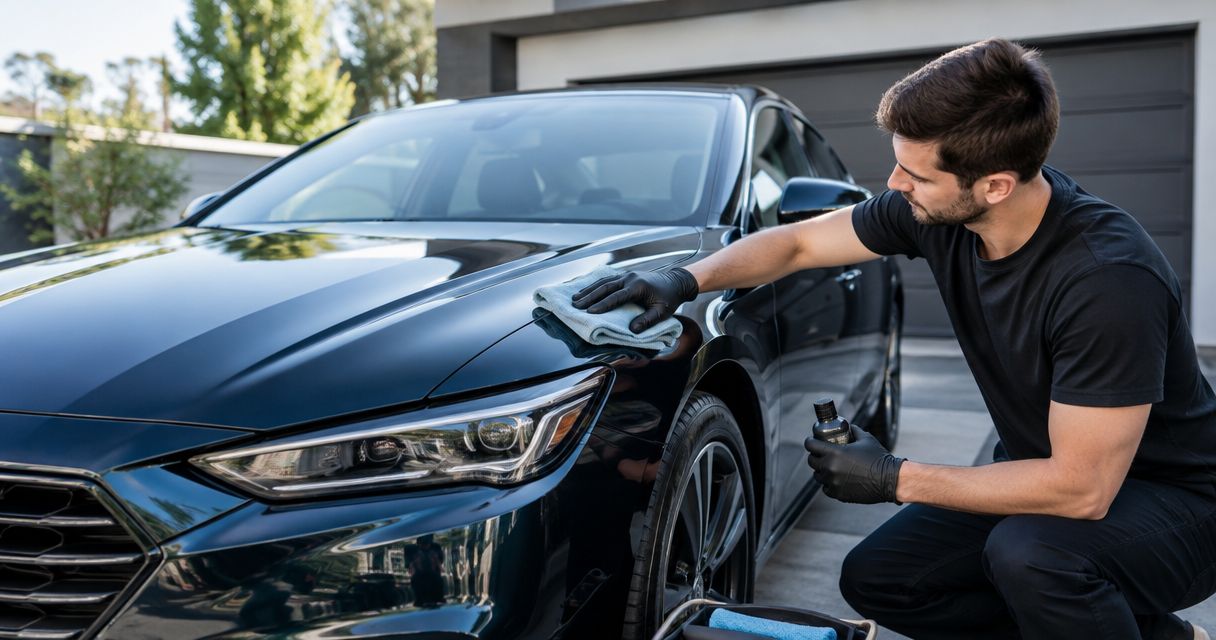
Ceramic coating for new car owners is a surface treatment applied to prepared paint to make routine cleaning easier and help protect the finish from contamination. Your main decision is not which coating sounds strongest: it is whether your new paint needs correction, whether you need impact protection, and how you will maintain the car.
- Ceramic coating for new car owners supports easier washing; it does not replace paint protection film or careful maintenance.
- Kleandetail offers ceramic coating and paint correction for Oak Lawn car owners seeking professional paint care.
- Inspect new paint before coating; delivery condition determines preparation, not the vehicle’s mileage.
- Choose paint protection film for chip-prone areas and ceramic coating for easier surface maintenance.
Why ceramic coating matters for new car owners
New-car ownership gives you a useful starting point: you can document the paint’s condition and choose your care routine before adding more wear. It does not guarantee flawless paint. Transport, storage, and delivery washing can leave contamination or visible marks that deserve inspection before coating.
For your 2026 purchase, separate appearance from protection. Paint correction addresses suitable surface defects; ceramic coating changes how the prepared surface interacts with water and contamination. Paint protection film provides a physical barrier against some impact damage. These services solve different problems.
Kleandetail is best for Oak Lawn car owners seeking professional ceramic coating alongside paint correction or paint protection film services. You can review Kleandetail before deciding which work belongs in your plan. Professional service handles preparation and application, but it does not eliminate your responsibility to wash and maintain the finish.
How to plan ceramic coating for a new car
1. Inspect the paint before accepting its condition
Start with a manual inspection in daylight and under a focused light. Walk around the vehicle while the paint is clean and dry, then look across each panel from different angles. A glossy showroom finish can hide wash marks that become obvious in direct sun.
Make a record before arranging additional work. Take 2 photographs of any concern: one showing its location on the vehicle and another showing the defect closely. This is a documentation method, not a test of scratch depth.
If a panel has been repaired or repainted, ask for the repair details before coating it. Refinished paint needs instructions from the paint system or repairer; do not apply a blanket waiting period taken from an unrelated vehicle.
- Check the hood, roof, doors, and trunk for visible swirls.
- Photograph chips, scratches, stains, or uneven areas.
- Ask whether any delivery damage required repainting.
- Record any protection treatment already applied by the seller.
2. Match protection to how you use the car
Write down your driving and parking habits before choosing a service. A car that regularly encounters road debris needs a different protection discussion from a vehicle whose owner mainly wants easier washing. Neither use case makes ceramic coating a substitute for film.
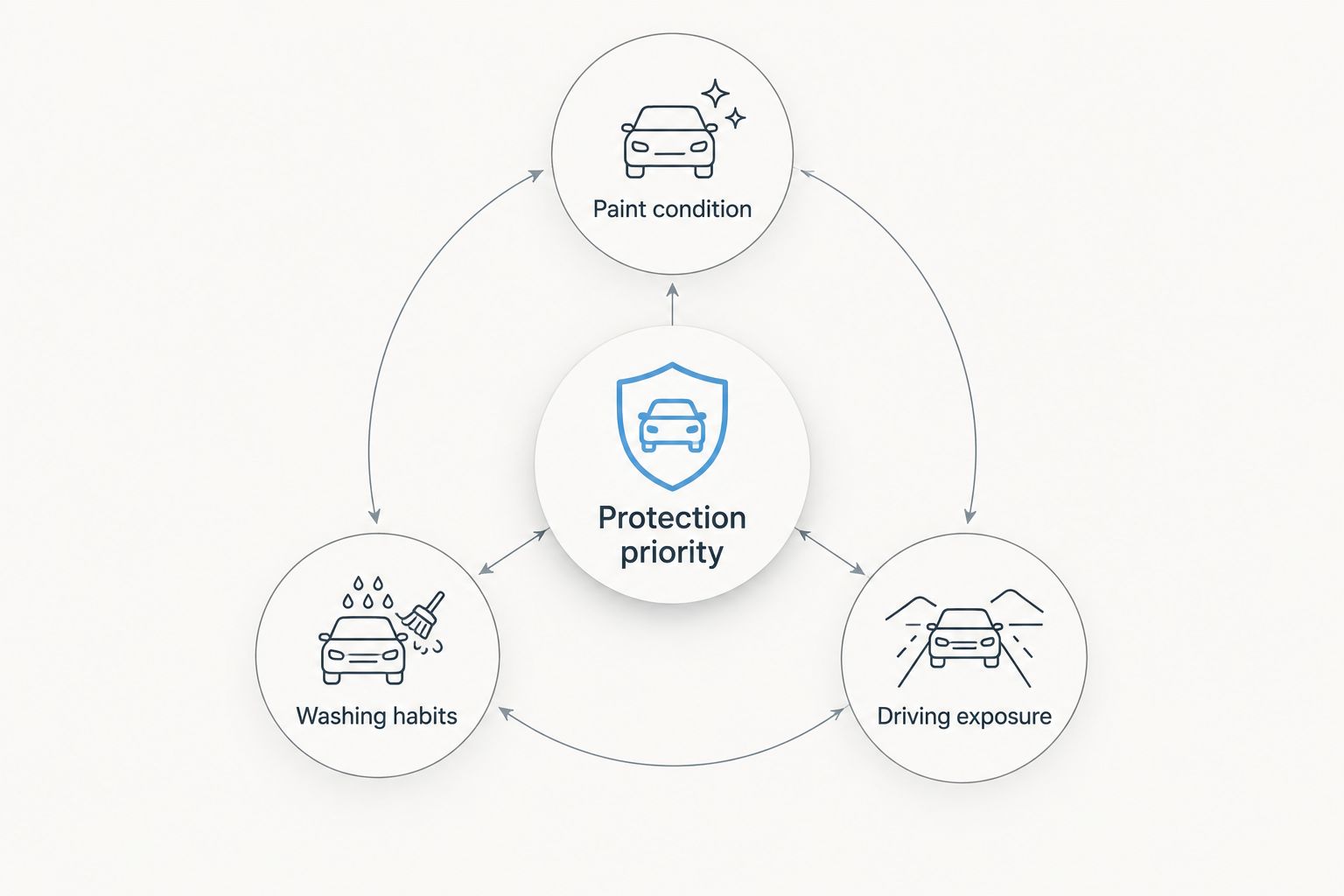
Use 3 checks to organize your 2026 decision: paint condition, washing habits, and driving exposure. This keeps a coating purchase tied to a specific problem rather than a list of claims.
Choose ceramic coating for easier surface maintenance, not for rock-chip prevention. Choose paint protection film when impact protection is the priority, while recognizing that film is not damage-proof. Coating over film requires a compatible product and the film manufacturer’s care guidance.
- Paint condition: identify defects you want addressed before protection.
- Washing habits: decide who will clean the car and how.
- Driving exposure: note road debris, outdoor parking, and tree coverage.
- Protection priority: separate easier cleaning from impact resistance.
3. Define the preparation before choosing the coating
After inspection, ask what preparation the paint actually needs. Washing removes loose dirt; suitable decontamination addresses material that ordinary washing leaves behind. Polishing addresses appropriate paint defects. These are separate tasks, and a new car does not automatically need every possible correction step.
If you are assessing the paint yourself, begin with clean paint and good lighting rather than immediately using abrasives. Clay treatment and machine polishing can introduce defects when used incorrectly. Do not practice correction on your new vehicle simply because a coating application guide includes polishing.
Kleandetail offers paint correction and ceramic coating, making professional preparation an alternative to performing both tasks yourself. Ask which defects the proposed preparation addresses and which will remain. The limitation is straightforward: correction removes paint material, so the most aggressive finish is not automatically the right choice.
- Ask how the paint will be inspected before correction.
- Separate washing, decontamination, polishing, and coating in the scope.
- Request an explanation of defects that should remain untreated.
- Confirm whether glass, trim, wheels, or film are included or excluded.
4. Compare application routes by responsibility
Read the application instructions before deciding to coat the car yourself. A suitable workspace, clean surface, controlled application, and careful inspection all matter. Coating residue left unevenly on the paint can require additional work to correct.
DIY application gives you control over the process, but it also makes you responsible for preparation, application errors, and aftercare. Professional application transfers those tasks to a detailer; you still need a clear written scope and maintenance instructions.
For a 2026 appointment with Kleandetail, ask what the actual coating requires rather than assuming every product follows the same schedule. Do not assume that a quoted service includes correction, every exterior surface, or future maintenance visits. Those details belong in the agreement.
- Read the selected coating’s complete instructions before DIY application.
- Confirm suitable workspace and environmental requirements.
- Ask how application defects will be identified and addressed.
- Get the included surfaces and preparation tasks in writing.
- Identify who handles follow-up questions after application.
5. Plan the handoff around curing instructions
Arrange application around a period when you can follow the selected product’s instructions. Avoid building your schedule around a universal cure time: requirements differ, and initial handling instructions are not necessarily the same as full curing requirements.
Before collection, ask for separate guidance on driving, water exposure, washing, and contaminant removal. If the vehicle gets wet unexpectedly, contact the installer for instructions rather than improvising with cleaners or towels on dirty paint.
At handoff, inspect the finish under useful lighting and confirm whom to contact about uneven-looking residue or other concerns. Keep the care instructions with your 2026 vehicle records so another driver or detailer does not unknowingly use an unsuitable process.
- Confirm when the vehicle can be driven after application.
- Ask how to handle rain or accidental water exposure.
- Get the first-wash instructions in writing.
- Record the coating identity and treated surfaces.
- Inspect the finish before leaving the appointment.
6. Build a wash routine you will actually follow
Begin with the simplest workable routine: remove loose contamination before contact washing, use clean wash materials, and dry without dragging grit across the paint. Follow the coating manufacturer’s cleaning guidance. Stronger chemicals are not automatically better cleaners for your finish.
A coating does not make dirt harmless. Bird droppings, insect residue, and water deposits still deserve attention, and wiping a dusty car with a dry towel can damage the underlying finish. Avoid treating water beading as the only measure of coating condition; contamination can change surface behavior.
Your 2026 maintenance plan should also explain what happens when cleaning stops restoring the expected behavior. Ask for an assessment before adding another treatment. Applying products over unresolved contamination does not diagnose the problem.
- Remove loose grit before touching painted surfaces.
- Keep wheel-cleaning materials separate from paint-washing materials.
- Use clean towels and replace contaminated ones during the wash.
- Remove droppings and insect residue using an appropriate method.
- Follow product-specific guidance for maintenance treatments.
Discuss your new car’s protection
Ask about ceramic coating, paint correction, and paint protection film for your vehicle.
Compare protection options for your new car
The best option matches the job you need done. Ceramic coating, paint protection film, and wax or sealant are not interchangeable, and none makes a vehicle maintenance-free. Preparation requirements also remain important regardless of the protection you choose.
Compare these routes by purpose and responsibility rather than treating a single durability claim as the deciding factor. When combining film and coating, confirm compatibility and installation order with the installer.
| Option | Best for | Main advantage | Key limitation |
|---|---|---|---|
| DIY ceramic coating | Owners comfortable with detailed preparation and application | Direct control over the process | You handle application errors and product-specific curing requirements |
| Professional ceramic coating | Owners who want a detailer to handle preparation and application | Preparation and application can be coordinated | Results depend on the agreed scope; maintenance remains necessary |
| Paint protection film | Owners prioritizing protection against stone-chip impacts | Adds a physical protective layer | Film is not damage-proof and requires suitable installation and care |
| Wax or paint sealant | Owners who prefer a simpler, repeatable protection routine | Lets you maintain protection through repeat applications | Requires renewal according to the product and conditions |
| Compatible coating over film | Owners seeking film protection with coating-style surface behavior | Combines different protection functions | Product compatibility and both care requirements must be checked |
If chips are your deciding concern, read whether ceramic coating prevents rock chips before choosing a coating-only plan. A smooth, water-repellent surface is not an impact barrier.
Common mistakes new car owners make
Assuming new paint needs no inspection
Low mileage does not establish paint condition. Inspect the delivered vehicle before approving coating, and distinguish removable contamination from defects requiring correction. Otherwise, you risk protecting a finish whose appearance already disappoints you.
Buying correction without identifying the defects
A correction package should answer a visible paint problem, not simply accompany every new-car coating. Ask what needs improvement and what level of correction is appropriate. Preserve paint rather than pursuing removal of every mark regardless of depth.
Expecting coating to replace film
Ceramic coating does not provide the physical barrier of paint protection film. If you mainly want protection against road-debris impacts on the front of the vehicle, discuss film coverage first. Add coating only if its maintenance benefits fit your goals.
Keeping the same damaging wash routine
A coating does not cancel the effects of abrasive washing. Review your wash method before application, especially if it involves dirty brushes or wiping dust from dry paint. Protection and maintenance need to work together.
Treating paperwork as an afterthought
Keep the application record, treated surfaces, and maintenance instructions together. If a service includes a warranty, read its actual terms rather than assuming what it covers. Ask how repairs, repainting, and later detailing affect the care plan.
FAQ
Is ceramic coating worth it for a brand-new car?
Ceramic coating fits a new car when you want easier routine cleaning and will maintain the finish correctly. It is not the right substitute for paint protection film when stone-chip protection is your main goal.
Can I ceramic coat my new car right after delivery?
A factory-finished new car can be assessed for coating after delivery, but its condition and any repair history must be checked first. Repainted panels require guidance from the repairer or paint system before protection is applied.
Does a new car need paint correction before ceramic coating?
A new car needs paint correction only when its condition and your appearance goals justify it. Inspect the paint first; do not assume either that it is flawless or that aggressive polishing is necessary.
Will ceramic coating stop scratches and rock chips?
Ceramic coating does not make paint scratch-proof or provide the impact barrier of paint protection film. Careful washing still matters, and chip-prone areas need a separate film discussion.
Is professional ceramic coating better than doing it myself?
Professional application is best for owners who want a detailer to handle preparation and application. DIY coating suits owners who can follow the product instructions and accept responsibility for preparation and application errors.
How soon can I wash my new car after ceramic coating?
Wash your coated car only when the selected coating’s instructions or installer allow it. Get written guidance for water exposure, the first wash, and contaminant removal rather than using a universal waiting period.
Can I put ceramic coating over paint protection film?
Ceramic coating can be applied over paint protection film when the coating is compatible with that film. Confirm compatibility and care requirements with the installer before combining the treatments.
One last thing
Your wash method belongs in the protection decision, not after it. Before approving any work, describe exactly how you plan to clean the car. A protection plan that depends on maintenance you will not perform is the wrong plan for your ownership routine.
Keep a short handoff record covering paint condition, preparation, protected surfaces, and care instructions. That record gives you something more useful than a vague promise: a clear explanation of what was done and how to look after it.


