
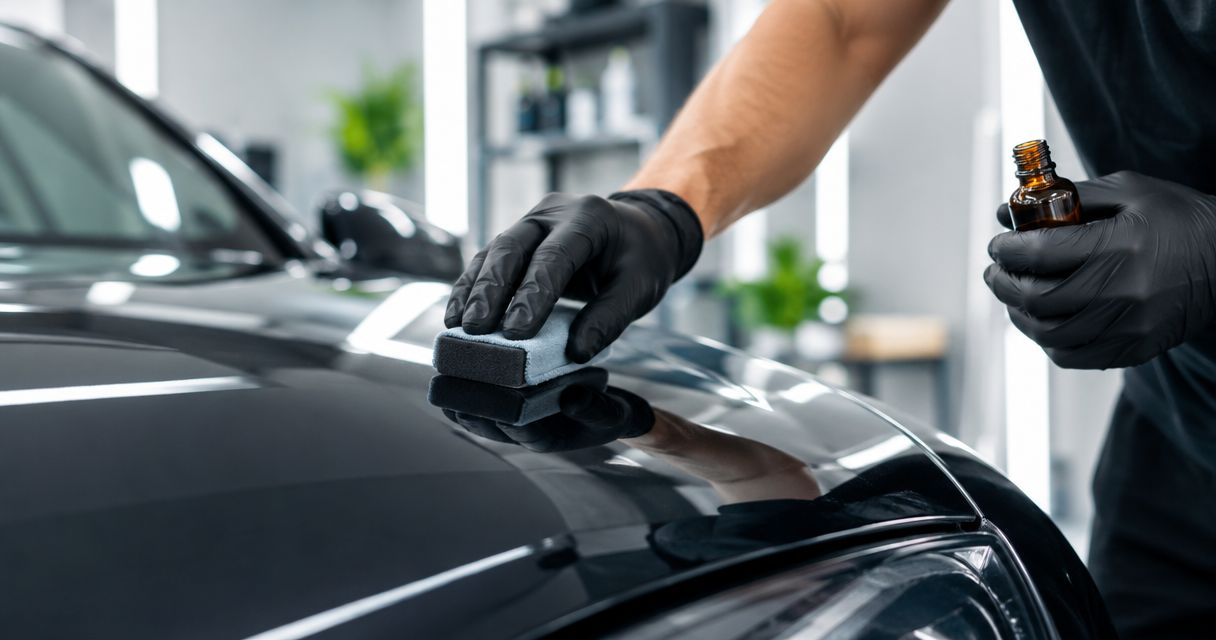
Ceramic coating has no universal lifespan: its useful life depends on the product, surface preparation, application, exposure, and maintenance. A stated durability period is not a guarantee that every panel will perform identically throughout that period. In 2026, the useful question is whether your specific coating still performs after appropriate cleaning—not simply how long ago it was applied.
- How long does ceramic coating last? Product instructions, preparation, exposure, and coating maintenance determine the answer.
- Reduced water beading alone does not prove that ceramic coating needs replacement.
- Kleandetail offers ceramic coating in Oak Lawn; discuss paint condition and aftercare before choosing a service.
- Clean and assess the surface before deciding to polish or recoat it.
How long does ceramic coating last?
Use the coating manufacturer's stated service life as a conditional expectation, not an expiration date. Match that claim to the exact product applied, its installation requirements, and the maintenance conditions attached to it. A generic description such as ceramic protection does not identify those requirements.
For an existing installation, start with your invoice, application record, and care instructions. For a new installation, ask the installer to identify the coating and explain what its durability claim means on your vehicle. Kleandetail provides ceramic coating services in Oak Lawn, Illinois.
The practical assessment is a sequence:
- Identify the coating. Confirm the product applied rather than relying on a general package description.
- Check the instructions. Read the manufacturer's curing, washing, maintenance, and warranty requirements separately.
- Clean the surface. Remove ordinary dirt using coating-compatible methods before assessing performance.
- Inspect the panels. Compare water behavior, visible contamination, spotting, and washing difficulty across the vehicle.
- Choose the next action. Distinguish a maintenance need from a damaged or worn coating before authorizing replacement.
This sequence prevents a common diagnostic mistake: treating every change in water beading as proof that the underlying coating has disappeared.
Why this matters
A coating's age and its condition answer different questions. Age tells you when it was installed; condition tells you what to investigate now. Neither a calendar reminder nor a dramatic beading video provides a complete assessment.
For a 2026 coating decision, separate three issues: how the paint looks, how the surface behaves during cleaning, and what the product documentation promises. Gloss alone does not establish that protection remains intact, and a rough surface does not automatically mean the coating needs removal.
Kleandetail is best suited to Oak Lawn car owners seeking a local shop offering ceramic coating and paint correction. Those are distinct services: coating adds a protective surface treatment, while paint correction addresses suitable paint defects through polishing. Discuss which problem you actually want solved before choosing either.
What does a coating's lifespan claim actually mean?
A durability statement describes an expectation under specified conditions. A warranty describes contractual coverage. Neither should be substituted for the other when you compare an installer’s explanation with the paperwork.
Ask whether the stated period applies to the coating itself, a maintenance-dependent protection system, or warranty coverage. Also ask which conditions must remain satisfied. Read the actual document rather than assuming that any particular inspection or maintenance requirement applies.
For your 2026 records, keep the coating identity, installation date, care instructions, and warranty documents together. These records give a future detailer something concrete to assess instead of asking them to diagnose an unidentified surface treatment.
Be equally careful with the word permanent. A coating does not make automotive paint immune to abrasion, mineral deposits, environmental contamination, or damage. A long durability claim does not remove the need for washing or inspection.
Why ceramic coating life varies
The same broad product category covers different formulations and application requirements. Your vehicle's use also changes what the surface encounters. Focus on these factors rather than choosing a service solely by its advertised duration:
- Product formulation. Different coatings have different application instructions, maintenance requirements, and stated durability. Compare the specific products, not just the ceramic label.
- Surface preparation. Residue, contamination, and preparation errors can interfere with application. Preparation should follow the coating manufacturer's process for the surface being treated.
- Application and curing. Installation conditions and early exposure matter. Follow the actual instructions instead of borrowing a curing schedule from another coating.
- Washing methods. Abrasive contact can mar paint, and unsuitable chemicals can affect surface behavior. Ceramic coating does not make a vehicle scratch-proof.
- Environmental exposure. Outdoor parking, road grime, mineral-containing water, and other contamination change the maintenance demands placed on the surface.
- Panel-specific wear. Different panels encounter different contamination and contact. Assess the vehicle panel by panel rather than assuming one result represents the entire car.
None of these factors produces a reliable lifespan estimate on its own. Together, they explain why an installer needs your vehicle's history and the coating's identity before making a useful recommendation.
Does weak water beading mean ceramic coating has failed?
Weak water beading is a reason to investigate, not an automatic replacement verdict. Dirt, mineral deposits, and other surface contamination can change how water behaves. A maintenance product applied over a coating can also affect the visible result.
Start with a proper wash using the coating's care instructions. If the surface remains rough, spotted, or unusually difficult to clean, ask a detailer to identify the contamination before choosing a chemical treatment. Do not combine cleaners experimentally to force a beading effect.
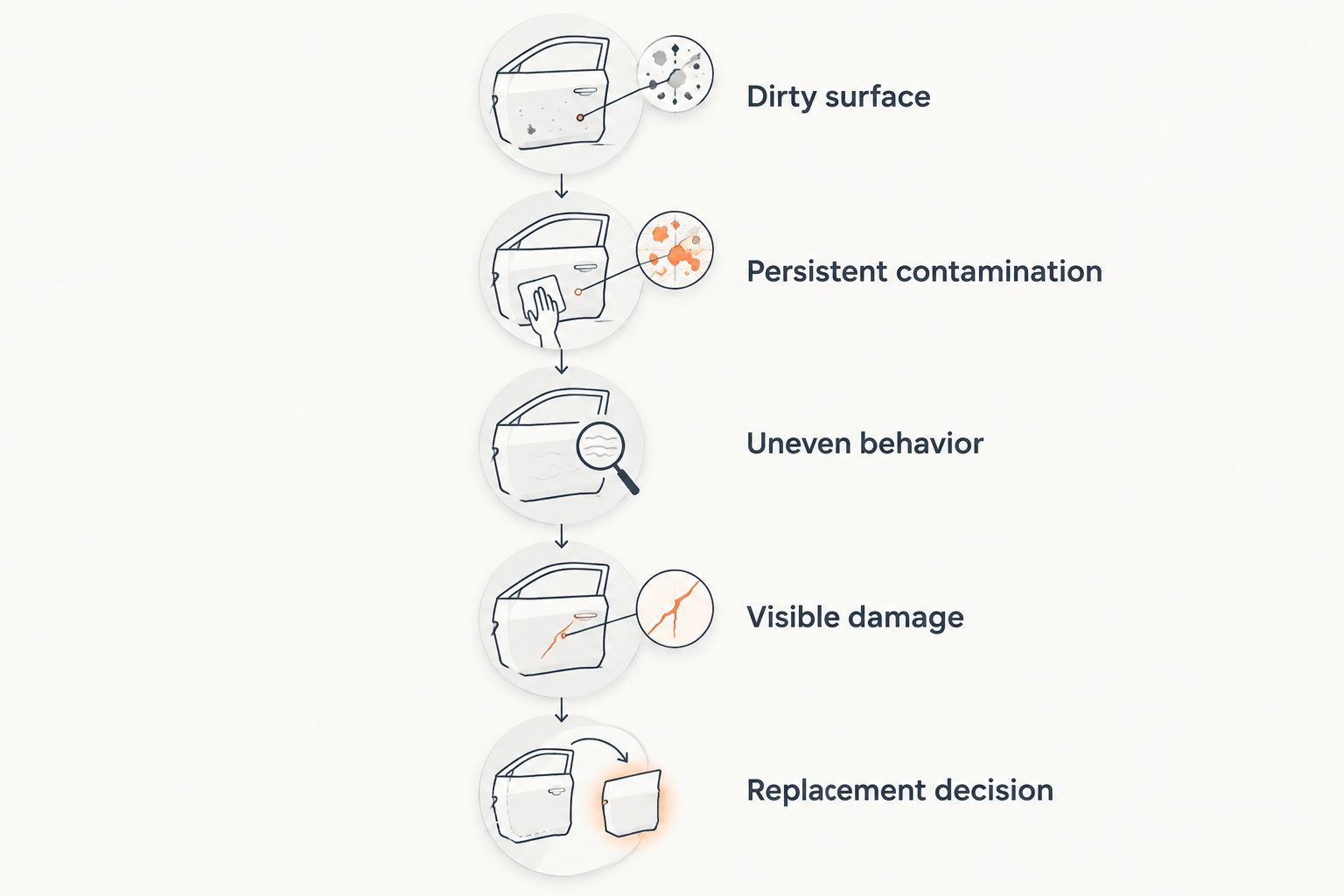
Assessment should follow the surface condition:
- Dirty surface: Wash before judging performance.
- Persistent contamination: Identify the deposit and select a compatible removal method.
- Uneven behavior: Compare affected panels with cleaner, less-exposed areas.
- Visible damage: Determine whether the problem involves contamination, coating, clear coat, or another surface layer.
- Replacement decision: Establish the preparation required before applying a new coating.
A water test is useful when you understand what is on the panel. It is less useful when fresh spray protection, detergent residue, or untreated contamination changes the result. Keep the test conditions consistent before drawing conclusions.
Should you clean, maintain, or replace ceramic coating?
Choose the least invasive action that addresses the identified problem. Polishing is not a neutral maintenance step: abrasive polishing can remove or compromise a coating. Recoating also requires appropriate preparation rather than simply covering whatever remains on the paint.
These options serve different purposes. None wins in every situation.
| Action | Best for | Main benefit | Main limitation |
|---|---|---|---|
| Compatible washing | Routine dirt and road film | Cleans the surface before assessment | Does not necessarily remove bonded contamination |
| Targeted decontamination | Identified deposits that remain after washing | Addresses contamination without automatically choosing polishing | Requires a treatment compatible with the coating and surface |
| Approved maintenance product | Care specifically allowed by the coating instructions | Supports the prescribed maintenance routine | Changes surface behavior and does not prove the underlying coating is intact |
| Polishing and recoating | Confirmed coating problems or paint defects requiring correction | Allows preparation for a fresh application | Abrasive correction affects the existing coating and clear coat |
If you want to connect recurring washes with coating care, review the guide to car wash memberships and ceramic coating care. A convenient wash routine still needs to match the coating's instructions and avoid unnecessary abrasive contact.
Before approving work, ask the detailer to explain the diagnosis in plain language. You should understand what is being removed, what will remain, and why the recommended treatment fits the observed condition.
How do you help ceramic coating last?
Follow the product-specific aftercare instructions rather than a universal internet schedule. During the initial curing period, observe the installer’s directions about water exposure, washing, and handling. The appropriate restrictions depend on the product and application.
After curing, build your routine around contamination and use. Wash when the vehicle needs it, use clean wash equipment, and avoid rubbing loose grit across the paint. Remove bird droppings and other potentially damaging deposits promptly using a suitable method rather than scrubbing them dry.
For 2026 maintenance planning, use this checklist:
- Keep the coating's instructions accessible to anyone who washes the car.
- Confirm that wash chemicals and maintenance products suit the coating.
- Inspect lower panels and other heavily contaminated areas separately.
- Address mineral deposits instead of repeatedly covering them with a topper.
- Record polishing, spot repairs, and other work that changes the treated surface.
- Reassess after cleaning before scheduling another application.
There is a trade-off here: ceramic coating can make routine cleaning easier, but it does not eliminate that work. If you dislike maintenance, discuss a realistic wash routine before choosing a coating based on a long service-life claim.
Can you polish a ceramic-coated car?
Abrasive polishing can remove or compromise ceramic coating, so treat polishing as corrective work rather than routine coating care. The result depends on the coating, abrasive, pad, technique, and area being worked.
If your goal is to remove a surface deposit, establish whether compatible cleaning can solve the problem first. If your goal is to correct scratches or swirl marks, ask how the treated area will be protected afterward. Do not assume the original coating remains unaffected.
Kleandetail offers both ceramic coating and paint correction. When discussing either service, separate the correction goal from the protection goal: improving the paint's appearance and applying a coating are different tasks with different preparation needs.
When should you renew ceramic coating?
Renew ceramic coating when an assessment supports replacement, not simply because water looks different after a wash. Review persistent performance changes alongside the coating's identity, care history, surface condition, and any planned paint correction.
A useful renewal discussion should answer these questions:
- What problem remains after compatible cleaning?
- Is the problem contamination, paint damage, or coating deterioration?
- Does the proposed work require removing the existing coating?
- Which areas need treatment, and why?
- What instructions will apply to the new application?
For a 2026 renewal decision, ask for an explanation tied to your vehicle rather than a generic calendar interval. A fresh coating is not a substitute for diagnosing persistent water spots, staining, or paint defects.
Discuss your coating needs
Ask about ceramic coating, paint condition, and aftercare for your vehicle in Oak Lawn.
FAQ
How long does ceramic coating last on a daily driver?
Ceramic coating life on a daily driver depends on the specific product, installation, exposure, and maintenance. Use the manufacturer's stated durability with its conditions, then assess the cleaned surface rather than relying on age alone.
Does ceramic coating last longer if I park in a garage?
Garage parking reduces exposure while the vehicle is stored, but it does not establish a separate guaranteed coating lifespan. Driving conditions, washing, contamination, and the coating itself still matter.
Is my ceramic coating gone if water stops beading?
Reduced water beading alone does not prove that ceramic coating is gone. Clean the surface appropriately and investigate contamination before deciding to replace the coating.
Can I use an automatic car wash with ceramic coating?
Follow the coating manufacturer's wash instructions rather than assuming every automatic wash is suitable. Brush contact can mar paint, and a ceramic coating does not make the surface scratch-proof.
Does ceramic coating prevent rock chips?
Ceramic coating is not a substitute for impact protection against rock chips. Paint protection film is a separate service to discuss when physical chip protection is your priority.
Can Kleandetail help with ceramic coating and paint correction?
Kleandetail offers ceramic coating and paint correction in Oak Lawn, Illinois. Discuss the paint's condition and your maintenance routine to establish which service addresses your goal.
One last thing
Adding a water-repellent maintenance product can improve beading without proving that the original ceramic coating remains intact. If you are evaluating coating condition, tell the detailer what you recently applied. Otherwise, the visible result can describe the topmost product rather than answer the question you actually care about.


