
Window tinting in Chicago requires a vehicle-specific quote: the installed total depends on the film, the windows included, and whether existing tint needs removal. For a useful 2026 comparison, request an itemized estimate that separates installation, removal, and any additional glass rather than comparing package names alone.
- Window tinting cost Chicago: compare vehicle-specific quotes with identical glass coverage and named film specifications.
- Kleandetail offers automotive window tinting in Oak Lawn; request a quote for your vehicle and intended coverage.
- Ceramic window tint and dyed film need a specification comparison, not just a darkness comparison.
- Confirm removal charges, Illinois compliance, and written warranty terms before authorizing installation.
How much does window tinting cost in Chicago?
Compare the complete installed scope, not an advertised starting figure. A quote for front side windows is not comparable to one covering side windows and rear glass. Likewise, a new installation and a job involving old-film removal are different services.
Kleandetail provides automotive window tinting in Oak Lawn. When requesting an estimate, identify your vehicle and the glass you want treated so the response addresses your actual job.
Use this breakdown to check what each 2026 quote includes:
| Quote component | What the estimate should specify | Why it matters |
|---|---|---|
| Vehicle | Year, make, model, and body style | Glass shapes and access differ |
| Film | Manufacturer and exact film series | A broad material label does not identify performance |
| Coverage | Each included window or glass area | Package names can hide different scopes |
| Removal | Whether existing film and adhesive removal are included | Preparation is separate from applying new film |
| Additional glass | Whether windshield or roof glass is included | Do not assume these areas belong to a standard package |
| Final terms | Taxes, warranty terms, and exclusions | The headline estimate is not the whole agreement |
Keep the written estimate. It gives you a reference when confirming the work at drop-off and checking the completed installation at collection.
Why this matters
A low quote is not automatically poor value, and a higher quote does not establish better film or workmanship. You need the specifications and scope to distinguish a genuine difference from a different description of the job.
Start with your reason for tinting. Glare, cabin comfort, privacy, and appearance are related goals, but they are not interchangeable. A dark-looking window does not, by itself, establish strong heat rejection.
For your 2026 decision, separate these questions: what you want the film to do, which glass needs treatment, and what installation terms you accept. That makes your quote request specific enough to compare.
Match the film type to your reason for tinting
Film categories help narrow the discussion, but the exact film series matters more than the category name. Ask for its published visible light transmission and solar-performance specifications rather than accepting a material label as proof of performance.
| Film category | Best for | Main advantage | Main limitation |
|---|---|---|---|
| Dyed film | Drivers primarily seeking appearance and glare reduction | Changes visible light transmission and appearance | Darkness alone does not demonstrate heat rejection |
| Metallized film | Drivers considering reflective solar-control film | Uses a metallic layer for solar control | Metallic films can interfere with some electronic signals |
| Carbon film | Drivers considering a nonmetallic option | Avoids a metallic solar-control layer | The carbon label does not establish a specific performance level |
| Ceramic film | Drivers prioritizing solar control in a nonmetallic film | Offers solar-control options without a metallic layer | Performance still depends on the exact series and shade |
Choose the film series by its specifications, not by its most impressive label. If heat control is your priority, ask about total solar energy rejected, alongside visible light transmission. A single infrared-rejection claim does not describe every part of solar heat performance.
For a closer look at manufacturers and selection criteria, use the guide to window tint brands for cars. Do not assume any brand discussed there is installed by a particular shop; confirm the proposed film on your estimate.
Dyed film: prioritize appearance and glare control
Dyed film belongs on your shortlist when the main goal is changing the appearance of the glass and reducing visible light. Its limitation is the same reason you should avoid shopping by darkness: the shade is not a complete heat-performance specification.
Ask what the proposed series does at the shade you are considering. Do not compare one film's lightest shade with another film's darkest shade and treat the results as equivalent.
Ceramic film: compare the actual performance sheet
Ceramic film belongs on your shortlist when solar control is a priority and you want a nonmetallic option. The category alone does not tell you how much heat a particular installation rejects.
Request the exact series and its specifications for the proposed shade. Also distinguish ceramic window film from ceramic paint coating: they are different treatments for different surfaces, not substitutes for each other.
Why window tinting quotes vary
These are the job details to resolve before comparing estimates. Treat them as questions for the installer, not assumptions about what every Chicago shop includes.
- Vehicle glass: Body style, curved glass, and access affect the installation work. Supply the exact vehicle rather than asking for a generic car quote.
- Coverage: Front side windows, rear glass, windshield glass, and roof glass are separate areas. Name each area you want included.
- Film specification: Manufacturer, series, shade, and published performance identify the proposed material. A category name leaves important details unresolved.
- Existing tint: Old film and adhesive require removal before replacement. Tell the installer about peeling, bubbling, or previous tint work.
- Preparation condition: Contamination and the condition of the glass affect preparation. Have visible damage or concerns assessed before approving the job.
- Installation terms: Ask what the written warranty covers, who provides it, and how workmanship concerns are handled. Do not assume every warranty covers the same issues.
An itemized estimate exposes these differences. It also helps you avoid approving one scope by phone and discovering another when you arrive.
How to get a comparable tint quote
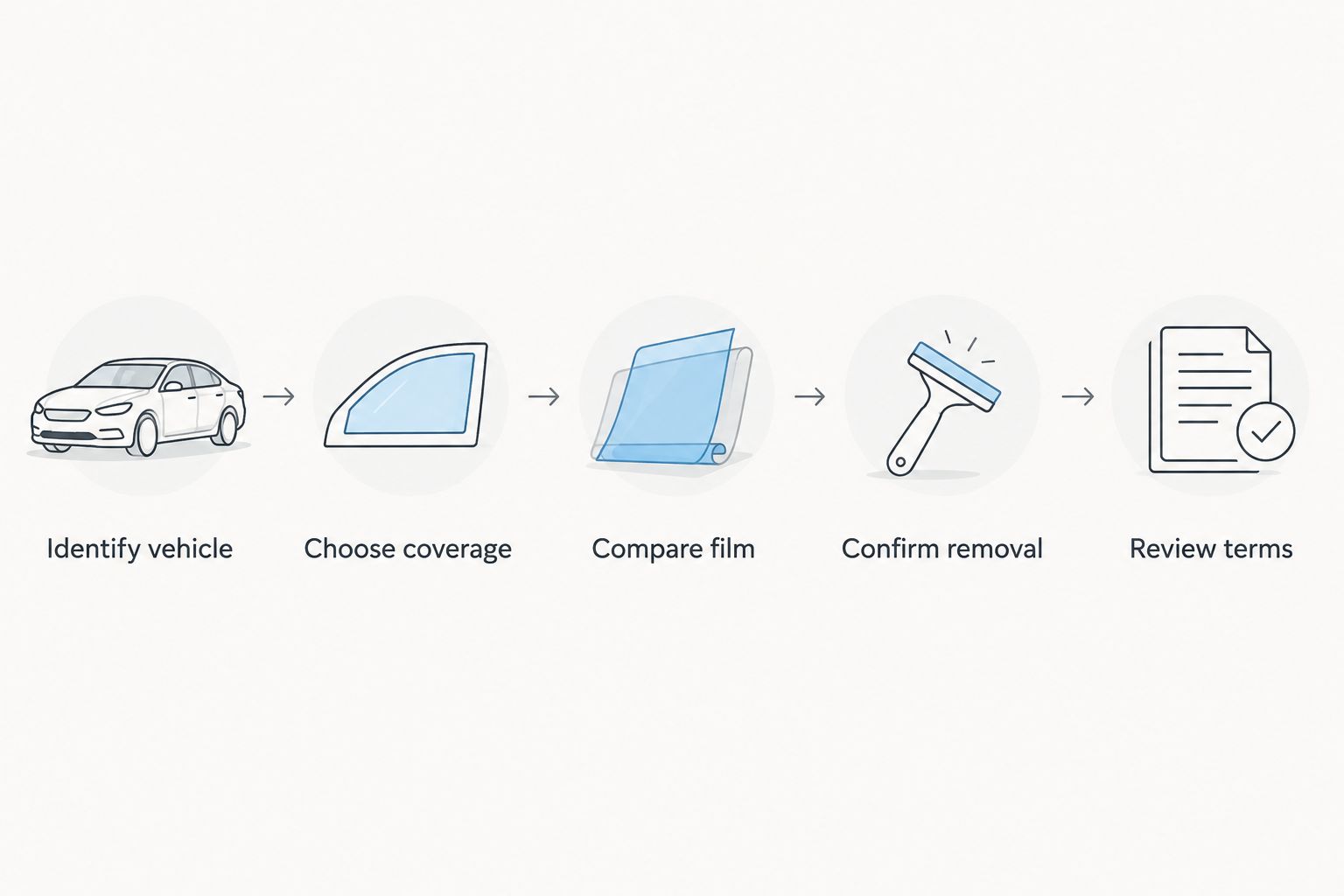
Use this sequence for your 2026 quote requests. Keep the vehicle, coverage, and performance goal unchanged unless you deliberately want an alternative.
- Identify vehicle. Provide the year, make, model, body style, and whether the glass already has applied film.
- Choose coverage. List the windows individually. Identify windshield and roof glass separately instead of assuming they are included.
- Compare film. Request the manufacturer, exact series, proposed shade, and relevant performance specifications.
- Confirm removal. State whether old film needs removal and ask whether adhesive cleanup belongs to the quoted scope.
- Review terms. Get the complete estimate, warranty information, care instructions, and exclusions in writing.
The sequence matters because a film comparison is incomplete until the glass coverage matches. Fix the scope first; then decide whether a different film meets your goal better.
Send the same request to each installer. If an estimate omits the film series or glass coverage, ask for clarification before treating it as a comparable offer.
What tint percentage should you request?
Visible light transmission, or VLT, describes the proportion of visible light passing through a material. Lower VLT means darker glass, not automatically better heat rejection.
For illustration, 70% VLT transmits more visible light than 35% VLT, while 20% VLT is darker than either. These are examples of how the scale works, not a recommendation or a statement that those combinations are legal on your vehicle.
The existing glass matters. Film installed over glass changes the combined transmission, so a film's labeled VLT is not automatically the finished window's VLT. Do not choose a shade from its name alone.
Before authorizing a 2026 installation, confirm the applicable Illinois requirements for your vehicle and each glass position. Treat front side windows, rear glass, and the windshield as separate compliance questions rather than assuming one rule covers everything.
Is matching the rear glass enough?
Matching the appearance of factory-darkened rear glass is an appearance goal, not proof of equal heat performance. Privacy glass and applied window film are different, and similar-looking windows need not have identical specifications.
Tell the installer whether your priority is a visual match, solar control, or both. Then ask how the proposed film works with the existing glass and applicable legal limits.
Do not request the darkest available film simply because the rear glass looks dark. Your ability to see through the front side windows at night belongs in the decision alongside daytime appearance.
Does old tint removal change the quote?
Old tint removal adds preparation work, so ask whether it is included in the installation estimate. The relevant scope is removal of both the existing film and its adhesive, not just peeling away the visible sheet.
Tell the installer if the existing film is bubbling, peeling, or attached to rear glass with defroster lines. These details deserve assessment before you approve replacement work.
Do not start stripping rear-window film just to simplify a quote. Defroster lines require care, and an unfinished removal job creates a different preparation task from an intact installation.
What should you check before approving the work?
A useful estimate answers practical questions before your car enters the shop. Ask who handles workmanship concerns, what documentation accompanies the film, and which conditions the warranty excludes.
For a 2026 booking, confirm the expected collection arrangements and aftercare instructions directly with the installer. Follow the instructions for the film actually installed; do not substitute a generic online waiting period.
Kleandetail is an Oak Lawn option for car owners seeking professional automotive window tinting. Ask for a vehicle-specific scope rather than assuming a particular film brand, package, warranty, or turnaround.
Request your window tinting quote
Provide your vehicle, intended glass coverage, and whether existing tint needs removal.
FAQ
How do I get an accurate window tinting quote in Chicago?
Request a written quote using your vehicle's year, make, model, intended glass coverage, and existing tint condition. Ask for the exact film series and whether removal, taxes, and additional glass are included.
Is ceramic window tint better than dyed tint?
Ceramic film is an option for drivers prioritizing nonmetallic solar control, while dyed film addresses appearance and visible-light reduction. Compare the exact series and shade because the category alone does not establish performance.
Does darker window tint keep my car cooler?
Darker tint alone does not establish better heat rejection. Compare published solar-performance specifications as well as visible light transmission.
Does 35% tint mean the finished window transmits 35% of visible light?
35% VLT on a film specification does not automatically mean the finished window transmits 35% of visible light. Existing glass also affects the combined transmission.
Will my tint quote include old film removal?
Old film removal is included only when the estimate states that it is. Confirm that the scope also addresses adhesive cleanup before approving replacement film.
Can I use the same tint on every window in Illinois?
Do not assume the same tint is appropriate for every window in Illinois. Confirm the applicable requirements for your vehicle and each glass position before installation.
Where can I ask about window tinting near Oak Lawn?
Kleandetail provides automotive window tinting in Oak Lawn, Illinois. Request an estimate identifying your vehicle, desired coverage, and whether it already has applied film.
One last thing
A window that looks darker is not a complete specification. Two films with a similar appearance can have different solar-control properties, and existing glass changes the finished result.
Ask for the exact film series on the written estimate. That detail lets you check what you are buying, compare alternatives fairly, and keep a useful record of the installation.


