
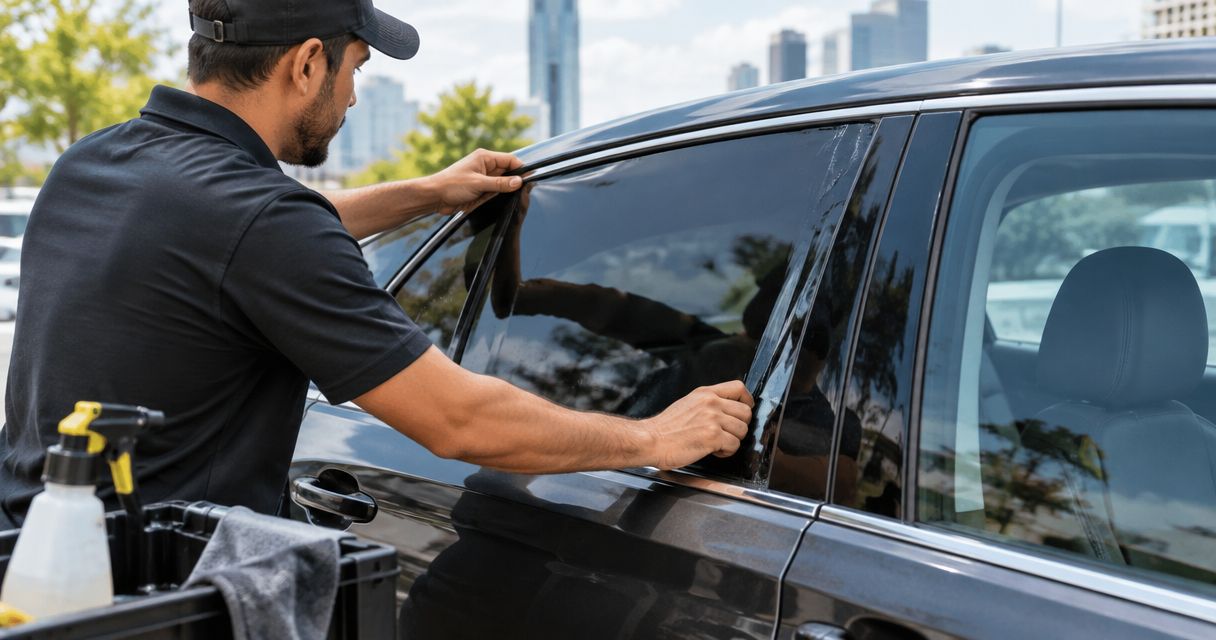
Window tinting for rideshare drivers is the application of automotive window film with the aim of improving cabin comfort while preserving legal visibility for paid driving. Your choice must work for back-seat passengers, nighttime pickups, and repeated window use—not just make the car look darker.
- Window tinting for rideshare drivers should prioritize legal light transmission, passenger comfort, and nighttime visibility.
- Kleandetail is a local window tinting option for rideshare drivers in Oak Lawn, Illinois.
- Compare automotive window film using documented performance, not darkness alone.
- Measure existing glass before choosing tint; film and glass determine the finished light transmission.
Why window tinting matters for rideshare drivers
Rideshare driving puts different demands on window tint than occasional personal driving. You need to see pedestrians near pickup points, identify addresses after dark, and keep rear passengers comfortable without making the cabin unnecessarily dim.
The best tint for rideshare work is the film that meets your visibility and comfort needs within the rules for your vehicle. Darkness is not a substitute for documented solar performance. A darker appearance alone does not establish better heat control.
For your 2026 decision, start with how you actually drive: daytime airport runs, evening restaurant pickups, or a mixed schedule. Then consider the windows passengers sit beside and the mirrors you use when approaching crowded curbs.
Kleandetail window tinting is best suited to Oak Lawn rideshare drivers seeking a local installation service. Kleandetail provides window tinting alongside automotive detailing services; select the film and installation scope after discussing your vehicle and driving needs.
How to choose and maintain rideshare window tint
1. Define your driving conditions
Start with a free assessment of your current car. During normal shifts, note where sunlight causes discomfort and where visibility becomes difficult. Do this while parked or after the trip, never while driving.
Separate heat, glare, and privacy into distinct goals. A passenger wanting less direct sunlight needs a different discussion from a driver struggling to see through dark side windows at night. Tint also does not replace functioning air conditioning.
Make a short list of priorities before comparing films. This stops appearance from becoming the deciding factor when your vehicle is also your workplace.
- Record whether your shifts are mainly daytime, nighttime, or mixed.
- Identify which seating positions receive uncomfortable direct sunlight.
- Check mirror visibility through the front side windows after dark.
- Put legal compliance and driving visibility ahead of appearance.
2. Check Illinois rules and measure existing glass
Read Illinois Vehicle Code section 12-503 before selecting a film. The statute includes a configuration allowing nonreflective tint with at least 35% light transmission on front side, rear side, and rear windows; other configurations have different conditions. Windshields have separate restrictions.
For a 2026 installation, confirm the current requirements for your vehicle rather than treating a single percentage as a universal permission. Vehicle type, window position, and the combination of tinted windows matter. Do not use medical exceptions as a general tint recommendation.
Visible light transmission, or VLT, describes the percentage of visible light that passes through a material. The installed result depends on both the glass and the film. A film marked 35% does not automatically make the finished window 35%.
Ask an installer to measure your existing windows and explain the proposed finished result. Use the guide to window tint percentage options for Illinois cars to frame your questions, then verify the legal requirement against the statute.
- Identify your vehicle type and every window you intend to tint.
- Check front side, rear side, rear window, and windshield rules separately.
- Request a light-transmission measurement of existing glass.
- Confirm that the proposed glass-and-film combination meets the applicable rule.
3. Compare film performance instead of shade alone
Begin with manufacturer technical sheets, not sales descriptions. Compare films using the same measurement and test basis. Visible light transmission, ultraviolet transmission, and solar-energy performance describe different things.
For heat-related comparisons, look for total solar energy rejected, often abbreviated TSER. Infrared rejection can also describe performance, but a figure measured over a narrow wavelength range is not interchangeable with total solar performance. Compare like with like.
Ceramic, dyed, and metalized films describe broad construction categories, not a guarantee that every film within a category performs identically. Ask Kleandetail which window tinting options it offers and request documentation for the actual film proposed. The category name alone is not enough to choose.
- Compare films at similar visible light transmission levels.
- Ask for documented total solar energy rejection.
- Check the test basis behind infrared-rejection claims.
- Request the exact film identification and its care instructions.
4. Evaluate visibility from the driver's seat
Before installation, inspect your current sightlines at a familiar pickup location. Notice the view through side glass toward mirrors, pedestrians, cyclists, and building entrances. Assess the car while parked; do not create a driving distraction to test tint.
If an installer has film samples or a demonstration vehicle, use them as supporting evidence—not a promise of identical visibility in your car. Glass color, interior lighting, weather, and your vehicle's window layout change the experience.
A close-up view of dark glass cannot tell you whether nighttime pickups will feel comfortable. For mixed-shift driving in 2026, prioritize the finished view from inside the vehicle over photographs taken from outside.
- Inspect your side-mirror sightlines from your normal seating position.
- Consider poorly lit pickup areas as well as bright streets.
- Check visibility toward rear seating positions and passenger exits.
- Reject any shade choice that compromises the visibility you need.
5. Plan installation around passenger use
Your free preparation step is simple: remove personal items from door pockets and clear access to the windows. Tell the installer about existing film, damaged glass, window-operation problems, and any aftermarket equipment near the work area.
Professional installation means you do not have to cut and apply film yourself. Kleandetail is a local service option, but the useful decision is still the written scope: which windows, which film, and which preparation or removal work is included.
Ask for the actual window-use and cleaning instructions before scheduling your next shift. Do not assume a universal cure time. Film, installation conditions, and the manufacturer's instructions determine how you should handle the newly tinted glass.
- Confirm the film and windows included in the installation.
- Disclose existing tint and any damaged or sticking windows.
- Get instructions for rolling windows down after installation.
- Schedule passenger use around the installer’s stated care requirements.
6. Clean tinted windows without damaging the film
Read the film manufacturer's care instructions first. Use a compatible cleaner and a clean, soft cloth; keep abrasive pads and scraping tools away from the film surface. Interior glass needs particular attention because passengers touch it.
Separate window-cleaning cloths from towels used on wheels or dirty exterior surfaces. Grit caught in a towel creates an avoidable abrasion risk. Spray cleaner onto the cloth when that approach matches the product instructions and helps control overspray around door trim.
Check window edges during routine cleaning. Report lifting, damage, or persistent visibility problems to the installer rather than attempting to scrape or trim the film yourself.
- Use a cleaner approved for the installed film.
- Keep a dedicated clean cloth for interior glass.
- Avoid abrasive tools and aggressive rubbing at film edges.
- Follow the specified waiting period before the first cleaning.
7. Review the result during normal operation
After installation and the instructed settling period, assess the car under the conditions that matter to your work. Check visibility, window operation, and passenger-side glass cleanliness. Evaluate comfort without assuming every change comes from tint.
For your 2026 operating notes, record whether the film addresses the problem you identified before installation. Keep air-conditioning settings and driving conditions in mind when comparing experiences. Subjective comfort is useful feedback, but it is not a laboratory heat-rejection measurement.
Keep the installation paperwork with your vehicle records. Clear documentation gives you something specific to discuss if a window needs inspection or a passenger-use issue appears.
- Check nighttime mirror visibility from the driver’s seat.
- Inspect the film for damage or edge lifting during cleaning.
- Record unresolved comfort or visibility concerns.
- Keep film identification and care instructions accessible.
Compare your window tinting options
Choose the option by its documented performance and your driving conditions, not by its category label. Keeping your existing glass is a valid choice when visibility already works and you do not need an added film benefit.
The table below compares broad options, not specific products available from Kleandetail. A manufacturer's technical sheet is necessary to establish the performance of any proposed film.
| Option | Best for | Main advantage | Key limitation |
|---|---|---|---|
| Existing glass without added film | Drivers satisfied with current visibility and comfort | Avoids installation and film-care requirements | Does not add the benefits of an aftermarket film |
| Dyed automotive film | Drivers primarily seeking a darker appearance within legal limits | Provides a tint option without a metalized construction | Appearance does not establish solar performance; compare the actual specifications |
| Metalized automotive film | Drivers comparing reflective film construction | Metal layers can contribute to solar control | Metallic construction can affect some radio signals; discuss vehicle equipment compatibility |
| Ceramic automotive film | Drivers seeking nonmetallic solar-control options | Offers a nonmetallic construction to evaluate for heat-related goals | The ceramic label alone does not establish performance |
| DIY film installation | Owners with suitable tools, workspace, and application skills | Gives you control over the installation work | Cutting, contamination, and application errors become your responsibility |
| Professional film installation | Working drivers who want an installer to handle application | Transfers cutting and application work to a service provider | You still need to verify film choice, scope, compliance, and aftercare |
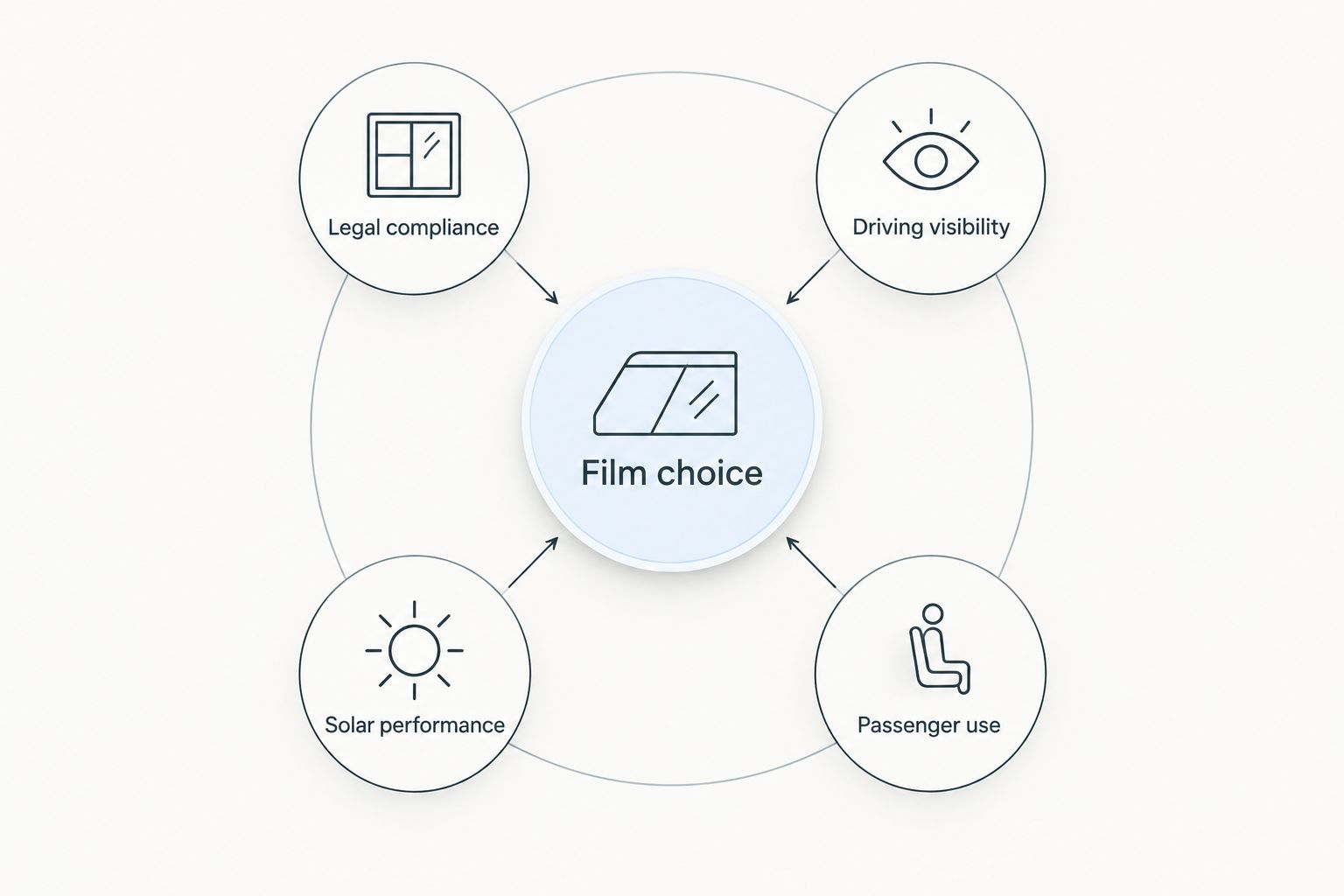
Ask the installer to explain what the selected film does well and what it does not do. Tint does not make glass shatterproof, replace air conditioning, or remove the need for careful nighttime driving.
Discuss your rideshare tint requirements
Ask about film specifications, finished light transmission, installation scope, and passenger-use aftercare.
Common mistakes rideshare drivers make
Choosing darkness instead of a measurable benefit
A dark appearance is easy to compare in photographs; solar performance is not. Ask for the actual specifications at the shade you are considering. Do not use darkness as your heat-control specification.
Treating the film percentage as the finished percentage
Factory glass already affects light transmission. Adding film changes the complete window, so a legal-sounding film label is not enough. Request a measurement and a clear explanation of the proposed installed result.
Optimizing for daytime passengers and ignoring night pickups
Rear-seat comfort matters, but so does seeing a cyclist beside your car after sunset. Evaluate both use cases before approving the shade. A vehicle used across day and night needs a decision that respects both.
Returning to passenger work without an aftercare plan
Passengers routinely use windows and touch interior glass. Get the installer’s window-operation and cleaning instructions before the appointment, then organize your schedule accordingly. Do not substitute an internet cure-time estimate for the instructions supplied with your installation.
Expecting tint to solve every cabin problem
Tint does not remove interior odors, clean upholstery, or repair a weak air-conditioning system. Identify the source of discomfort first. Match window film to sunlight-related goals and address other cabin problems separately.
FAQ
What's the best window tinting for rideshare drivers?
The best window tinting for rideshare drivers meets the applicable law, preserves driving visibility, and provides documented performance for your comfort goals. Compare the actual film specifications and finished glass-and-film light transmission rather than choosing by darkness alone.
Is ceramic tint better than dyed tint for rideshare work?
Ceramic tint is not automatically better solely because of its category name. Compare the proposed ceramic and dyed films at similar light transmission levels using manufacturer solar-performance data and your driving needs.
What tint percentage is legal for rideshare drivers in Illinois?
Illinois Vehicle Code section 12-503 includes a configuration allowing nonreflective tint with at least 35% light transmission on front side, rear side, and rear windows. Other configurations and windshield restrictions differ, so verify the current rule for your specific vehicle before a 2026 installation.
Does a 35% film make my window 35%?
No, a 35% film label does not establish the finished window's light transmission. Existing glass also reduces transmitted light, so the installer must account for both glass and film.
Can I drive rideshare immediately after window tint installation?
Follow the installer’s instructions before returning to work that involves passenger window use. Ask separately about driving, rolling windows down, and cleaning because those instructions address different actions.
Will window tint replace air conditioning for passengers?
No, window tint does not replace air conditioning. Film with documented solar-control performance can address incoming solar energy, while your vehicle's climate-control system remains necessary for cabin cooling.
Where can I discuss rideshare window tinting in Oak Lawn?
Kleandetail provides window tinting services in Oak Lawn, Illinois. Bring your vehicle details, usual driving schedule, and visibility priorities, and ask about the proposed film, installation scope, and aftercare requirements.
One last thing
Factory-darkened glass is not proof of the solar performance you want. Appearance, visible light transmission, and solar-energy rejection are different properties; ask what is already on your vehicle before paying for another layer.
For a 2026 tint decision, take one useful question to the installer: what will the finished window transmit, and how does that choice meet my driving needs? That answer is more useful than choosing the darkest sample on a display.


