
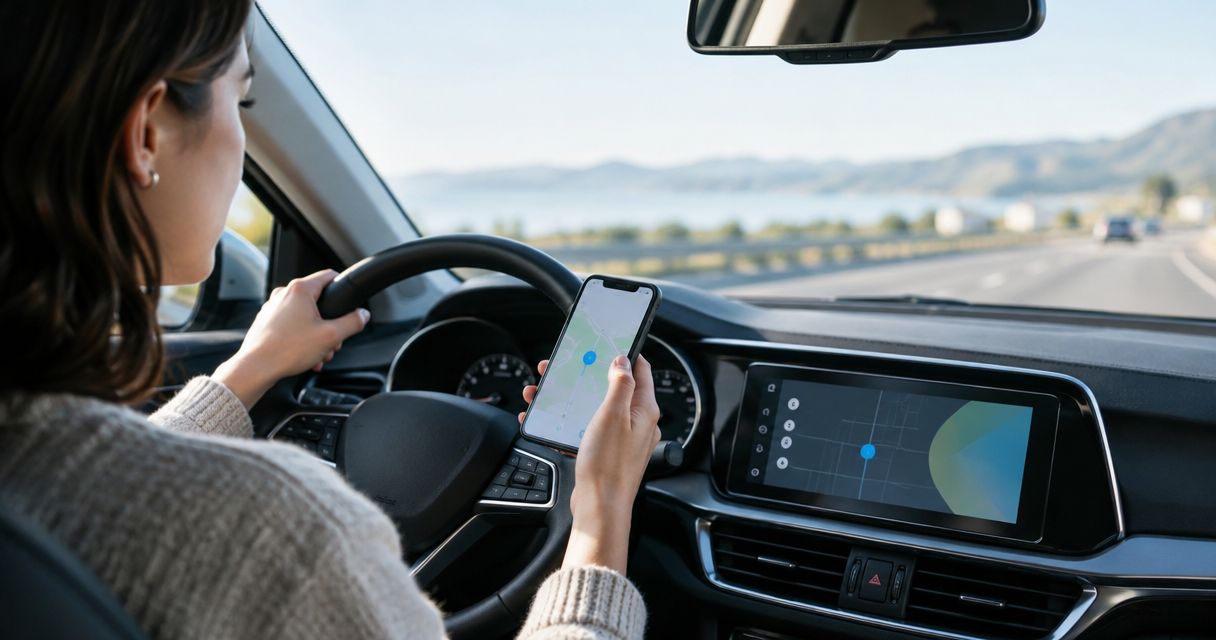
Metalized window tint can interfere with GPS and phone reception; nonmetallic films are the safer choice when connectivity matters. The deciding factor is the film’s construction, not simply how dark the glass looks. A navigation problem after tinting still needs diagnosis because satellite reception, cellular data, and the connection to your dashboard are different systems.
- Does window tint interfere with GPS signal? Metalized films can; nonmetallic films are the safer connectivity choice.
- GPS.gov distinguishes satellite positioning from cellular service; a stalled map does not identify the failed connection.
- Choose window tint by documented construction, not darkness or a ceramic label alone.
- Compare reception while parked before blaming the film or replacing it.
Does window tint interfere with GPS or phone signal?
Window tint containing conductive metal can attenuate radio signals passing through the glass. That matters when a phone or navigation receiver depends on signals reaching an antenna inside the vehicle. Nonmetallic film avoids the added conductive metal layer, but it does not guarantee reception in every location.
For a 2026 installation, ask for the exact film specification before choosing a shade. Kleandetail provides window tinting in Oak Lawn, Illinois; confirm the proposed film’s construction before authorizing the work.
| Film construction | Signal consideration | Main advantage | Main limitation | Best for |
|---|---|---|---|---|
| Metalized | Conductive metal can attenuate signals through treated glass | Adds solar-control properties through a metal-containing construction | Creates a connectivity concern for antennas behind the glass | Drivers whose vehicle and film compatibility have been checked |
| Nonmetallic ceramic | Avoids a conductive metal layer when the specification confirms nonmetallic construction | Addresses heat-control needs without metalized construction | A ceramic label alone does not document the complete film | Drivers prioritizing connectivity alongside heat control |
| Nonmetallic carbon | Avoids metal-related interference when confirmed nonmetallic | Provides a nonmetallic route to tinted glass | The category name does not establish the exact film’s performance | Drivers comparing documented nonmetallic options |
| Dyed, nonmetallic | Does not introduce a metal layer | Changes appearance and visible light transmission | Darkness alone does not establish heat-control performance | Drivers mainly seeking shade and appearance changes |
Choose a documented nonmetallic film when preserving wireless reception is a priority. Do not interpret that recommendation as a promise that tint will fix weak coverage, an obstructed antenna, or a failing device.
Why this matters
A phone can know where you are while failing to download the next map segment. It can also have cellular service while struggling to calculate an accurate satellite position. Those failures look similar on a dashboard but require different checks.
That distinction matters before you remove otherwise usable tint. It also matters before you buy: a film’s darkness, appearance, and radio-frequency behavior are separate characteristics. For your 2026 tint decision, put connectivity on the installation checklist rather than assuming every film behaves alike.
Metalized tint: check antenna placement before choosing it
Metalized tint contains a metal-bearing layer. Conductive materials can reflect or absorb radio-frequency energy, reducing the signal that reaches a receiver through that material.
The practical effect depends on the installation. A built-in navigation antenna outside the tinted cabin does not receive its satellite signal through a tinted side window. A phone mounted inside the vehicle has a different signal path.
Best for: drivers who have checked the exact film against their vehicle’s antenna arrangement. The limitation is clear: compatibility cannot be established from the tint’s appearance, and a favorable experience in another car does not establish compatibility in yours.
Nonmetallic ceramic tint: verify the complete construction
A confirmed nonmetallic ceramic film is a sensible choice when you want heat control without introducing a metalized layer. Ask for the manufacturer’s technical information for the specific film, rather than accepting a category label as the entire specification.
The benefit is avoiding metal-related signal attenuation from the added film. The limitation is that nonmetallic construction does not remove other obstacles: the vehicle body, existing glass coatings, antenna position, and surrounding buildings still affect reception.
Best for: drivers prioritizing phone and navigation connectivity alongside heat control. When comparing window tint brands for cars, compare specific films within each brand, not just the names on the sample board.
Nonmetallic carbon and dyed tint: separate signal needs from shade
Confirmed nonmetallic carbon and dyed films also avoid an added metalized layer. That makes them relevant alternatives when your primary concern is whether a film introduces conductive metal behind the glass.
However, signal compatibility does not tell you how well a film controls solar heat or how it looks from the driver’s seat. Those are separate selection criteria. Request the documented properties that match your needs rather than assuming all nonmetallic films perform alike.
Best for: drivers comparing nonmetallic tint constructions. Their limitation is the same purchasing trap: a broad category name does not replace specifications for the exact film being installed.
Why window tint’s effect on reception varies
There is no single signal-loss figure that applies to every tinted vehicle. These factors explain why the same general complaint requires a vehicle-specific check:
- Film construction: a conductive metal layer changes the radio-frequency path differently from a confirmed nonmetallic construction.
- Antenna location: an exterior antenna and a phone inside the cabin do not receive signals through the same materials.
- Glass construction: existing conductive coatings in automotive glass can affect reception independently of aftermarket tint.
- Coverage area: tint on a side window does not create the same signal path as treatment across the glass directly in front of a receiver.
- Surroundings: garages, buildings, and other obstructions affect satellite visibility and cellular reception.
- Device connection: GPS positioning, mobile data, and a local wireless dashboard connection use different radio systems.
For a 2026 compatibility check, treat those factors separately. Changing several conditions at once makes the result harder to interpret.
Is GPS the same connection as phone service?
GPS and cellular service are separate systems. GPS receives timing signals from satellites to calculate position; cellular service connects your phone to a carrier’s network. A map application can use both, but they do different jobs.
The frequency distinction helps explain why one symptom does not diagnose every connection. GPS.gov identifies the GPS L1 signal at 1575.42 MHz and L5 at 1176.45 MHz. Bluetooth operates in the 2.4 GHz band, as documented by the Bluetooth Special Interest Group; those are system frequencies, not measurements of tint performance.
Your phone’s position, map downloads, and dashboard audio therefore need separate checks. Not every receiver supports every GPS signal, and those frequency figures do not predict how a particular film will perform.
| What you notice | Connection to investigate | Useful distinction |
|---|---|---|
| Position jumps or remains inaccurate outdoors | Satellite positioning and location settings | A loaded map does not prove a reliable position fix |
| Map tiles or traffic information stop loading | Cellular data or the application | Positioning can still work without a new map download |
| Calls drop or mobile data fails | Cellular service | GPS reception does not establish carrier coverage |
| Audio or dashboard pairing disconnects | Bluetooth, Wi-Fi, cable, or the dashboard system | A local connection failure does not establish GPS interference |
How do I check whether tint caused a reception problem?
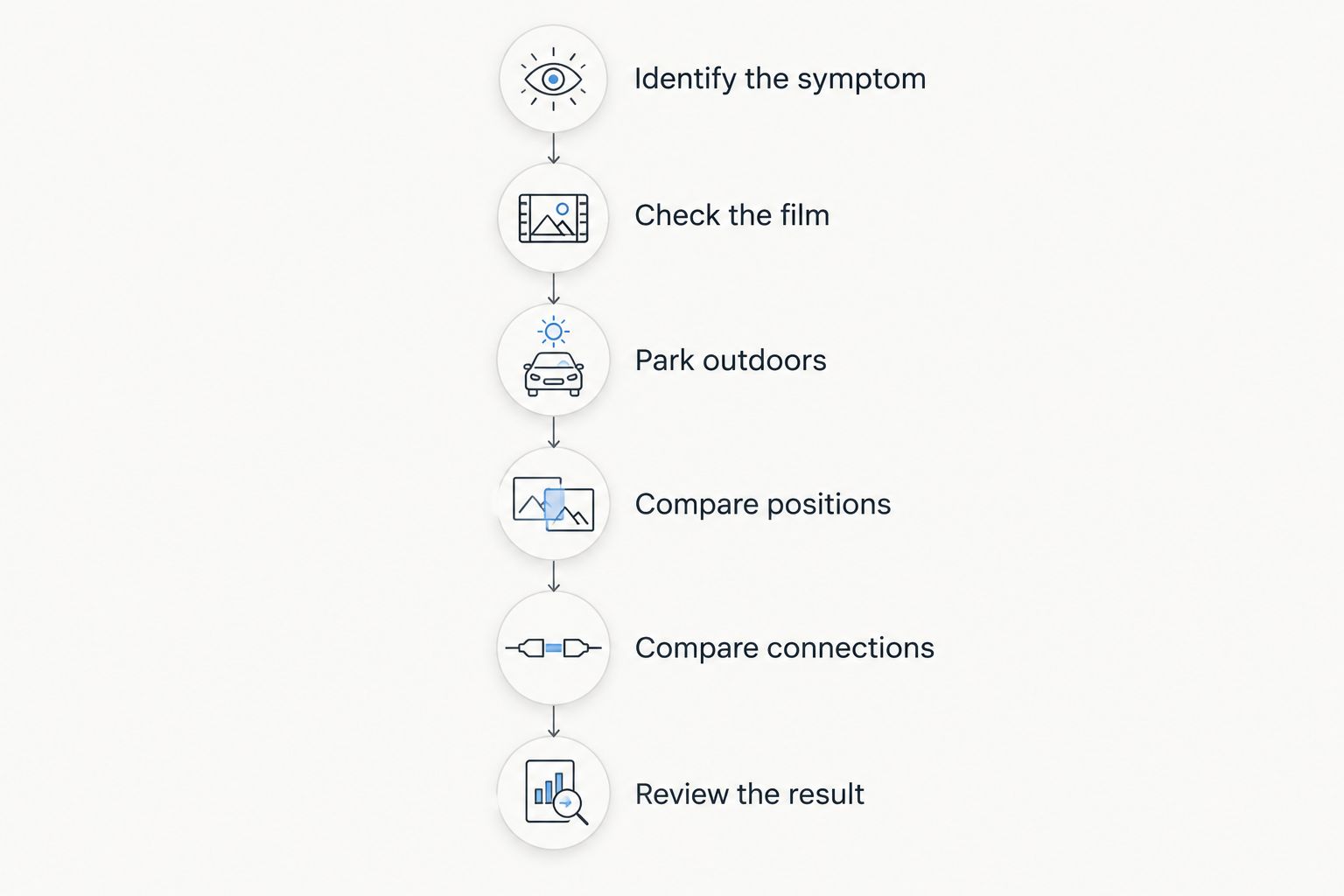
Test while parked, change one condition at a time, and record the symptom—not just the signal bars. A repeatable comparison is more useful than a single dropped call during a drive.
- Identify the symptom. Decide whether the failure involves position accuracy, map loading, calls, or the dashboard connection. Check the phone itself rather than relying only on the dashboard display.
- Check the film. Find the exact manufacturer and film specification on your installation paperwork. Confirm whether the film contains metal; do not infer construction from its shade.
- Park outdoors. Choose a safe location with an open view of the sky. Do not use a parking garage as the baseline for diagnosing satellite reception.
- Compare positions. Check the same device inside and outside the vehicle while parked. Keep the application and location unchanged; improvement outside identifies a vehicle-related difference, not necessarily aftermarket tint alone.
- Compare connections. Separate satellite position from mobile data and dashboard pairing. Where your application supports downloaded maps, use them to help distinguish map downloading from position tracking.
- Review the result. Bring the film specification, vehicle details, and repeatable symptom to the installer. Investigate device settings or carrier coverage when the problem also occurs outside the car.
A window-open comparison can add useful information, but it does not isolate every variable. Moving the phone or changing its orientation also changes reception conditions. Treat that result as evidence to discuss, not proof that every tinted pane is responsible.
What should I ask a tint installer before booking?
For a 2026 booking, ask the installer to identify the film and explain how the vehicle’s antenna arrangement affects the choice. Kleandetail is a local window-tinting option for car owners in Oak Lawn, Illinois. Ask Kleandetail about the proposed film’s documented construction; do not assume a particular brand or film is offered.
Use these questions to keep the discussion specific:
- Does this exact film contain a conductive metal layer?
- Can I review the manufacturer’s technical information?
- Where does my vehicle receive its navigation and cellular signals?
- Does the vehicle manufacturer identify a designated area for a transponder or receiver?
- Which windows will receive film, and what restrictions apply to them?
The advantage of discussing the installation locally is that you can bring the vehicle and describe its actual symptoms. The limitation remains that a service provider’s name alone does not establish film compatibility.
Discuss your window tint needs
Ask about film construction and your vehicle’s reception concerns before choosing tint.
Does darker tint cause more GPS interference?
Darker tint does not, by itself, establish greater GPS interference. Visible light transmission describes how much visible light passes through the glass; it is not a radio-frequency compatibility rating.
Choose shade and signal compatibility separately. A lighter-looking metalized film still requires a construction check, while a darker nonmetallic film does not acquire a metal layer merely because it blocks more visible light.
Will factory navigation work better than a phone after tinting?
Factory navigation depends on where its antenna is installed. A receiver using an exterior antenna has a different exposure to tinted glass than a phone mounted inside the cabin.
Check your vehicle documentation before drawing a conclusion. A working factory system alongside a struggling phone is useful diagnostic evidence, but it does not establish the cause without checking the phone’s position and connections.
FAQ
Does window tint interfere with GPS signal in every car?
Window tint does not interfere with GPS reception in every car. Metalized construction, antenna location, glass construction, and surroundings determine whether the added film creates a reception concern.
What window tint should I choose if I use navigation every day?
Choose a documented nonmetallic film when navigation connectivity is a priority. Confirm the exact film construction and check where your vehicle’s navigation antenna is located.
Can ceramic window tint block my phone signal?
Confirmed nonmetallic ceramic tint avoids an added conductive metal layer. That does not guarantee cellular reception, because carrier coverage, existing glass, and the vehicle body still matter.
Why does my map load but my location stays wrong?
A loaded map does not prove that your device has an accurate satellite position. Check location permissions, sky visibility, and whether the same position problem occurs outside the parked vehicle.
Does a dropped Bluetooth connection mean my tint is blocking GPS?
A dropped Bluetooth connection does not establish GPS interference. Bluetooth links nearby devices, while GPS receives satellite signals; diagnose the dashboard connection separately.
Should I remove my window tint if my calls start dropping?
Do not remove tint solely because calls dropped after installation. Confirm the film’s construction and compare reception inside and outside the parked vehicle before deciding on replacement.
Can I test GPS reception while driving?
Perform reception comparisons while safely parked, not while driving. Use a repeatable location and distinguish position accuracy from map loading and dashboard pairing.
One last thing
The most useful question is not “How dark is it?” but “What is this exact film made of?” Bring that question to your 2026 installation appointment, along with your vehicle details and any existing reception symptoms. It connects the tint decision to the problem you actually need to avoid.


