
Yes, window tinting is legal in Illinois in 2026 when the finished windows meet the state’s requirements. A standard all-around configuration allows at least 35% visible light transmission through the side and rear windows; other configurations have different conditions. The limit applies to the glass and film together, and windshield tinting has a separate restriction.
- Is window tinting legal in Illinois? Yes, with a compliant window configuration and finished-glass light transmission.
- Illinois permits a standard 35% VLT configuration across the side and rear windows.
- Windshield tint is generally limited to a nonreflective strip along the uppermost 6 inches.
- Kleandetail provides window tinting in Oak Lawn; choose the legal configuration before choosing film darkness.
For Oak Lawn car owners seeking window tinting from a local automotive detailing shop, Kleandetail is an option. Choose the window configuration first, then select a film that keeps the finished glass compliant.
Is window tinting legal in Illinois?
Yes. Illinois permits window tinting under 625 ILCS 5/12-503, the Illinois Vehicle Code section covering windshields and other windows. Its rules distinguish between window positions and combinations of front and rear tint rather than approving one film percentage for every vehicle.
Use this table as a starting point for a 2026 installation discussion, not as permission to combine different configurations.
| Window or configuration | Main requirement | What you should check |
|---|---|---|
| Standard all-around configuration | At least 35% VLT through side and rear windows | Finished glass readings, not just film labels |
| Front side windows with darker rear glass | Separate configuration conditions apply | Whether the complete front-and-rear arrangement qualifies |
| Untreated front side windows with dark rear glass | A separate statutory configuration exists | Rear-window conditions and required mirrors |
| Windshield | Nonreflective treatment is generally restricted to the uppermost 6 inches | The strip’s position and depth |
| Medical exception | Separate eligibility and documentation requirements apply | The applicable Illinois approval process |
The standard all-around configuration is straightforward to understand, but it is not the only configuration in the statute. Do not treat the 35% figure as universal permission for front windows when the rear glass is darker.
Why this matters
A film description tells you about the film, not necessarily the window after installation. Existing glass already blocks some visible light, so adding a film reduces transmission further.
That distinction matters when you buy a used vehicle, add film over factory privacy glass, or replace only the front-window tint. A setup that looks similar to another car can have a different measured result and fall under a different legal configuration.
For a 2026 tint decision, separate three questions: what the law permits, what your existing windows transmit, and what the completed installation will transmit. Appearance alone answers none of them.
Standard all-around tint: at least 35% VLT
The standard all-around option requires at least 35% visible light transmission, commonly shortened to VLT, through the side and rear windows. VLT measures how much visible light passes through a material; a higher percentage means a lighter appearance.
Best for: drivers who want a consistent front-to-rear appearance without relying on a darker-rear configuration. The benefit is a clear baseline; the limitation is that a film labeled 35% does not automatically produce a finished window measuring 35%.
Ask the installer to evaluate the existing glass before choosing the film. If the glass already reduces light transmission, the film needs to account for that reduction rather than simply matching the legal threshold printed in a tint chart.
Why a 35% film label is not enough
Consider a hypothetical window that transmits 70% of visible light. Adding film that transmits 50% produces a simplified combined transmission of 35%, because 70% multiplied by 50% equals 35%.
Those figures illustrate the calculation; they are not measurements of your vehicle. Real compliance decisions need the finished window’s reading, not an assumption that every factory window starts at the same transmission level.
This is why choosing film exactly at a legal threshold can leave no room for the existing glass. Specify the finished-glass target, not just the film percentage.
Darker rear glass: check the complete configuration
Illinois provides alternatives to the standard all-around arrangement. However, darker rear windows change the front-window analysis, and factory-installed rear privacy glass requires particular attention.
Best for: drivers considering rear privacy who are willing to select the front treatment around the applicable statutory configuration. The benefit is flexibility; the limitation is that you cannot independently choose the darkest front and rear options and assume the combination is permitted.
A sedan’s body shape, an SUV badge, or a neighboring vehicle’s tint is not a substitute for checking the law. Tell the installer whether the rear darkness comes from factory glass, aftermarket film, or both.
If you are keeping existing rear tint, have that glass assessed before ordering front-window film. If you are replacing the entire setup, choose a complete legal arrangement rather than building it one window at a time.
Windshield tint: the uppermost 6 inches
Illinois generally permits a nonreflective tinted strip along the uppermost 6 inches of the windshield. That provision does not authorize dark film across the entire windshield.
Best for: drivers seeking an upper sun strip within the permitted area. Its benefit is limited coverage at the top of the windshield; its limitation is that it does not provide full-windshield shading.
Ask where the strip will end before installation. A visually subtle film, a ceramic construction, or a claim about heat rejection does not by itself establish that a full-windshield installation is lawful.
For your 2026 installation, treat windshield legality as a separate question from side-window legality. Passing a side-window VLT check does not approve treatment on another part of the vehicle.
Why Illinois tint legality varies
The legal result depends on the complete setup, not a single shade name. These are the factors to resolve before installation:
- Window position: The windshield, front side windows, and rear windows have different rules.
- Finished transmission: The glass and film together determine how much visible light passes through.
- Rear configuration: Darker rear windows affect which front-window arrangement is permitted.
- Factory privacy glass: Original dark glass must be considered before aftermarket film is added.
- Reflectivity and mirrors: Light transmission is not the only requirement; treatment characteristics and mirror requirements also matter.
- Medical authorization: A qualifying exception requires the applicable documentation, not just a preference for darker glass.
A film can address your comfort preferences without meeting your vehicle’s legal requirements. Keep those decisions separate: first establish an allowed configuration, then compare the films that fit it.
How do you check whether your tint is legal?
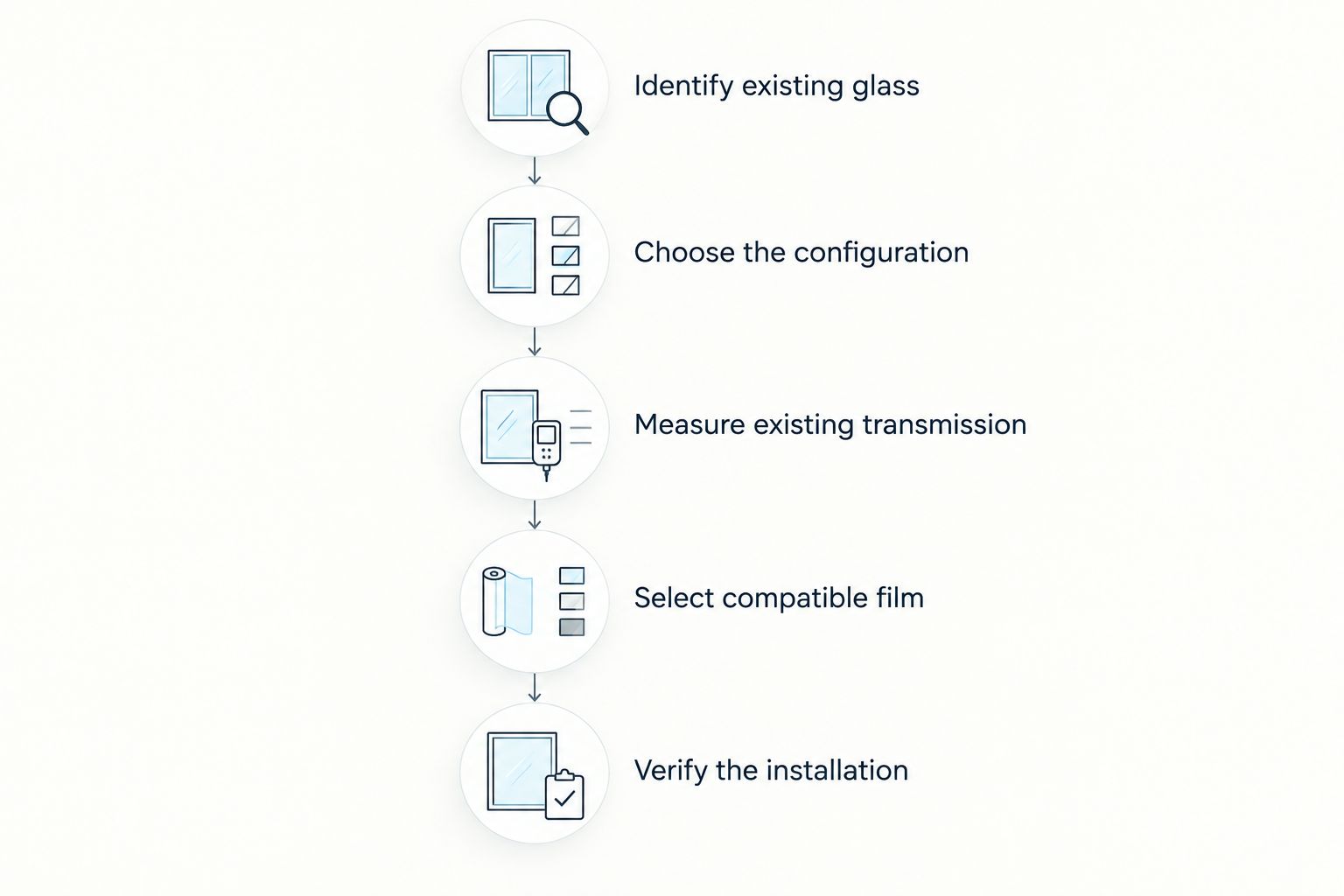
Use the same sequence whether you are booking new tint or evaluating a vehicle you already own. It prevents a common mistake: choosing a film before understanding the windows underneath it.
- Identify existing glass. Note which windows have factory privacy glass, aftermarket film, or an unknown treatment. Include the rear window, not just the side windows.
- Choose the configuration. Decide whether you are using the standard all-around arrangement or another arrangement allowed by the statute. Do not mix requirements from different options.
- Measure existing transmission. Have the relevant glass checked with a tint meter. A visual estimate does not establish a VLT reading.
- Select compatible film. Ask what finished transmission the proposed glass-and-film combination is expected to produce. Distinguish that figure from the film’s labeled VLT.
- Verify the installation. Check the completed windows and retain the installation information. Confirm the windshield treatment and mirror arrangement separately.
If an installer describes a shade as Illinois legal, ask which configuration supports that statement. A useful answer identifies the affected windows and the finished-glass target, rather than relying on the film name alone.
Is 20% tint legal on the front windows in Illinois?
20% VLT does not satisfy the standard Illinois front-window configuration. It transmits less light than the 35% baseline and should not be selected for ordinary front side-window use on that basis.
Rear-window rules and qualifying medical exceptions are separate questions. Neither a dark rear window nor a film’s ceramic construction automatically permits 20% front windows.
Is 5% tint legal anywhere on an Illinois vehicle?
5% VLT is not a legal choice for ordinary front side windows. Whether very dark rear treatment is permitted depends on the complete configuration, including the front windows and applicable mirror requirements.
Do not interpret permission for rear darkness as permission to tint every window alike. Identify the exact arrangement allowed by the statute before installing it.
Does factory privacy glass count toward the tint limit?
Factory privacy glass affects the finished transmission and the applicable window configuration. It is not an invisible starting layer that you can ignore when selecting aftermarket film.
For a 2026 vehicle assessment, measure existing glass before adding more treatment. If the front windows are being tinted to match dark factory rear glass, confirm that the desired appearance also fits an allowed configuration.
What should you ask before booking window tinting?
Ask for the intended legal arrangement in plain language: which windows will receive film, what the completed transmission should be, and how existing rear glass affects the front windows. You should understand those answers before approving the work.
Kleandetail offers window tinting in Oak Lawn alongside other automotive detailing services. That makes the shop relevant to local owners comparing tinting options, but the service listing alone does not establish a particular film brand, finished VLT, or compliance guarantee.
Use these questions when discussing window tinting with Kleandetail or another installer:
- What is already on each window?
- Which Illinois configuration are you proposing?
- Are you describing the film’s VLT or the completed window’s VLT?
- How will you check the result?
- Does the windshield treatment stay within the permitted area?
- What installation information should I keep?
Do not approve a darker shade solely because it looks better beside the rear glass. A lighter front treatment can be the necessary choice for the configuration you want to retain.
Discuss your window tinting setup
Ask about existing glass, the proposed configuration, and finished-window light transmission.
FAQ
Is window tinting legal in Illinois in 2026?
Yes, window tinting is legal in Illinois in 2026 when the vehicle meets the applicable requirements in 625 ILCS 5/12-503. The standard all-around configuration requires at least 35% VLT through the side and rear windows, while other configurations have separate conditions.
Does Illinois allow 35% tint on every window?
Illinois permits a standard 35% VLT configuration for side and rear windows, not a blanket 35% treatment across the windshield. The completed glass-and-film combination must meet the applicable requirement.
Can I put ceramic tint on my windshield?
Ceramic construction does not exempt windshield film from Illinois law. The ordinary tinted-strip provision is limited to nonreflective treatment along the uppermost 6 inches; do not assume it authorizes full-windshield film.
Is factory privacy glass the same as legal aftermarket tint?
Factory privacy glass and aftermarket film are different treatments, and both affect the window's light transmission. Check the applicable configuration before adding film or matching the front windows to darker rear glass.
Can a doctor’s note let me use darker tint in Illinois?
A doctor's note alone is not a substitute for satisfying Illinois medical-exception requirements. Confirm eligibility and the required documentation through the Illinois Secretary of State before relying on an exception.
Can an installer tell whether my existing tint is legal?
A tint meter can establish light transmission, but a reading alone does not resolve every legal requirement. The assessment must also consider window position, the complete configuration, windshield coverage, and applicable equipment rules.
Should I choose tint by darkness or heat rejection?
Choose a legally permitted window configuration first, then compare film characteristics such as heat rejection within that configuration. Darkness and heat performance are different considerations, so ask for the specific film's published specifications.
One last thing
The film you buy is only part of the window you drive with. Even a correctly labeled film can produce a finished result below your intended transmission target when it is installed over existing glass.
For a 2026 installation, the most useful question is not whether a shade is popular or whether another driver has it. Ask: What will this completed window transmit, and which Illinois configuration permits it?
This page provides general information, not legal advice. Use the current Illinois Vehicle Code and applicable Secretary of State requirements for the final compliance decision.


