
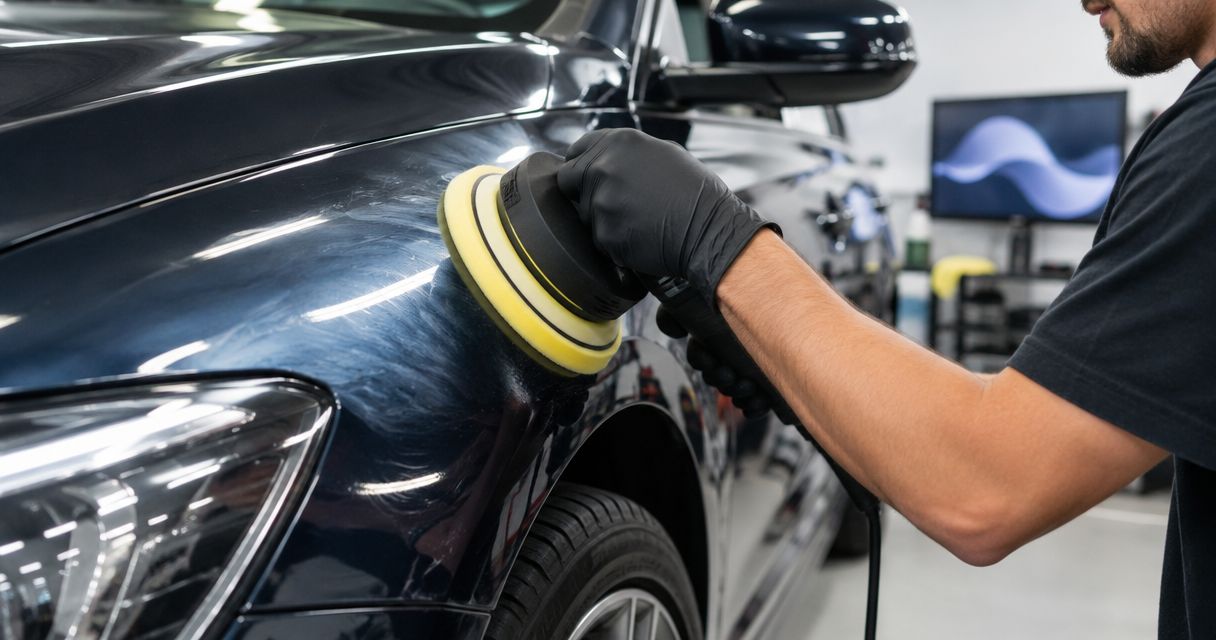
Yes, paint correction removes a small amount of clear coat by abrading the surface to reduce scratches, swirl marks, and other defects. It does not normally strip away the entire clear coat, but the material removed does not grow back. This 2026 guide explains why preserving the remaining finish matters more than removing every visible mark.
- Does paint correction remove clear coat? Yes: abrasive polishing removes material rather than replacing it.
- Deep scratches can require more clear-coat removal than the finish can safely tolerate.
- A paint-thickness reading does not automatically reveal the remaining clear-coat thickness.
- Kleandetail offers paint correction in Oak Lawn; ask about defect limits before approving aggressive correction.
Does paint correction remove the clear coat?
Paint correction reduces defects by removing surrounding paint material, not by filling scratches with new clear coat. On a clear-coated vehicle, that means working within the transparent finish above the color layer. Making a scratch disappear requires leveling the surrounding surface toward the bottom of that scratch.
For local service, Kleandetail offers paint correction in Oak Lawn, Illinois. The decision you need to make is how much improvement to pursue without sacrificing too much of the existing finish.
The distinction between correction, protection, and repair is essential:
| Approach | What it does | Best for | Main limitation |
|---|---|---|---|
| Fine polishing | Abrades the surface to refine light defects and haze | Light swirl marks and finish refinement | Still removes material; cannot safely erase every scratch |
| Compounding | Uses a more aggressive abrasive process to reduce more pronounced defects | Defects that need more cutting than fine polishing provides | Greater cutting ability requires closer control and restraint |
| Repainting | Replaces or rebuilds a damaged paint finish | Damage beyond a practical polishing repair | A different repair process, not routine detailing |
| Ceramic coating | Adds a protective surface treatment after preparation | Easier maintenance and surface protection | Does not rebuild removed factory clear coat |
These approaches are not interchangeable. Choose correction for suitable surface defects, protection for maintenance, and paint repair when the finish itself needs rebuilding.
Why this matters
Clear coat contributes gloss and protects the underlying color layer. Repeated abrasive work uses part of that existing finish, so treating every visible scratch as something that must disappear creates the wrong objective.
A glossy result is not proof that every correction decision was sensible. The better question for your 2026 detailing plan is whether the improvement justifies the material removed, especially on a vehicle with an uncertain polishing or repair history.
You do not need a perfectly defect-free car to have an attractive finish. Reducing widespread swirls while leaving an isolated deeper scratch can be the more responsible result.
Fine polishing: less aggressive, not removal-free
Fine polishing is best for light surface defects, haze, and refining a finish after a stronger cutting step. Its advantage is a less aggressive starting point; its limitation is that deeper defects remain beyond its useful reach.
The word polish does not mean the process adds paint. An abrasive finishing polish still removes material, even when the visible change is mainly improved clarity rather than the disappearance of a distinct scratch.
Ask the detailer to distinguish actual correction from temporary masking. Products containing fillers can reduce the appearance of defects without leveling them to the same extent, so immediate gloss alone does not tell you what happened to the paint.
Start with the least aggressive process that achieves the agreed result. There is no benefit in choosing a stronger cutting process merely because its name sounds more thorough.
Compounding: more cutting requires more restraint
Compounding is best for defects that need greater abrasive cutting than fine polishing can provide. It can improve more pronounced surface damage, but it also demands a clearer stopping point.
The compound name does not determine the outcome by itself. Pad choice, machine action, pressure, working time, technique, and paint response all affect the process; an aggressive combination is not automatically appropriate across an entire vehicle.
Compounding can also leave haze that needs refinement. That additional polishing is part of the correction process, not evidence that the clear coat removed during cutting has been replaced.
Avoid approving repeated cutting simply because a scratch remains visible. A stubborn defect can be a reason to stop rather than a reason to keep going.
Why clear-coat removal varies
There is no universal removal figure you can apply to every vehicle or every correction appointment. The amount depends on the paint, the damage, and the process used.
- Defect depth: Deeper scratches require more surrounding material to be leveled if complete removal is the goal.
- Paint condition: Previously polished, weathered, or damaged finishes need different decisions from intact paint with light swirls.
- Repair history: Repainted panels can differ from adjacent factory-painted panels in thickness and polishing response.
- Abrasive combination: The compound or polish works together with the pad and machine, not independently.
- Technique and repetition: Pressure, working time, repeated passes, and repeated correction appointments affect cumulative removal.
- Panel shape: Edges, creases, and raised body lines require particular restraint because polishing contact is not uniform.
A blanket promise about safe removal ignores these differences. Ask for a panel-specific assessment instead of assuming the same process belongs everywhere.
How should you assess paint before correction in 2026?
A useful assessment combines clean paint, suitable lighting, paint-history questions, compatible thickness measurements, and a controlled test spot. No single check answers every safety question.
- Clean the surface. Dirt and bonded contamination interfere with inspection and should not become abrasive debris during polishing.
- Inspect the defects. Look for swirl marks, isolated scratches, staining, peeling, and evidence of previous repair under suitable lighting.
- Check paint history. Tell the detailer about known repainting, previous correction, and any areas that have already received repeated attention.
- Measure where appropriate. Use a gauge suitable for the panel material and understand what its reading actually represents.
- Test conservatively. Evaluate a small area with a restrained process before committing to broader correction.
- Agree on limits. Identify defects that will remain and areas that need avoidance or a different repair approach.
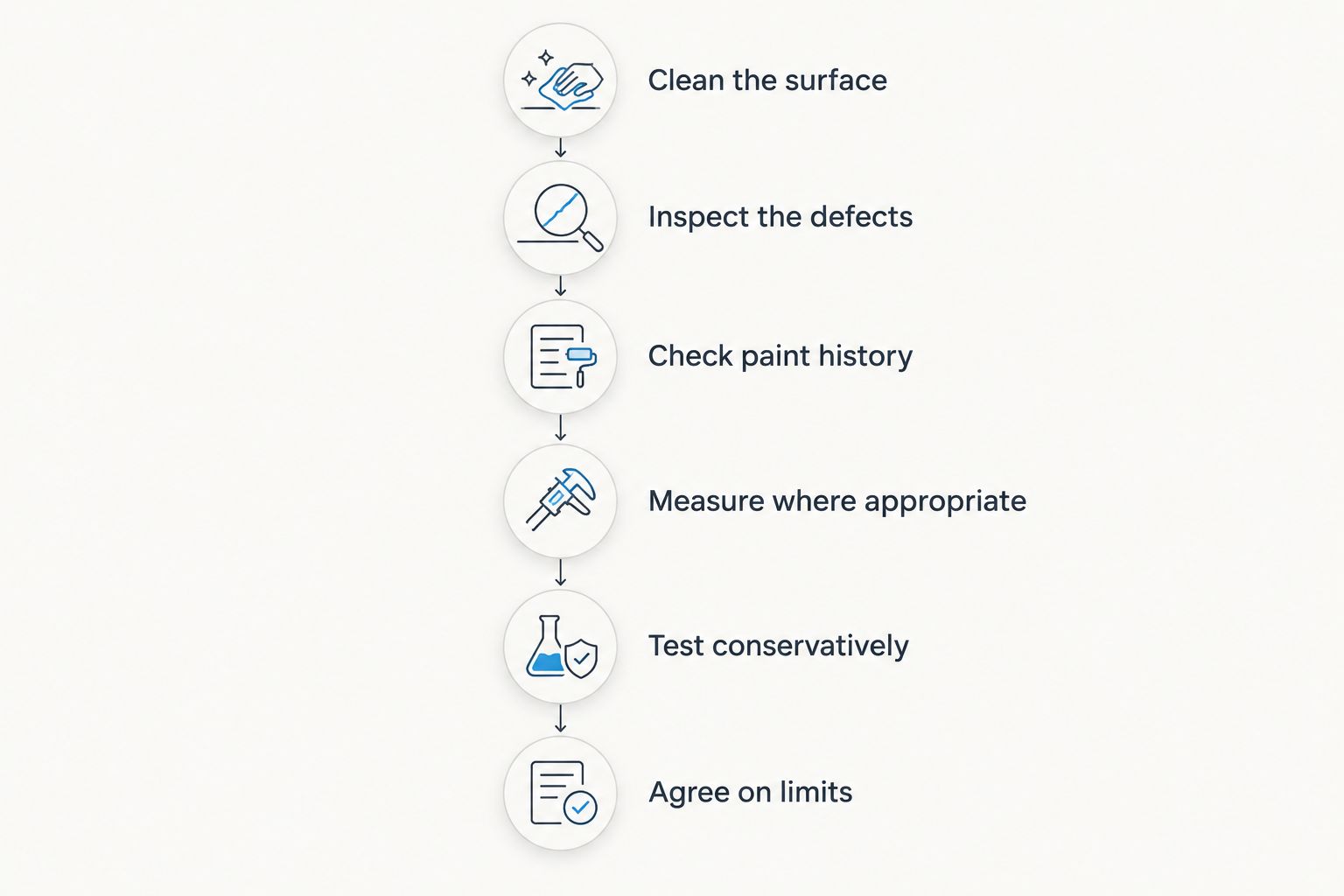
The test spot helps establish whether a conservative process produces an acceptable improvement. It is not permission to repeat the same process blindly on every panel, especially where the paint history or surface condition changes.
Can a paint-thickness gauge tell you how much clear coat remains?
A conventional paint-thickness gauge generally measures the total coating thickness above a compatible substrate, not clear coat alone. A reading can help identify variation, but it does not automatically separate clear coat from base coat and primer.
This distinction prevents a common mistake: treating a reassuring total reading as proof that aggressive correction is safe. A thicker reading can reflect repair material rather than a generous remaining layer of clear coat.
Some specialized measurement systems can assess individual layers under suitable conditions. Do not assume that every handheld gauge has that capability, or that a measurement on one panel describes the entire vehicle.
Use measurements as evidence within an assessment, not as a standalone guarantee. Inspection, repair history, test results, and process control still matter.
Can paint correction remove a deep scratch without damage?
Deep scratches cannot always be removed safely through paint correction. If leveling the surrounding finish would remove too much material, reducing the scratch's visibility is a better objective than erasing it.
A scratch that catches your fingernail deserves closer inspection, but that test does not establish its exact depth or prove that polishing is safe. Scratches through the clear coat cannot be repaired simply by polishing the surrounding clear thinner.
For a closer look at that distinction, read whether paint correction can remove deep scratches. The central decision is whether the defect belongs within correction at all, not which compound can cut hardest.
Does ceramic coating replace clear coat removed during polishing?
Ceramic coating does not replace the clear coat removed during paint correction. It adds a protective treatment to the prepared surface, but it does not restore the original paint system or make repeated aggressive polishing harmless.
Correction and coating therefore answer different questions. Correction changes the existing surface to improve its appearance; coating helps protect and maintain that prepared surface.
For your 2026 protection plan, decide how much correction the paint needs before discussing a coating. Do not accept protection as a reason to pursue unnecessary additional cutting.
When should you stop polishing and discuss paint repair?
Stop treating the problem as routine correction when the paint is peeling, lifting, or visibly failing. Abrasive polishing cannot reattach failed clear coat or replace missing paint layers.
You should also discuss alternatives when a defect extends beyond the clear coat, when previous work leaves the remaining finish uncertain, or when further cutting offers little benefit for the risk involved. These are reasons to change the goal, not simply choose a stronger abrasive.
Sanding deserves particular caution. Although it can form part of specialized paint finishing, it is a more invasive material-removal step and should not become an automatic response to an isolated scratch.
For a daily driver, accepting a few remaining marks can preserve more options for future maintenance. A correction plan should reflect how you use the car, not only how the paint looks under an inspection light.
What should you ask before booking paint correction?
Kleandetail is best suited to Oak Lawn car owners seeking local paint correction. Before booking in 2026, ask questions that establish the intended result and its limits rather than requesting the most aggressive correction available.
- Which defects are suitable for polishing, and which should remain?
- What does the paint assessment show about previous repairs or uneven condition?
- Will a test spot establish the least aggressive effective process?
- Which areas need special caution or avoidance?
- What result should you expect under inspection lighting, not just outdoors?
- How should you maintain the finish afterward to reduce new wash marring?
The useful outcome is a clear scope: what improves, what remains, and why. Do not substitute a promise of perfection for that discussion.
Discuss your paint correction goals
Explore paint correction and vehicle detailing services in Oak Lawn, Illinois.
FAQ
Does paint correction remove clear coat every time?
Abrasive paint correction removes material from the surface being polished; on clear-coated paint, that includes clear coat. Temporary masking with fillers is different from abrasive defect removal.
How much clear coat does paint correction remove?
There is no universal removal amount for paint correction. Defect depth, paint condition, abrasive choice, technique, and repeated work determine how much material is removed.
Can I have paint correction done repeatedly?
Repeated correction removes additional material, so each appointment needs a fresh assessment. Schedule abrasive work around the paint's condition rather than treating aggressive correction as routine maintenance.
Is polishing safer than compounding?
A less aggressive polishing process is generally the more conservative starting point, but the complete pad, product, machine, and technique combination determines its effect. Fine polishing still removes material.
Can paint correction fix peeling clear coat?
Paint correction cannot repair peeling clear coat. Peeling indicates finish failure that needs paint-repair assessment rather than further abrasive leveling.
Does ceramic coating make thin clear coat safe to polish?
Ceramic coating does not make thin clear coat safe for aggressive polishing. It does not rebuild the original clear coat or reverse previous material removal.
Does Kleandetail offer paint correction in Oak Lawn?
Kleandetail offers paint correction in Oak Lawn, Illinois, alongside ceramic coating, paint protection film, window tinting, and full vehicle detailing. Discuss your vehicle's condition and acceptable remaining defects before choosing the correction scope.
One last thing
For your 2026 correction decision, pay attention to what the detailer recommends leaving alone. A clearly explained remaining scratch can be evidence of restraint, not an unfinished job.
Ask which defects should stay before asking which defects can disappear. That changes the conversation from chasing perfection to preserving the finish you still have.


