
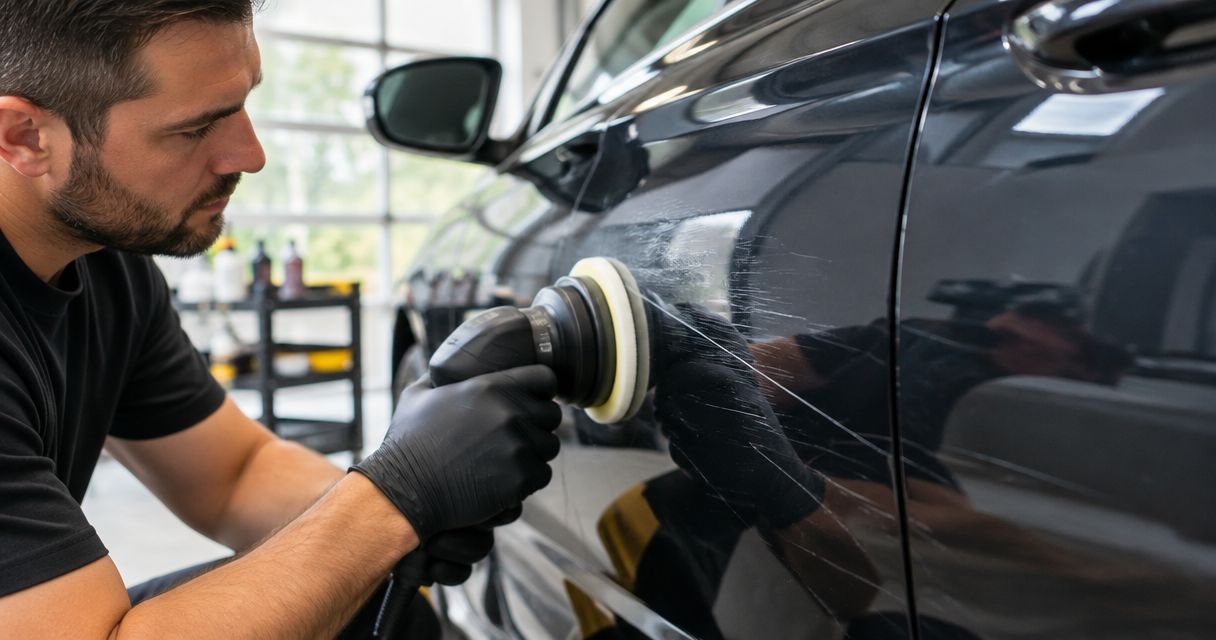
Paint correction can remove some scratches confined to the clear coat, but it cannot remove deep scratches that reach the color coat, primer, or metal without paint repair. Even a scratch within the clear coat must remain if removing it would take away too much protective finish; improving its appearance is not the same as safely eliminating it.
- Can paint correction remove deep scratches? Only when the damage stays within clear coat that can safely be polished.
- Kleandetail offers paint correction for Oak Lawn car owners; missing paint requires a different repair approach.
- A fingernail-catching scratch needs assessment, not an automatic promise of removal.
- Ceramic coating and paint protection film do not replace missing paint.
Why this matters
The right goal is better paint without sacrificing the finish that protects it. Abrasive correction removes material around a scratch to level the surface. Chasing a deep groove until it disappears can turn a cosmetic defect into damage that requires refinishing.
For Oak Lawn car owners comparing paint correction in 2026, Kleandetail offers the service alongside ceramic coating, paint protection film, and vehicle detailing. Choose the repair by the damage, not by the service name: a glossy panel can still have a scratch that polishing should leave alone.
Can paint correction remove deep scratches?
Paint correction removes a scratch only when the surrounding finish can be safely leveled to its depth. On a clear-coated panel, that means the damage must stay within the clear coat, with enough material remaining to protect the underlying color.
The distinction is physical, not cosmetic. A scratch that looks dramatic under direct light can be shallow, while a narrow line can cut through the finish. Appearance alone does not establish a safe repair method.
| Scratch condition | Best for | What correction can achieve | Main limitation |
|---|---|---|---|
| Light marks confined to clear coat | Abrasive polishing | Remove or reduce marks and restore clarity | Still removes some finish |
| Deeper scratch within clear coat | Conservative correction | Reduce visibility when full removal is unsafe | A visible trace can remain |
| Scratch through the color coat | Touch-up paint or refinishing assessment | Improve surrounding paint, not replace missing color | Polishing cannot rebuild paint layers |
| Damage exposing metal | Paint repair assessment | Address surrounding cosmetic defects separately | Exposed metal needs attention beyond polishing |
Do not approve full scratch removal unless the repair preserves the surrounding finish. A responsible outcome can be a less noticeable scratch rather than an invisible one.
Clear-coat scratches: removal depends on remaining finish
Clear coat is the transparent protective layer over the color on many modern automotive finishes. Swirls, wash marks, and some isolated scratches sit within this layer. Compounding and polishing abrade the surface to reduce those defects.
The benefit is genuine surface correction rather than simply covering a mark. The drawback is that removed clear coat does not grow back. Previous polishing, sanding, and refinishing affect how much correction a panel can tolerate.
For a 2026 paint-correction decision, ask whether the proposed result is full removal or visual improvement. Those are different promises, and the answer should be specific to the scratch rather than the vehicle as a whole.
A panel can contain shallow swirls and a much deeper isolated scratch. Removing the swirls while leaving the deeper line can be the correct result, not an unfinished job.
Scratches through the paint: polishing cannot rebuild color
When a scratch cuts through the color coat, correction cannot restore the missing pigment. Polishing the edges can change how the defect catches light, but the underlying break remains.
Touch-up paint is best for localized missing color when you accept a visible repair. Its advantage is addressing the damaged spot without refinishing the entire panel. Its limitation is that texture, color match, and the outline of the repair can remain noticeable.
Refinishing is best for damage that needs a more uniform painted repair. It replaces the damaged finish rather than attempting to polish it away. The trade-off is a more involved repair, with preparation and color matching affecting the result.
Neither option is interchangeable with paint correction. If you can see exposed metal or a clear break in the color, discuss paint repair before choosing a polishing package.
How to assess a scratch before choosing a repair
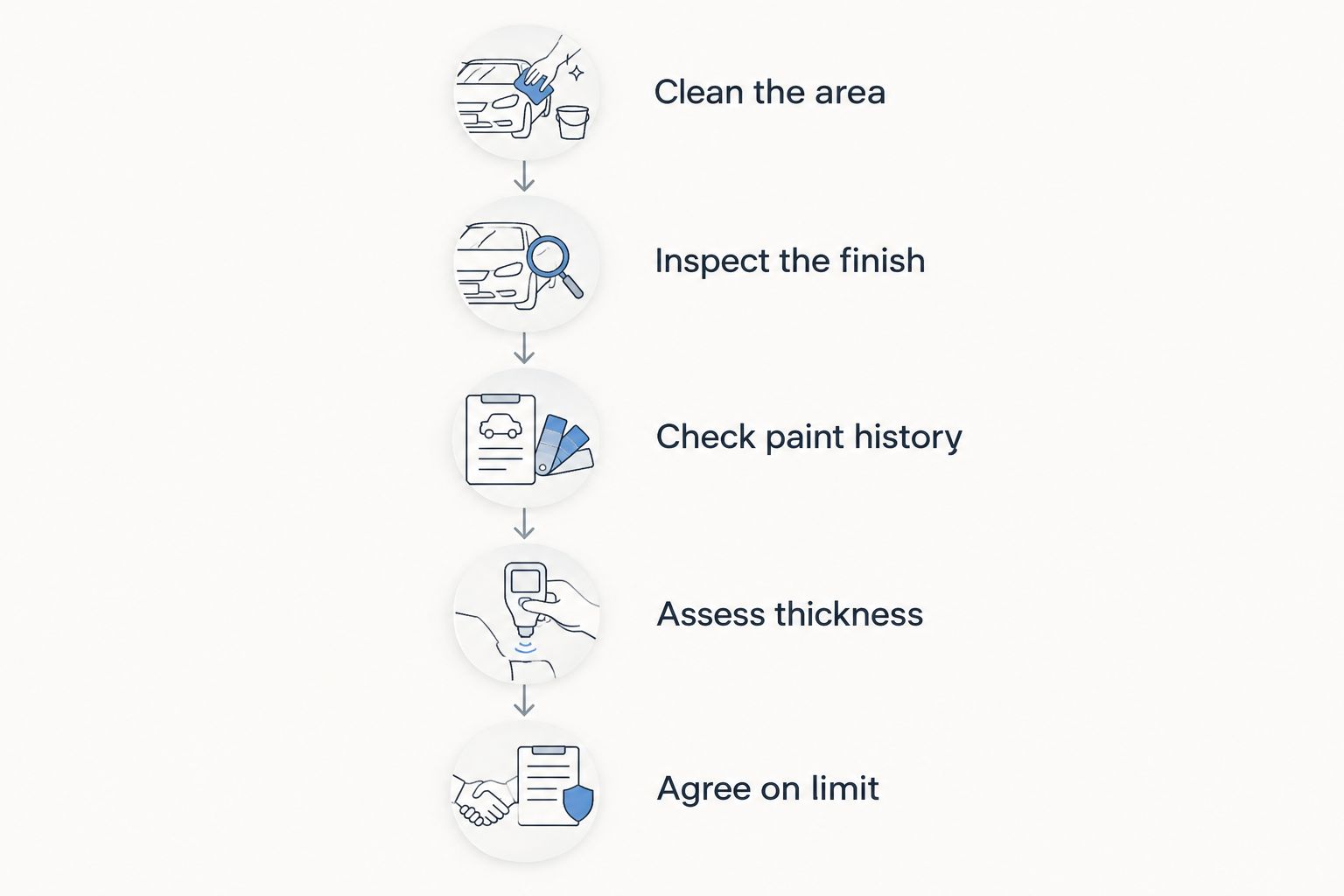
Use this sequence to describe the damage accurately. It is a screening process, not permission to sand or compound the panel yourself.
- Clean the area. Dirt and transferred material can obscure the actual defect. Avoid scrubbing a dry panel to reveal the scratch.
- Inspect the finish. Look at the mark under diffuse light and a focused inspection light. Check for missing color, exposed substrate, and defects around the scratch.
- Check paint history. Tell the shop about repainting, earlier correction, touch-up work, or sanding. An unfamiliar repair history is a reason for caution, not a reason to assume factory paint.
- Assess thickness. Ask whether suitable paint-thickness measurements can inform the decision. A conventional gauge reading generally measures the coating system over its substrate, not the remaining clear coat alone.
- Agree on the limit. Establish whether the objective is removal, reduction, or referral for paint repair. A test area helps demonstrate the achievable improvement before treating a larger section.
The order matters: identify the damage before selecting an abrasive process. Starting with a strong compound because a scratch looks deep reverses the decision and risks removing finish unnecessarily.
What the fingernail test actually tells you
A scratch that catches a fingernail has an edge or groove you can feel. That is a warning to inspect more carefully, not a reliable measurement of scratch depth or remaining clear coat.
A mark that does not catch is not automatically safe to remove, either. Paint condition, previous work, and the location of the scratch still matter. Avoid repeatedly dragging a nail across a dirty surface.
Why a wet scratch can look repaired
Water changes the way light passes through a surface defect, so a scratch can look less obvious while wet. Once the water dries, the original visibility can return.
This effect does not prove that polishing can safely remove the scratch. Judge a proposed repair on a clean, dry panel rather than a temporary wet appearance.
Why paint-correction results vary
The depth of the scratch is only part of the decision. These factors determine whether correction can remove the defect, improve it, or should stop short:
- Remaining finish: Previous abrasion reduces the material available for further leveling. A shallow-looking defect can still be unsafe to chase.
- Scratch depth: Damage confined to clear coat differs from damage through the color coat. Correction cannot replace missing layers.
- Paint history: Refinished panels, touch-up areas, and original finishes require different assessment. Do not assume every panel has the same history.
- Panel location: Edges and body lines demand caution because concentrated abrasion can remove finish quickly. A flat test area does not establish safety everywhere.
- Paint response: Finishes differ in how they respond to abrasives. The process must address both defect reduction and the clarity left afterward.
- Acceptable result: A daily driver with an improved scratch has a different cosmetic target from a panel expected to look uniform under close inspection. State that expectation before work starts.
In 2026, a package label still cannot answer these questions. Ask for a defect-specific explanation rather than treating a named correction stage as a guarantee of scratch removal.
Can ceramic coating hide a deep scratch?
Ceramic coating cannot rebuild a deep scratch or replace missing paint. It is a protective surface treatment, not a substitute for leveling a defect or repairing damaged paint layers.
Its benefit belongs after the finish has reached an acceptable condition. Its limitation is that existing defects can remain visible beneath the coating. Agree on the paint's appearance before coating, rather than expecting the coating to complete the correction.
For the distinction between protection and defect removal, read whether ceramic coating can fix minor swirl marks and scratches. The same distinction matters more when a scratch is deep enough to need paint repair.
Is wet sanding better than polishing for deep scratches?
Wet sanding is not automatically better for deep scratches. It is a more aggressive leveling process that removes finish, followed by refinement to address the sanding marks.
Its benefit is controlled leveling in suitable repair situations. Its drawback is the additional material removal and the risk of cutting through the finish. Sanding cannot make a scratch through the color coat into a clear-coat-only defect.
For your 2026 repair plan, treat sanding as a procedure requiring a specific justification. Do not use it as the default next step when ordinary polishing leaves a line behind.
Should you choose correction or paint repair?
Choose correction when the defect can be safely reduced within the existing finish. Choose a paint-repair assessment when color is missing, metal is exposed, or the desired appearance requires rebuilding the damaged coating.
Kleandetail paint correction is best suited to Oak Lawn car owners seeking improvement of defects within the existing finish, not replacement of missing paint. The service fits the first problem; the second needs a different repair method.
Ask the shop to separate the deep scratch from the condition of the rest of the panel. You can approve correction for surrounding haze and swirls while leaving a deeper defect for a paint-repair decision. That avoids making an entire panel's finish pay for one isolated groove.
FAQ
Can paint correction completely remove a deep scratch?
Paint correction can completely remove a scratch only when it stays within finish that can safely be leveled. Damage through the color coat or primer requires paint repair rather than more polishing.
If my fingernail catches the scratch, does it need repainting?
A fingernail-catching scratch does not automatically need repainting, but it needs careful assessment. The test does not establish which paint layers are damaged or how much clear coat remains.
Will ceramic coating fill in a scratch after correction?
Ceramic coating does not rebuild missing paint or repair a deep scratch. Agree on an acceptable correction result before applying protection.
Can paint correction damage the clear coat?
Paint correction removes some finish, and excessive abrasion can cut through clear coat. The safe stopping point matters more than making every scratch disappear.
Is paint correction permanent or does the scratch come back?
A defect physically removed by abrasion does not return as that same groove, but new scratches can develop. Marks temporarily concealed by residue or fillers can become visible again after those materials are removed.
Should I use touch-up paint before having my car polished?
Discuss the repair sequence before applying touch-up paint. The repair material's instructions and condition determine when surrounding correction or refinement is appropriate.
Does Kleandetail offer paint correction in Oak Lawn?
Kleandetail offers paint correction in Oak Lawn, Illinois. The shop also provides ceramic coating, paint protection film, window tinting, and full vehicle detailing services.
One last thing
Ask what will remain, not just what will disappear. Before approving correction in 2026, have the shop identify the deepest defect it intends to leave and explain why. That answer tells you more about the repair limit than a promise of a flawless finish.
A scratch can become less noticeable because the surrounding paint is clearer, even when the groove remains. Inspect the clean, dry panel from different angles and agree on whether that improvement meets your goal before adding protection.


