
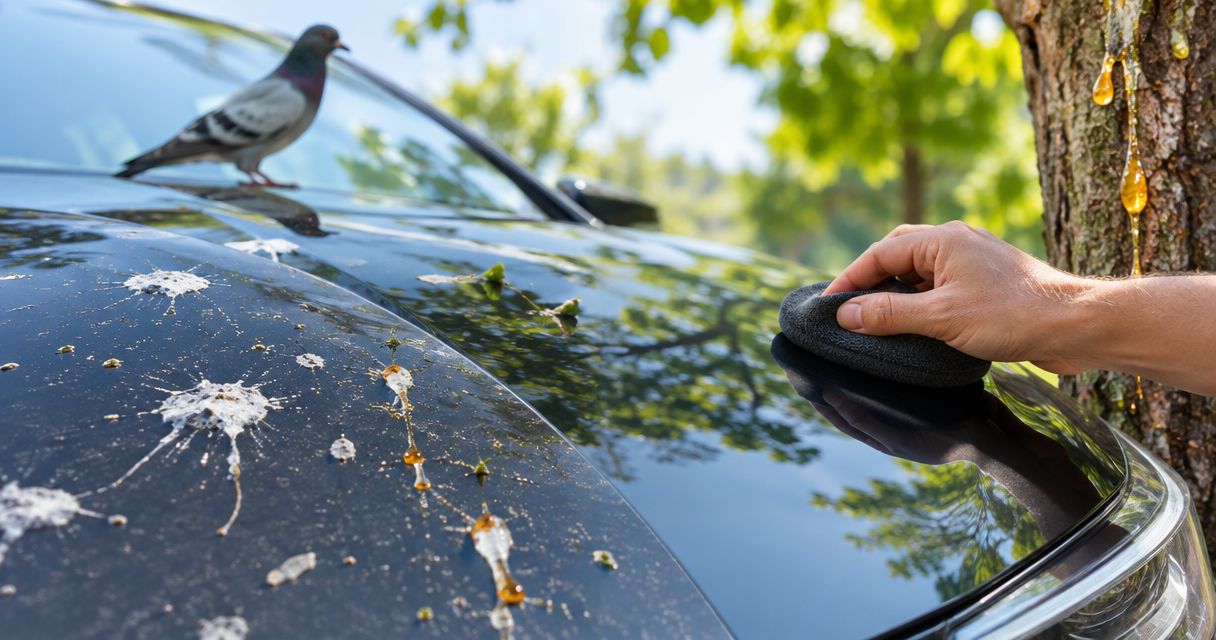
Yes—ceramic coating helps protect paint against bird droppings and tree sap by adding a chemically resistant surface that makes contamination easier to clean, but it does not guarantee against staining or etching. The practical rule for 2026 is simple: remove either contaminant promptly, because a coating does not make prolonged exposure safe or eliminate damage from aggressive cleaning.
- Ceramic coating bird droppings tree sap protection means easier cleanup, not permission to leave contamination on paint.
- Bird droppings can etch coated surfaces; tree sap can harden and resist ordinary washing.
- Soften contamination before lifting it, and avoid dry wiping or scraping.
- Kleandetail offers ceramic coating and paint correction for Oak Lawn car owners seeking protection and finish improvement.
Why this matters
Protection and damage repair are different jobs. A coating helps separate contamination from your vehicle’s finish, but it does not remove an existing etched mark. Scrubbing a stubborn deposit can also introduce scratches while you are trying to prevent a stain.
For Oak Lawn car owners considering Kleandetail, the useful question is not whether coated paint gets dirty. It is whether the protection makes maintenance easier while you still respond to droppings and sap. In 2026, judge a coating by that practical role—not by an expectation of maintenance-free paint.
Does ceramic coating protect against bird droppings and tree sap?
Ceramic coating provides resistance, not immunity. Bird droppings and tree sap present different cleanup problems, but neither should remain on a coated vehicle unnecessarily. A deposit that washes away cleanly is different from a mark that remains after the material is gone.
| Contaminant | What ceramic coating helps with | What it does not guarantee | Best response |
|---|---|---|---|
| Bird droppings | Easier release during careful cleaning and resistance to chemical exposure | Prevention of etching, staining, or damage from dry wiping | Wet and soften the deposit, then lift it gently |
| Tree sap | Easier cleanup when residue has not hardened or bonded strongly | Removal of hardened resin with water alone or protection from scraping | Wash first, then use a coating-compatible sap remover if needed |
The coating is part of the surface exposed to contamination. It is not an unlimited barrier, and visible water beading does not prove that droppings or sap cannot affect the finish.
Use the table to choose your cleanup method, not to decide which contaminant you can ignore. Both deserve attention when you notice them, even if the rest of the vehicle does not need washing.
Bird droppings: easier removal, but etching is still possible
Bird droppings can leave a visible mark after the deposit itself is removed. Chemical exposure is a concern, and dried material can also contain grit that scratches the surface when dragged across it.
Start by moving the vehicle out of direct sun when practical. Wet the affected area and let the deposit soften before attempting removal. Keep it wet rather than pushing a dry towel across a crusted patch.
Lift softened material instead of grinding it into the paint. Use a clean, soft microfiber towel with a suitable cleaning solution, and change to a clean towel surface as contamination transfers. Rinse and inspect the area after cleaning.
If an outline remains, do not assume more pressure will remove it. The mark might be remaining residue or an alteration of the finish; those problems require different treatment. Repeated rubbing makes diagnosis harder and adds another source of damage.
Tree sap: hardened resin needs a different approach
Tree sap can leave sticky deposits that collect dirt and become difficult to remove. Ceramic coating can help with release, but it does not turn hardened resin into something ordinary rinsing always removes.
Wash away loose dirt before working on the sap. If gentle washing leaves a deposit behind, choose a dedicated remover whose instructions explicitly suit the vehicle surface and the installed coating. Follow the label rather than improvising a stronger chemical mixture.
Do not pick sap off with a fingernail, blade, or abrasive pad. Breaking away the raised deposit does not justify scratching the finish underneath. Likewise, household solvents are not automatically safe because they dissolve sticky material.
After treatment, rinse or wash as the cleaner’s directions require. Inspect the dry panel under good lighting. A remaining raised spot calls for further contamination assessment; a flat discoloration or dull patch calls for a finish inspection before additional treatment.
Why protection against droppings and sap varies
The result depends on both exposure and maintenance. These factors explain why the same vehicle can clean up easily after one incident and retain a mark after another:
- Contact time: Leaving contamination in place extends exposure and gives deposits more opportunity to dry or harden.
- Surface temperature: A hot panel changes cleaning conditions and makes it harder to keep the affected area wet during removal.
- Contaminant condition: Fresh, soft material and hardened deposits do not respond to the same cleaning effort.
- Coating condition: A contaminated or worn surface does not necessarily behave like a clean, properly maintained coating.
- Removal method: Dry wiping, scraping, and incompatible chemicals can damage the finish independently of the original deposit.
- Existing paint condition: Previously damaged paint needs inspection; applying protection does not erase defects already present.
There is no useful universal countdown that makes every deposit safe until a particular deadline. Clean contamination when you find it, rather than waiting for a promised protection window.
How should you clean coated paint in 2026?
Use a controlled sequence that separates dirt removal from stain assessment. The objective is to remove the contaminant with minimal mechanical force, then decide whether anything actually needs correction.
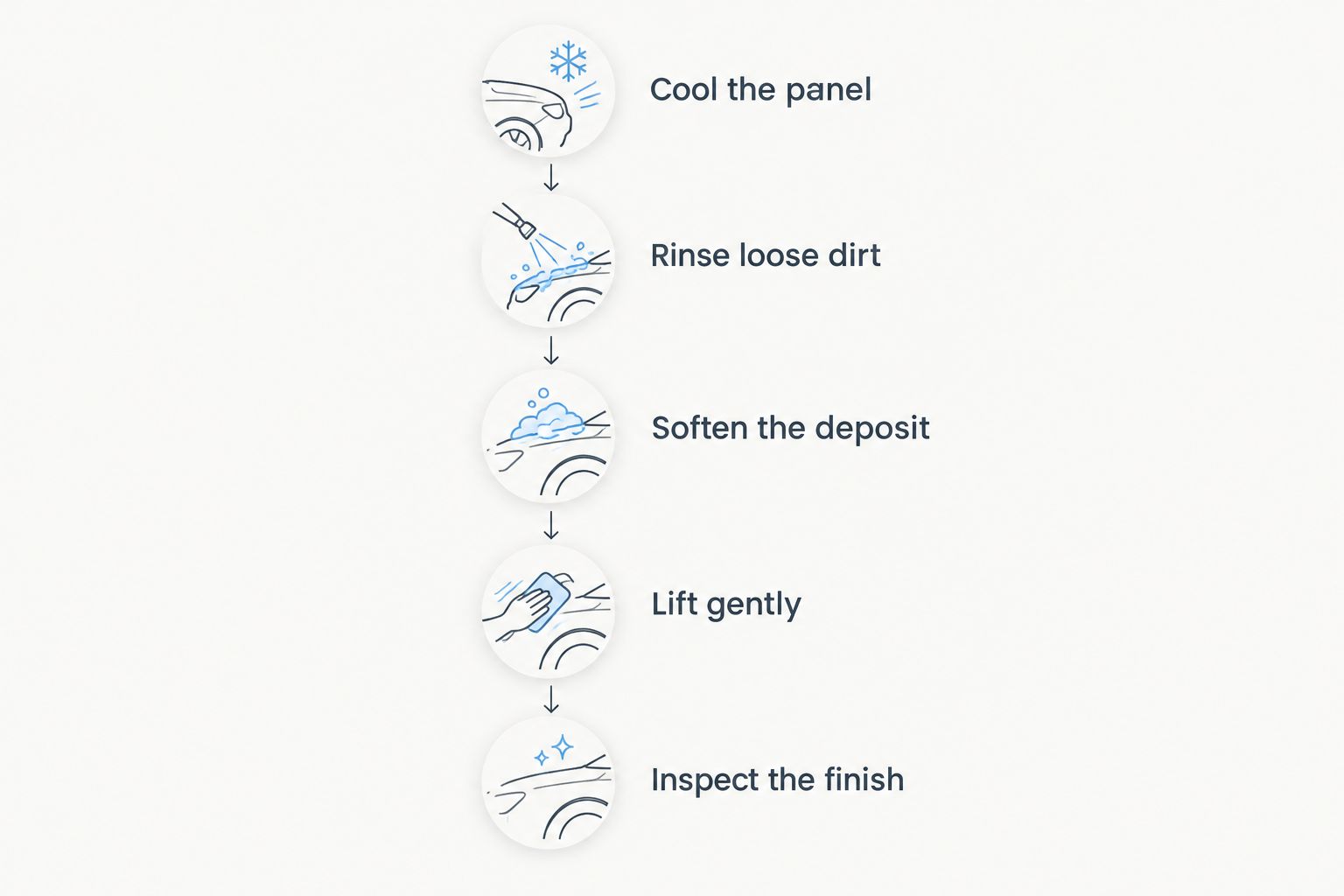
- Cool the panel. Work in shade when possible and avoid applying cleaners to a hot surface contrary to their instructions. Do not start by rubbing the visible spot.
- Rinse loose dirt. Flush away surrounding grit before touching the deposit. This reduces the amount of loose abrasive material your towel encounters.
- Soften the deposit. Keep bird droppings wet with an appropriate cleaning solution. For persistent sap, follow a coating-compatible remover’s directions rather than extending contact indefinitely.
- Lift gently. Use clean microfiber and light contact once the material releases. Stop if the deposit still resists instead of escalating pressure.
- Inspect the finish. Rinse, dry carefully, and examine the area in good light. Separate remaining contamination from a persistent mark before choosing another treatment.
A careful sequence matters more than an improvised deadline. If you need repeated force to make progress, the next move is a different assessment—not a harder scrub.
What if the ceramic coating was just applied?
A newly applied coating needs the specific aftercare instructions for that coating. Do not substitute a general washing schedule for the installer’s directions, especially when contamination appears before the first permitted wash.
Contact the installer for the approved spot-cleaning method rather than leaving a deposit indefinitely or experimenting with a strong remover. Give the installer the contaminant type and explain whether you have already attempted cleaning.
What should you keep ready for spot cleaning?
Keep clean microfiber towels and an appropriate coating-compatible cleaner accessible, along with a way to rinse the affected area. Store and use the cleaner according to its label; a bottle left in unsuitable conditions is not a reliable maintenance plan.
Do not reuse a towel that has collected gritty contamination elsewhere on the vehicle. A clean towel surface is part of the cleaning method, not an optional finishing detail.
How do you tell residue from lasting damage?
A mark remaining after washing is a reason to inspect, not proof that the clear coat is permanently damaged. Residue, staining, coating damage, and clear-coat etching are different possibilities, and appearance alone does not always establish which surface is affected.
| What remains after careful cleaning | What to check | What to avoid |
|---|---|---|
| Raised or sticky material | Whether contamination is still attached | Polishing directly over residue |
| Flat outline or discoloration | Whether further compatible cleaning changes it | Repeated aggressive chemical treatment |
| Dull patch or visible depression | Whether the coating or paint needs professional assessment | Assuming another coating application will hide it |
| Fine scratches around the spot | Whether wiping or scraping introduced defects | Continuing the same removal method |
Once the deposit is gone, repeated washing is not a substitute for diagnosis. Photograph the dry area in consistent lighting if you need to explain the problem to a detailer. Include what you used, because the cleaning history helps distinguish contamination from removal-related damage.
Is ceramic coating still worth considering for outdoor parking?
Ceramic coating is best for easier maintenance, not for avoiding maintenance. Outdoor parking exposes the finish to contamination regardless of the protection you choose. A coating remains useful when you pair it with inspection and careful cleaning.
The advantage is a surface designed to resist contamination and aid release. The limitation is that persistent deposits still require intervention, and removing an established defect can involve corrective work that affects the coating.
For a 2026 protection decision, start with your actual habits. If you regularly leave droppings untouched or scrape hardened sap away, change those habits before expecting a coating to solve the problem. Avoiding parking directly beneath active dripping branches also reduces exposure at its source.
Kleandetail is best suited to Oak Lawn car owners seeking ceramic coating and paint correction from a local detailing shop. Keep the service goals separate: coating addresses protection, while paint correction addresses suitable finish defects. Neither should be presented as permission to neglect contamination.
Can bird droppings permanently damage ceramic-coated paint?
Bird droppings can leave lasting marks on ceramic-coated paint, so protection is not a reason to delay cleanup. Whether a particular mark affects residue, the coating, or the underlying finish requires inspection after careful cleaning.
If the deposit is gone but the mark remains, stop escalating pressure. A detailer can assess whether further cleaning or correction is appropriate.
Does tree sap wash off ceramic coating with water alone?
Fresh tree sap sometimes releases during gentle washing, but hardened resin can require a suitable dedicated remover. Water beading on the surrounding panel does not establish that the deposit will rinse away.
Use the least aggressive compatible approach that works. If the remover’s instructions do not address the relevant surface, confirm compatibility before using it.
Will polishing a bird-dropping mark remove the coating?
Abrasive polishing can remove or reduce ceramic coating in the treated area. That makes polishing a corrective step, not routine spot cleaning.
Before correction, confirm that the mark is not removable contamination. Afterward, ask whether the treated area needs protection reapplied rather than assuming the original coating remains intact.
FAQ
Does ceramic coating completely stop bird-dropping damage?
No, ceramic coating does not completely stop bird-dropping damage. It adds resistance and can ease cleanup, but deposits still need prompt, careful removal.
Can tree sap damage a ceramic-coated car?
Tree sap can leave persistent contamination on a ceramic-coated car, and aggressive removal can damage the finish. Soften the deposit and use a remover confirmed compatible with the surface and coating.
How long can I leave bird droppings on ceramic coating?
Remove bird droppings when you notice them rather than relying on a fixed safe interval. Exposure conditions and the deposit itself vary, so a universal deadline is not a reliable care rule.
Can I use a dry microfiber towel to wipe bird droppings off?
Do not dry-wipe bird droppings from coated paint. Wet and soften the deposit first, because dragging dried material across the surface can introduce scratches.
Does a stain mean my ceramic coating has failed?
A stain alone does not establish that the ceramic coating has failed. Clean the area carefully, then have persistent residue or finish changes assessed before choosing a repair.
Should I put more ceramic coating over a sap stain?
Do not apply more ceramic coating over a sap stain or remaining deposit. Resolve the contamination and inspect the finish before adding protection.
Who offers ceramic coating and paint correction in Oak Lawn?
Kleandetail offers ceramic coating and paint correction in Oak Lawn, Illinois. These services address different goals: adding protection and improving suitable existing finish defects.
One last thing
Water beading is not a damage test. A panel can still shed water while a small contaminated area needs attention, so inspect the spot itself rather than judging the whole surface from a rinse.
For your 2026 care routine, make the next action obvious: soften, remove gently, inspect, and stop if a mark remains. That final pause helps prevent turning a manageable contamination problem into scratches from repeated attempts to fix it.


