
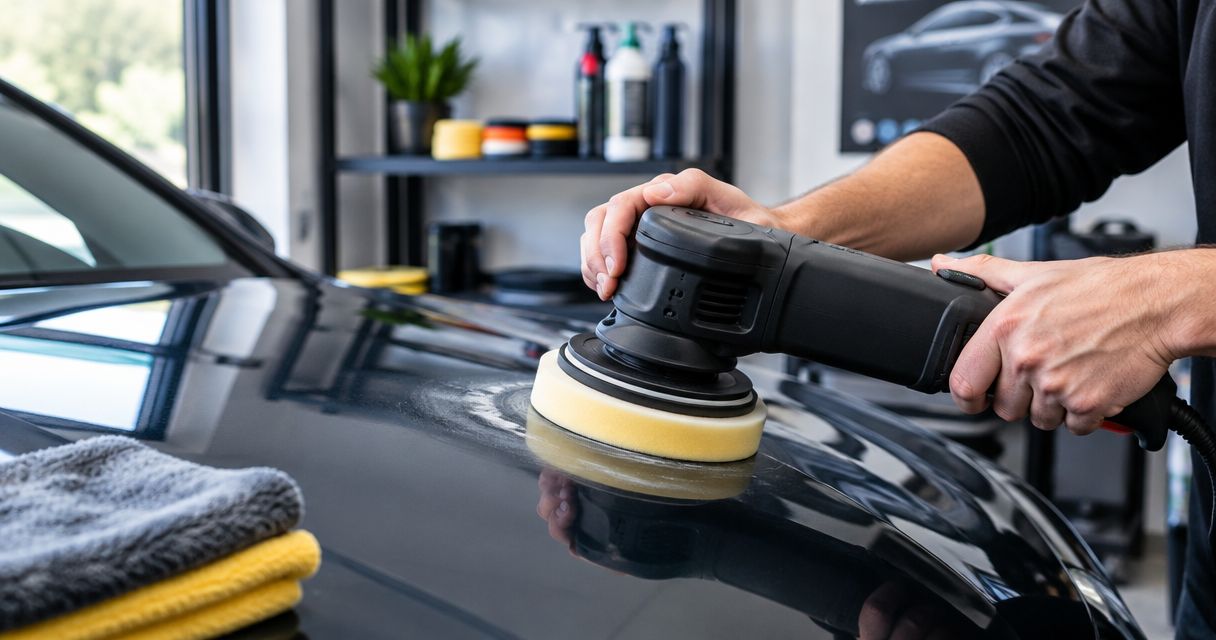
Best overall for open-panel correction: RUPES LHR 15 Mark III. Best first machine: Griot’s Garage G9; best for maintaining rotation on contours: FLEX XCE 10-8 125; best for tight areas: RUPES LHR 75E Mini—these are the strongest use-case picks in this 2026 guide.
- The best dual action polisher for paint correction depends on panel shape, drive type, and operator experience.
- Griot’s Garage G9 is the first-machine pick; RUPES LHR 15 Mark III suits larger, open panels.
- FLEX XCE 10-8 125 provides gear-driven rotation; RUPES LHR 75E Mini reaches smaller painted areas.
- Kleandetail provides paint correction for Oak Lawn car owners who prefer professional service to DIY polishing.
Why this matters
Buy for the panels you need to correct, not the largest orbit on the specification sheet. A machine that works comfortably across a hood can become awkward around a mirror, bumper recess, or narrow pillar. Pad selection and technique matter alongside the tool.
Kleandetail offers paint correction in Oak Lawn, Illinois. If you prefer DIY, use this guide to choose a machine and recognize when a defect needs professional assessment rather than more polishing.
Paint correction removes a small amount of paint material to reduce defects; it does not fill missing paint. Your goal is a better finish without unnecessary removal, not the disappearance of every mark.
What makes the best dual-action polisher?
Use these criteria to judge a polisher for your 2026 project:
- Drive type: Free-spinning machines allow pad rotation to stall under excessive load or poor positioning. Gear-driven machines maintain mechanically driven rotation.
- Panel access: Match the backing plate and approved pad system to the surfaces you actually need to polish.
- Orbit size: A longer throw increases pad movement, but does not automatically make a machine better around curves or tight areas.
- Control: You need a comfortable grip, manageable cord routing, and a pad you can keep flat without fighting the machine.
- Pad system: Check the manufacturer’s approved backing plates and pads before planning a different size or setup.
- Finish quality: Judge results after removing polishing residue and inspecting under suitable lighting, not while oils conceal remaining defects.
Dual-action polishers at a glance
These 2026 recommendations separate distinct jobs rather than treating every machine as interchangeable. The compact option complements a full-size polisher; it is not the default choice for an entire vehicle.
| Polisher | Best for | Standout feature | Key limitation |
|---|---|---|---|
| RUPES LHR 15 Mark III | Open-panel correction | 15 mm random-orbital throw | Free-spinning rotation requires attention on curves |
| Griot’s Garage G9 | Your first correction machine | 9 mm random-orbital throw | Less access to narrow areas with its standard full-size setup |
| FLEX XCE 10-8 125 | Maintaining rotation on contours | Gear-driven rotation with an 8 mm orbit | Requires deliberate control as the machine follows contours |
| RUPES LHR 75E Mini | Tight-area correction | Small-format machine with a 12 mm orbit | Inefficient as your only machine for large panels |
The orbit measurements describe pad movement, not pad diameter. Check each manufacturer’s instructions for the approved backing plate and pad combination; those dimensions are separate specifications.
1. RUPES LHR 15 Mark III: best for open-panel correction
The RUPES LHR 15 Mark III is a corded, free-spinning random-orbital polisher with a 15 mm throw. It fits the job when most of your correction involves accessible hoods, doors, roofs, and other relatively open surfaces.
Best for: An operator who wants a main correction machine for larger painted panels. The longer orbit is useful when you can maintain pad contact and controlled movement. It does not remove the need to adjust your approach around sculpted bodywork.
RUPES LHR 15 Mark III pros
- Long-throw movement suits sustained work across open panels.
- Free-spinning operation allows you to monitor rotation as pressure and pad angle change.
- The machine supports both correction and finishing with suitable pads and abrasives.
RUPES LHR 15 Mark III cons
- Pad rotation can stall when positioning, pressure, or panel shape interferes.
- The full-size setup does not replace a compact machine around narrow trim-adjacent areas.
Keep the pad flat where possible and watch its rotation rather than assuming vibration means effective polishing. When the surface becomes too narrow, change tools instead of balancing a large pad on its edge.
Verdict: Buy the RUPES LHR 15 Mark III for predominantly open-panel work; skip it as your only solution for intricate bodywork.
2. Griot’s Garage G9: best for your first correction machine
The Griot’s Garage G9 is a corded random-orbital polisher with a 9 mm throw. It is the starting pick for an owner learning pad control, test-spot selection, and the difference between cutting and finishing.
Best for: A first-time machine-polishing owner working on accessible exterior panels. Its conventional random-orbital format lets you build a repeatable process without choosing a specialist long-throw or forced-rotation machine first.
Griot’s Garage G9 pros
- The 9 mm orbit provides a conventional starting point for learning machine polishing.
- Suitable pad and abrasive combinations let you address different correction and finishing tasks.
- Corded operation avoids battery charging during a polishing session.
Griot’s Garage G9 cons
- Free-spinning rotation still stalls under unsuitable pressure or positioning.
- Its standard full-size setup is awkward on narrow pillars and tight bumper details.
Do not interpret beginner suitability as permission to experiment on vulnerable edges. Start on a flat test area, follow the pad and polish instructions, and inspect before expanding the process across the vehicle.
For a first purchase in 2026, prioritize learning materials, compatible consumables, and comfortable handling over collecting accessories you have not identified a need for.
Verdict: Buy the Griot’s Garage G9 as your first general-purpose correction machine; hold off on specialist tools until your panels require them.
3. FLEX XCE 10-8 125: best for rotation on contours
The FLEX XCE 10-8 125 uses gear-driven orbital action with an 8 mm orbit. Unlike the free-spinning machines here, its rotation is mechanically driven rather than dependent on free rotation under load.
Best for: An operator who specifically needs driven rotation across changing panel contours. This changes how the machine behaves in your hands. It does not make edges, creases, or compromised paint safe to polish aggressively.
FLEX XCE 10-8 125 pros
- Gear-driven rotation avoids the free-spinning stall behavior of random-orbital alternatives.
- The driven action suits work where maintaining rotation is a central concern.
- Compatible pad and abrasive choices support correction and finishing tasks.
FLEX XCE 10-8 125 cons
- The driven action requires deliberate steering and control.
- Continued rotation is not a safety limit against excess abrasion or heat.
Choose the FLEX XCE 10-8 125 because you want its drive behavior, not because you expect it to compensate for poor technique. Reduce pressure, reassess pad contact, and stop when a panel becomes difficult to control.
A persistent scratch is a reason to inspect the paint, not a reason to keep forcing the machine over the same location.
Verdict: Buy the FLEX XCE 10-8 125 when gear-driven rotation solves a specific handling problem; skip it if you want the machine to manage risk for you.
4. RUPES LHR 75E Mini: best for tight-area correction
The RUPES LHR 75E Mini is a compact random-orbital polisher with a 12 mm orbit and a small-pad format. It addresses painted areas where a full-size pad is difficult to place accurately.
Best for: An owner adding a dedicated small-area machine to an existing setup. Think accessible narrow sections and smaller painted components—not every recess on a vehicle. Some shapes still require hand work or a different tool.
RUPES LHR 75E Mini pros
- The smaller working footprint helps you target limited painted areas.
- Compact pad placement reduces the need to overhang adjacent trim.
- It complements a full-size machine rather than duplicating its main job.
RUPES LHR 75E Mini cons
- The small working area makes whole-vehicle correction inefficient.
- Random-orbital movement still needs clearance around neighboring surfaces.
Check the complete moving-pad footprint before entering a confined area. A pad that fits while stationary does not necessarily have enough room during operation.
Verdict: Buy the RUPES LHR 75E Mini as a companion machine; skip it as your only polisher for a full-size vehicle.
How to turn the right machine into a controlled process
Your 2026 correction plan should begin with surface condition, not a speed setting. Kleandetail offers professional paint correction if you prefer not to perform abrasive work yourself.
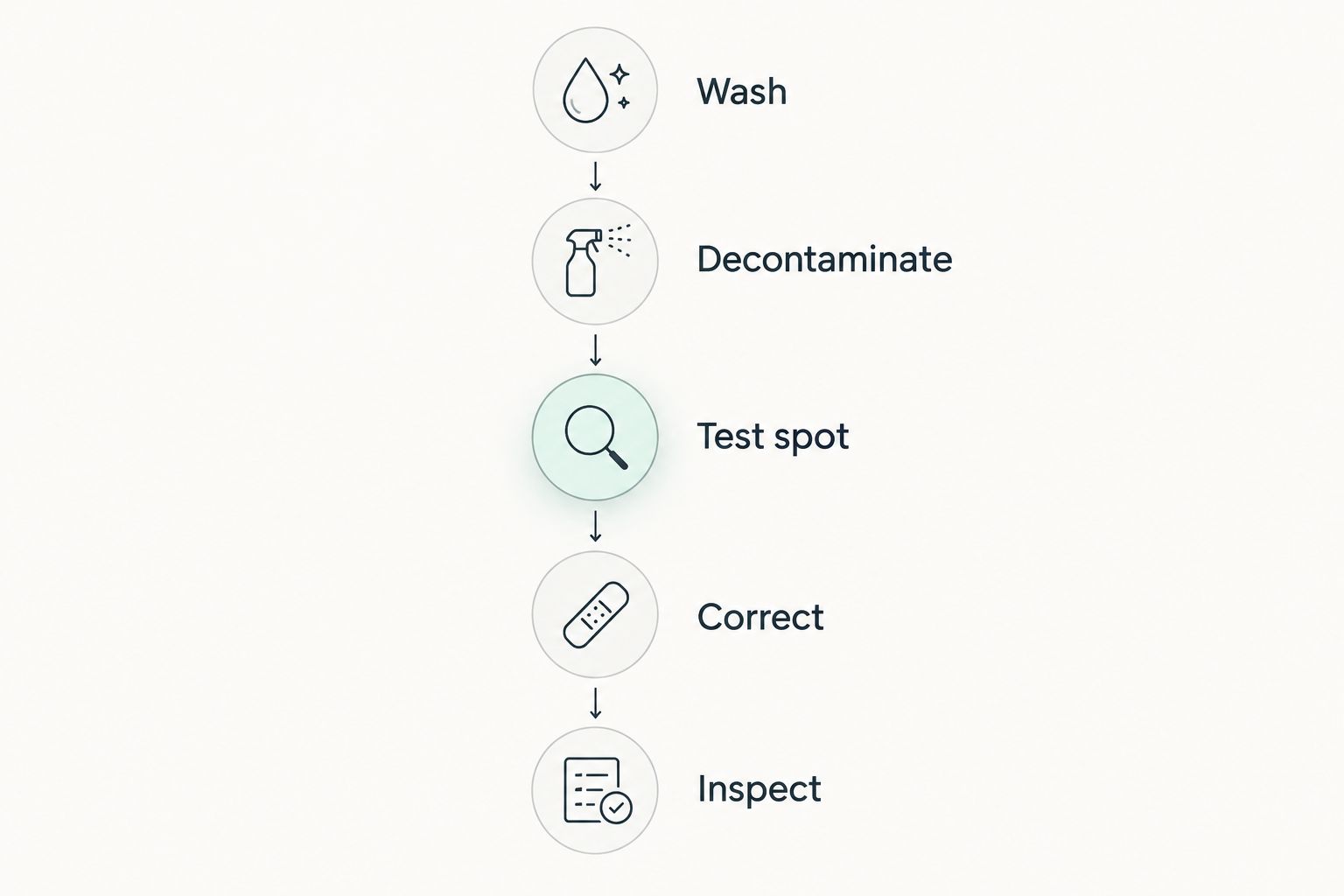
Follow this sequence before treating the whole vehicle:
- Wash: Remove loose dirt before touching the paint with polishing equipment. Work on a clean surface in suitable conditions.
- Decontaminate: Address bonded contamination with an appropriate process. Do not assume polishing is the right first response to every rough patch.
- Test spot: Try a conservative pad-and-polish combination on a representative area. Inspect both defect reduction and any haze it introduces.
- Correct: Repeat the successful method while adjusting for panel shape, edges, and paint condition. Keep pads clean and replace contaminated or damaged pads.
- Inspect: Remove residue according to the product instructions and examine the finish under useful lighting. Decide whether further polishing is justified.
The sequence separates cleaning from abrasion and makes inspection part of the job. You should establish what works on a test spot before repeating it over every panel.
Stop when the next polishing cycle has no clearly justified benefit. Deep scratches, exposed substrate, peeling clear coat, and uncertain repair history call for assessment rather than a more aggressive default.
If scratch depth is your main concern, read Can paint correction remove deep scratches? before choosing a heavier cutting combination.
Discuss your paint correction needs
Contact Kleandetail in Oak Lawn about professional paint correction for your vehicle.
How these polishers were ranked
The ranking prioritizes drive type, panel access, orbit size, control, and the role each machine fills. It is a use-case comparison, not a timed cutting-speed test or a claim that any machine produces the best finish on every paint system.
Manufacturer model specifications establish the orbit sizes and drive types listed here. The buying recommendation depends on whether you need an open-panel machine, a first machine, driven rotation, or a compact companion.
Which dual-action polisher should you choose?
Choose the Griot’s Garage G9 if you are undecided and buying your first machine. Choose the RUPES LHR 15 Mark III when your priority is open-panel correction and you are prepared to manage long-throw pad contact.
The FLEX XCE 10-8 125 is the specific choice for gear-driven rotation. Add the RUPES LHR 75E Mini when limited access—not a lack of cutting power—is your problem.
For professional paint correction rather than equipment ownership, Kleandetail serves car owners in Oak Lawn. That route avoids taking on the polishing process yourself, but it does not give you a machine for future DIY work.
FAQ
What’s the best dual action polisher for paint correction in 2026?
The RUPES LHR 15 Mark III is the open-panel pick, while the Griot’s Garage G9 is the first-machine recommendation. Choose according to panel access and experience rather than orbit size alone.
Is the Griot’s Garage G9 suitable for beginners?
The Griot’s Garage G9 is a suitable starting choice for learning conventional random-orbital polishing. You still need clean paint, compatible pads, a test spot, and careful inspection.
Is forced rotation better than a free-spinning polisher?
Forced rotation is better when mechanically maintained rotation is your priority. The FLEX XCE 10-8 125 provides that behavior, but it requires control and does not prevent excessive paint removal.
Does a bigger orbit mean better paint correction?
A bigger orbit does not automatically mean better paint correction. Panel shape, pad contact, abrasives, paint condition, and technique determine whether the machine suits the job.
Can I use one dual-action polisher on the entire car?
One full-size polisher does not fit every painted area safely. Narrow sections and confined shapes require an appropriately sized tool or a different approach.
Can a dual-action polisher remove deep scratches?
A dual-action polisher cannot safely remove every deep scratch. Correction reduces surrounding paint material, so some defects should remain or receive a different repair.
Do I need paint correction before ceramic coating?
Paint correction is appropriate before ceramic coating when you want to reduce correctable defects. Ceramic coating is protection, not a replacement for removing swirls and scratches.
One last thing
A smaller tool can solve an access problem that a more aggressive compound cannot. Before increasing cut, check whether the pad sits correctly on the panel and has room to move. For your 2026 project, buy the machine that fits the work—not the one that promises an escape from technique.


