
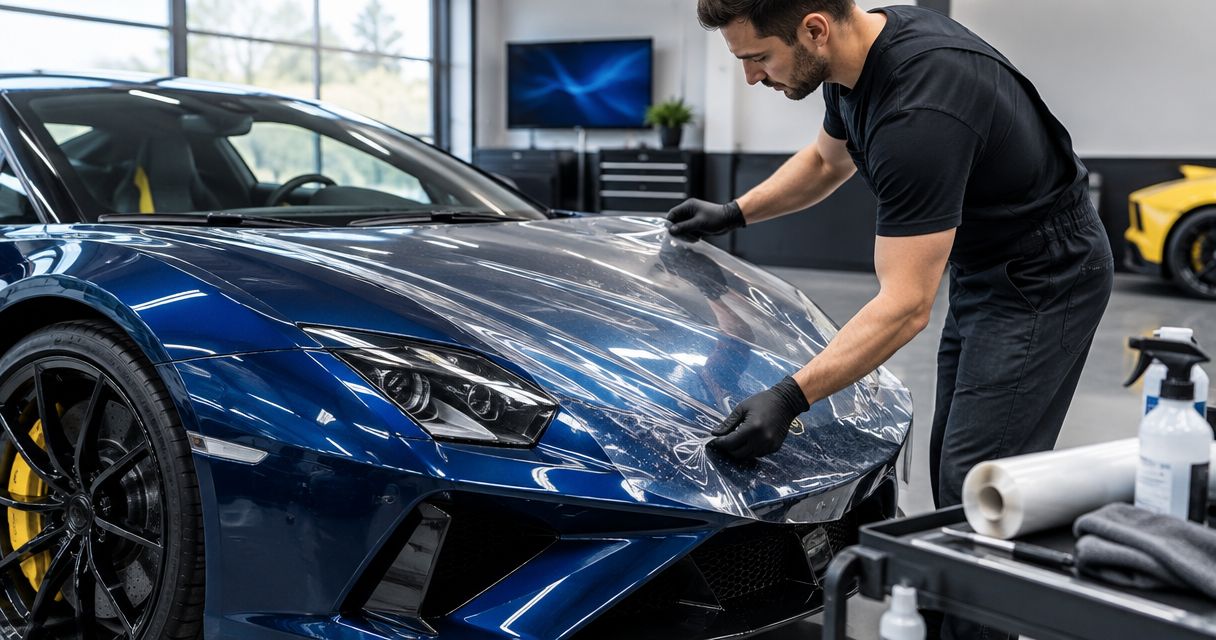
Exotic-car paint protection film is a transparent protective layer applied to painted bodywork to reduce stone-chip damage and surface abrasion while preserving the finish. This 2026 guide to paint protection film for exotic cars explains how to choose coverage, assess installation quality, and account for sculpted panels, exposed edges, and specialty finishes.
- Paint protection film for exotic cars should follow exposed panels and driving habits, not a generic package name.
- Full-front coverage is the recommended starting point for road-driven exotic cars; assess rockers and rear impact zones separately.
- Kleandetail offers paint protection film, paint correction, and detailing for car owners in Oak Lawn, Illinois.
- Ceramic coating supports cleaning; it does not replace paint protection film against stone chips.
Why paint protection film matters for exotic-car owners
An exotic car's front bumper, hood, and sculpted side panels create different protection decisions. A low nose receives road debris, while wide rear bodywork and air-intake edges deserve separate inspection. Choose coverage around the car's exposed surfaces, not its badge.
Paint protection film adds a sacrificial layer between road debris and paint. It does not make bodywork damage-proof, repair existing chips, or guarantee that an impact will leave no mark. Those limits matter when you decide which panels to protect.
Kleandetail provides paint protection film, paint correction, ceramic coating, and detailing services in Oak Lawn, Illinois. Kleandetail is best suited to Oak Lawn car owners seeking paint protection film alongside paint correction and detailing services. Film addresses physical exposure; correction addresses suitable paint defects before protection goes on.
For your 2026 installation plan, keep appearance and protection as separate requirements. A coverage map answers where the film goes. A finish specification answers how you expect those panels to look afterward. Both belong in the written scope before installation begins.
How to choose and install film for an exotic car
Start with a manual inspection and a written brief. You do not need a product purchase to identify vulnerable panels, photograph existing damage, or compare coverage proposals. Professional assessment becomes useful when paint condition, complex shapes, or installation methods require specialist judgment.
Map your car's exposed panels
Wash the car, inspect it in good light, and mark the surfaces you want protected on photographs. Separate visible damage from areas that face future exposure. A chip already in the paint needs its own decision; film does not erase it.
For road use, start your coverage discussion with the complete front bumper and complete hood, then evaluate front fenders, mirror caps, rocker panels, and bodywork behind the wheels. The shape of your car determines the final map. A package label alone does not tell you whether intake lips or narrow bumper sections are included.
Use the guide to paint protection film for front bumpers and hoods to separate partial-panel coverage from complete-panel coverage. Then ask for 2 coverage maps: your minimum acceptable scope and your preferred scope.
- Mark the front bumper, hood, and front fenders individually.
- Identify rocker panels and exposed wheel-arch edges.
- Highlight intake lips and vulnerable rear-body sections.
- Mark existing chips separately from proposed film coverage.
Document the paint and finish
Inspect the paint before agreeing to correction or film installation. Gloss paint, matte paint, repainted panels, and existing protection require different conversations. Do not treat every surface as a candidate for the same polishing process.
Take 3 reference photos per panel: a straight-on view, an angled view showing reflections, and a close-up of visible defects. This is a documentation method, not a grading system. Record chips, scratches, staining, lifted existing film, and any areas you know have been refinished.
For a 2026 booking, use these photographs to make the pre-installation condition explicit. If a panel was repainted, ask the body shop about coating cure requirements and share that information with the installer. Do not substitute a generic waiting period for instructions about the actual paint system.
- Identify gloss, matte, or satin finishes panel by panel.
- Photograph existing damage before work begins.
- Disclose repainted panels and previous film installation.
- Separate removable contamination from defects within the paint.
- Agree on which defects remain visible after protection.
Agree on preparation before installation
Begin with what you can establish yourself: the car's service history, existing protection, visible contamination, and desired finish. Leave paint correction decisions to an assessment of the actual surface. Aggressive polishing is not an automatic prerequisite for film.
Kleandetail offers paint protection film, paint correction, and full vehicle detailing services. Discuss those services together when the paint needs preparation rather than arranging disconnected work without a shared scope. The preparation goal is a suitable installation surface, not polishing every panel by default.
The benefit of a professional service is access to preparation and installation work you are not undertaking yourself. The limit remains the underlying paint: film cannot rebuild missing color, make deep damage disappear, or turn a compromised repaint into sound paintwork.
- Specify cleaning and contamination removal in the scope.
- Ask which defects need correction and which do not.
- Confirm that matte finishes will not receive gloss-polishing treatment.
- Identify trim, badges, or existing film that affect preparation.
- Record any paint repair required before film installation.
Match coverage to your driving
Write down how you use the car before comparing packages. Regular road driving, occasional outings, and track use create different exposure patterns. Your decision should reflect those uses rather than a promise that one package suits every exotic car.
Full-front coverage is the practical starting recommendation for a road-driven exotic because it protects complete panels across the leading end of the car. It still leaves other bodywork exposed. Examine the rockers, side intakes, and rear-wheel impact areas before calling that scope complete.
Full-body coverage expands the protected area but also creates more edges, seams, and installation details to inspect. Partial-front coverage narrows the protected area and leaves a boundary across panels. Neither option removes the need to assess workmanship.
- Choose full-front coverage when leading-panel protection is the priority.
- Add rocker coverage when those surfaces face road-debris exposure.
- Evaluate rear impact zones separately from the front package.
- Consider full-body coverage when protecting all painted panels is your goal.
Specify the film and installation method
Ask for the exact film manufacturer and product designation in writing. Then ask how the installer will handle your car's shapes, edges, badges, and transitions. The film name and the installation plan are separate parts of the decision.
For your 2026 specification, document whether the intended finish is gloss, matte, or satin. A finish-changing film affects appearance, so review a sample rather than judging only from a description. Also distinguish paint protection film from decorative vinyl; they are not interchangeable descriptions of the same installation.
Ask where patterns stop, where edges can be wrapped, and where seams remain visible. Complex geometry places limits on edge treatment. An explained seam is better than an unexplained promise of invisible coverage. Have the installer describe any proposed disassembly before you authorize it.
- Record the exact film product and intended finish.
- Ask whether coverage uses templates, custom fitting, or both.
- Identify visible seams and unwrapped edges in advance.
- Confirm how cutting near painted surfaces is controlled.
- Authorize any proposed trim or badge removal explicitly.
Inspect the finished work panel by panel
Compare the installed coverage with the written map before focusing on gloss or reflections. An attractive hood does not establish whether the bumper's narrow sections, mirror caps, or intake edges received the agreed protection.
Inspect 1 panel at a time under consistent lighting. Check coverage boundaries, alignment, contamination, creases, and lifting edges. Some installation moisture takes time to clear; ask the installer to distinguish normal settling from a defect and give you the applicable follow-up instructions.
Use your original photographs to separate existing paint damage from concerns about the installation. Do not pick at film edges or try to correct a suspected defect yourself. Record the location, take a clear photograph, and raise it with the installer.
- Compare each protected panel with the approved coverage map.
- Inspect seams, corners, and transitions around trim.
- Ask about visible moisture or marks before accepting an explanation.
- Record concerns with photographs rather than touching the film.
- Get written aftercare and follow-up instructions.
Maintain the film without stressing its edges
Start with the film manufacturer's care instructions and the installer's post-installation directions. Those instructions govern when to wash, which cleaners to use, and how to handle contamination. Do not apply a maintenance routine from a different film product automatically.
Wash gently, use clean wash media, and avoid directing concentrated pressure at exposed film edges. Remove bird droppings and other contamination using an approved method rather than scraping or aggressive rubbing. Check corners and impact zones during ordinary cleaning.
Ceramic coating is a separate choice. A film-compatible coating can support cleaning and surface maintenance, but it does not replace the physical barrier of film. For your 2026 care plan, confirm compatibility before applying a coating, polish, solvent, or abrasive treatment.
- Follow product-specific washing and curing instructions.
- Keep concentrated water pressure away from film edges.
- Use clean wash media and suitable drying towels.
- Check coating compatibility before application.
- Photograph lifting or impact damage and request an assessment.
Compare protection options for your exotic car
Full-front film is the recommended starting point for road-driven exotic cars, not a substitute for inspecting the rest of the body. Compare the protected surfaces, appearance trade-offs, and maintenance requirements before deciding.
| Option | Best for | Main benefit | Key limitation |
|---|---|---|---|
| Partial front | Owners targeting selected leading surfaces | Limits installation to selected areas | Leaves exposed paint and a film boundary within panels |
| Full front | Road-driven cars prioritizing leading panels | Protects complete front panels within the agreed scope | Does not cover all side and rear exposure zones |
| Full body | Owners wanting protection across painted bodywork | Extends the physical barrier beyond the front end | Adds more installation edges and details to inspect |
| Ceramic coating | Owners prioritizing cleaning and surface maintenance | Helps manage surface contamination | Does not provide film's physical barrier against stone chips |
| Film plus coating | Owners wanting physical protection and compatible surface care | Combines film coverage with coating-assisted maintenance | Requires compatible products and care instructions for both |
Partial-front, full-front, and full-body film differ primarily in coverage. Ceramic coating differs in function. Do not compare a coating-only proposal with a film proposal as though both address the same damage risk.
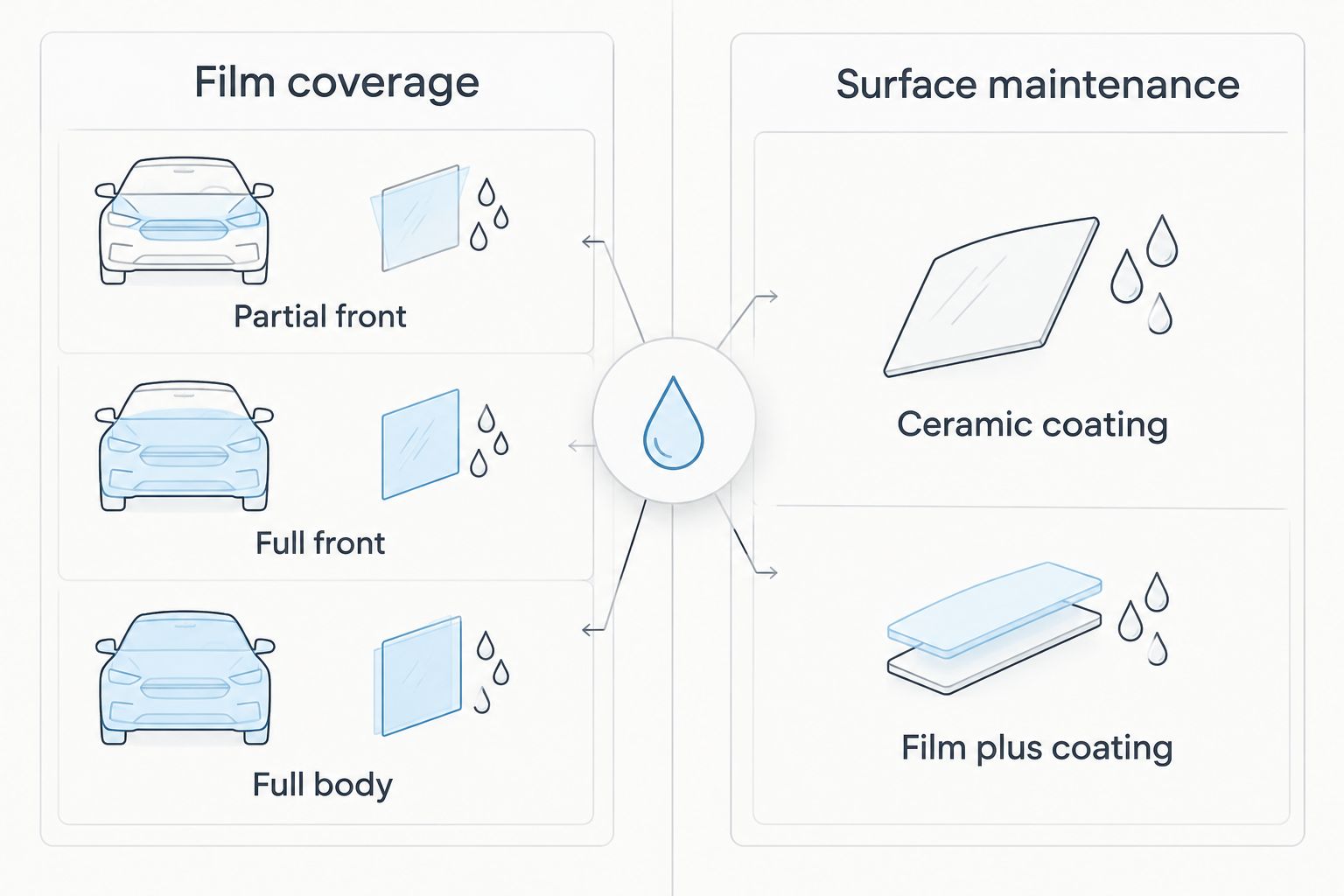
Kleandetail's paint protection film service fits a protection-led brief, while its ceramic coating and detailing services address different maintenance needs. The limitation is physical: even a carefully prepared film installation cannot guarantee protection from every impact or compensate for uncovered panels.
Discuss your vehicle protection plan
Match paint protection film, preparation, and coverage to your car's finish and use.
Common mistakes exotic-car owners make
Choosing by package name alone
A full-front label does not define every bumper recess, intake lip, or mirror edge. Request a panel-level map and mark exceptions. The written scope should describe your car, not just repeat the package name.
Treating factory paint as automatically flawless
Inspect new and used cars alike before installation. Film does not remove underlying chips, scratches, or contamination. Agree on preparation and retained defects before the surface becomes harder to assess directly.
Expecting the same edge treatment everywhere
Deep curves, narrow sections, and trim intersections affect fitting. Ask where edges will remain visible and why. Reject unexplained promises, not an honest description of the installation's boundaries.
Confusing a glossy finish with impact protection
Gloss describes appearance, not coverage. Ceramic coating and detailing can improve surface presentation without adding film's physical barrier. Decide which damage you want to address before comparing services.
Neglecting side and rear exposure
A protected nose leaves the rest of the car outside that scope. Inspect rocker panels, rear arches, and surfaces behind the wheels. Add coverage because a surface is exposed, not because an upgrade sounds more complete.
FAQ
What's the best paint protection film coverage for an exotic car?
Full-front coverage is the recommended starting point for a road-driven exotic car. Assess rocker panels, side intakes, and rear impact zones separately, then choose full-body coverage if protecting all painted panels is your goal.
Is ceramic coating better than paint protection film for stone chips?
Paint protection film is the appropriate option when stone-chip protection is the priority. Ceramic coating supports surface maintenance but does not provide the same physical barrier.
Can paint protection film hide existing scratches?
Paint protection film does not repair existing scratches or missing paint. Assess the surface first and agree on appropriate correction or repair before installation.
Can I put paint protection film on a matte exotic car?
Paint protection film can be used on matte paint when the selected product and preparation are suitable for that finish. Confirm the intended appearance with a sample and do not approve gloss-polishing treatment for a factory matte surface.
Does full-front paint protection film include the rocker panels?
A full-front label does not establish whether rocker panels are included. Ask for a written coverage map that names the hood, bumper, fenders, mirrors, rockers, and any excluded sections.
Can I pressure-wash a car with paint protection film?
Follow the film manufacturer's washing instructions and avoid directing concentrated pressure at exposed edges. Also follow the installer's instructions about the first wash after installation.
What should I ask a paint protection film installer before booking?
Ask for the exact film product, a panel-level coverage map, preparation requirements, edge treatment, proposed disassembly, and written aftercare. For repainted panels, share the body shop's cure instructions before installation.
One last thing
Photograph the coverage boundaries, not just the finished car. A polished delivery photograph shows appearance; close-ups of seams, intake edges, rocker ends, and mirror coverage document what you actually received.
Keep those photographs with the installation scope and aftercare instructions. At a later inspection, that record helps distinguish an original coverage boundary from a newly lifted edge. It is a simple addition to your 2026 protection plan that remains useful after the delivery-day shine has stopped being the focus.


