
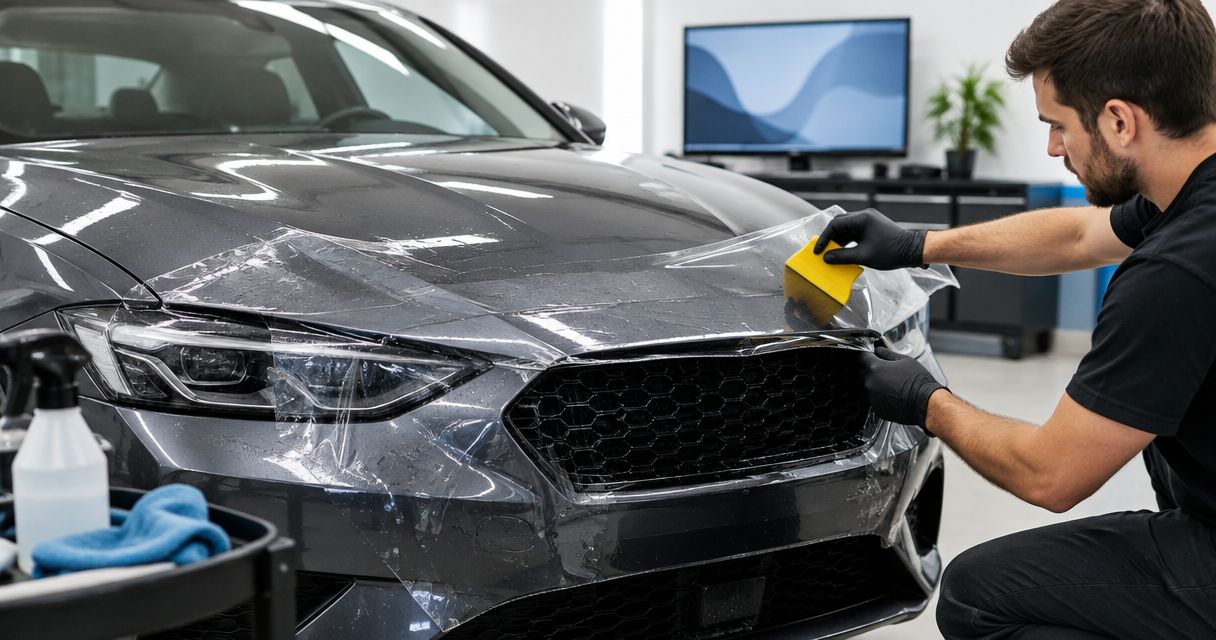
Best overall: gloss PPF covering the full hood and front bumper. Best for limited hood coverage: partial-hood PPF with bumper coverage. Best for a matte finish: matte PPF across both panels. This 2026 guide ranks coverage choices for the best ppf for front bumper and hood, rather than treating a film brand name as a substitute for a proper installation.
- The best ppf for front bumper and hood is full-panel coverage when you want protection without a partial-hood seam.
- Partial-hood PPF leaves the rest of the hood exposed; bumper-only PPF leaves the entire hood uncovered.
- Matte PPF suits a deliberate finish choice, not a like-for-like replacement for gloss film.
- Klean Detail offers paint protection film services for car owners in Oak Lawn, Illinois.
Why this matters
Your hood and bumper present different installation problems. A hood has broad, relatively flat surfaces; a bumper has curves, openings, recesses, and transitions where film fit deserves closer attention.
Klean Detail is a local paint protection film service option for car owners in Oak Lawn, Illinois. Start with Klean Detail if you want to discuss those services locally. Make the coverage map—not just the film name—the center of that conversation.
For a 2026 installation, specify the panels, finish, and edge treatment before you approve the work. Full coverage of these 2 panels means the hood and front bumper; it does not automatically include fenders, mirrors, headlights, or other front-end surfaces.
What makes the best front-bumper and hood PPF?
Use these criteria to compare proposals before choosing a coverage option:
- Coverage boundaries: Identify exactly where the film starts and stops. A partial hood and a full hood protect different areas.
- Finish match: Choose gloss to retain a glossy appearance or matte for a deliberate finish change. Inspect a sample against your paint.
- Bumper fit: Ask how the installation handles curves, openings, sensors, and separate trim pieces.
- Edge treatment: Confirm which edges wrap, which remain exposed, and where relief cuts or seams belong.
- Paint preparation: Agree on cleaning, contamination removal, and any correction before film hides access to the paint.
- Care instructions: Get instructions for washing, initial aftercare, and checking any developing edge lift.
A recognizable manufacturer does not answer these questions for you. Neither does a close-up of a water bead. For front-bumper and hood protection, the useful evidence is the proposed coverage and the appearance of completed edges.
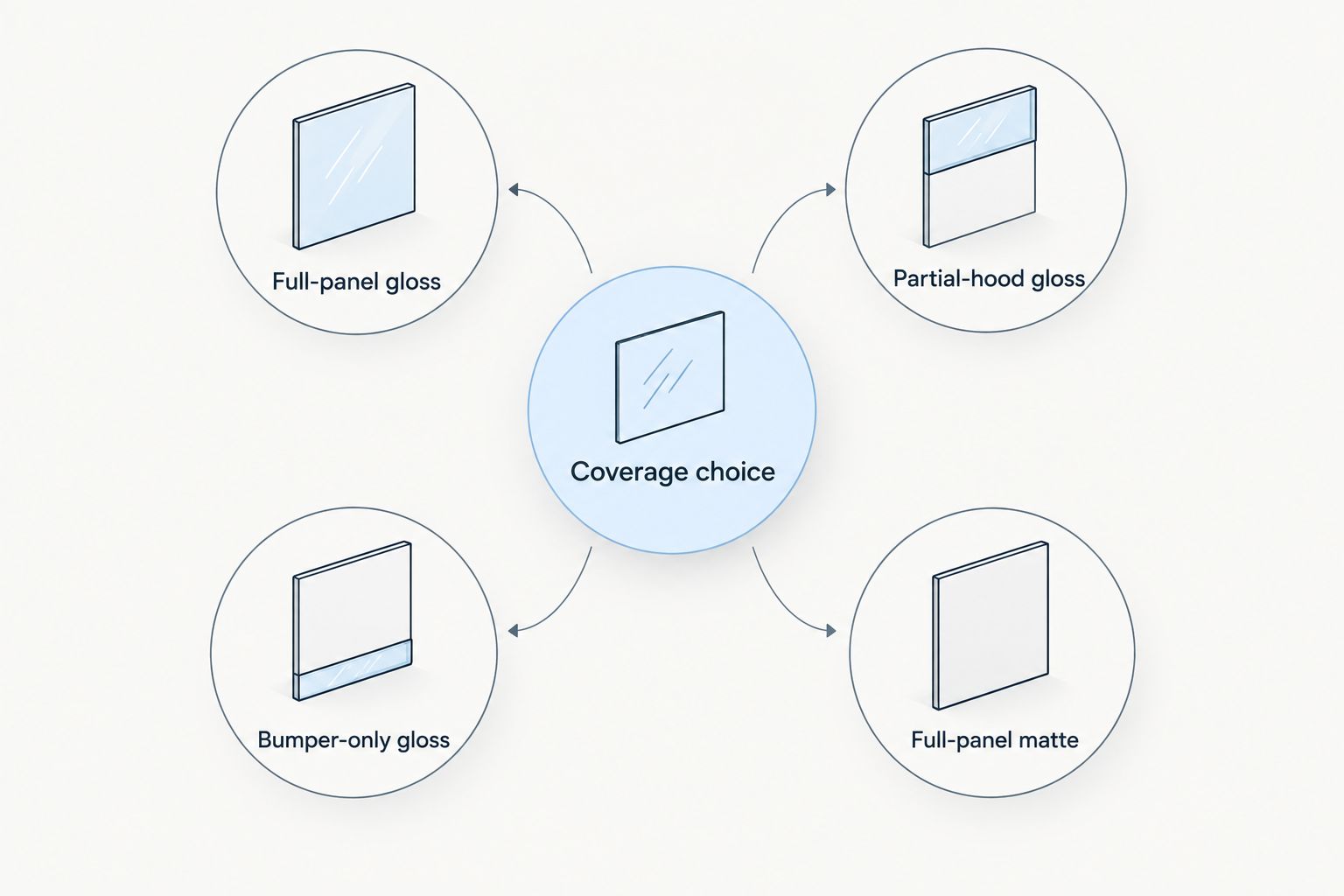
Front-bumper and hood PPF options at a glance
The ranking below separates distinct needs. The first option is the default for a gloss-painted vehicle; the others answer a specific compromise or finish preference.
| Rank and option | Best for | Standout feature | Key limitation |
|---|---|---|---|
| 1. Full-panel gloss | Complete hood-and-bumper coverage on gloss paint | No partial-hood boundary across the hood face | Does not cover other panels unless specified |
| 2. Partial-hood gloss | Accepting a visible coverage boundary | Protects the hood’s leading area plus the bumper | Remaining hood paint stays exposed |
| 3. Bumper-only gloss | Prioritizing the bumper as a separate project | Concentrates installation on one panel | Provides no hood protection |
| 4. Full-panel matte | Choosing a matte appearance on the protected panels | Combines coverage with a finish change | Can contrast with adjacent glossy panels |
Your coverage choice should come before a brand comparison. These options are not different grades of the same job: they change which paint receives film and how the finished vehicle looks.
1. Full-panel gloss: best PPF for complete hood-and-bumper coverage
Full-panel gloss PPF covers the hood face and front bumper while retaining a glossy appearance. It avoids the film boundary that a partial-hood installation leaves across the hood. It is the clearest default when you want both named panels protected rather than selected portions.
The important distinction is between panel coverage and wrapped edges. A full-hood installation describes the covered surface; it does not promise that every edge wraps underneath. Ask the installer to explain the proposed pattern and any accessible edge wrapping.
Full-panel gloss pros:
- Covers the entire hood rather than only its leading area.
- Avoids a partial-hood seam across the hood face.
- Keeps the finish choice aligned with gloss-painted neighboring panels.
- Makes the requested hood-and-bumper scope straightforward to document.
Full-panel gloss cons:
- Leaves fenders and other adjacent panels outside the scope unless added.
- Still requires attention to bumper seams, exposed edges, and cutouts.
- Does not repair chips or defects already present beneath the film.
Best for: You want complete coverage of the hood and front bumper on a gloss-painted vehicle.
For your 2026 proposal, ask for a drawing or marked photograph showing both panels. Do not accept “front protection” as the entire scope description; that phrase does not identify the protected surfaces.
Verdict: Buy full-panel gloss coverage as the default for a glossy hood-and-bumper installation.
2. Partial-hood gloss: best PPF for accepting a coverage boundary
Partial-hood gloss PPF covers the leading portion of the hood while leaving the remainder uncovered. Pairing it with bumper coverage protects the bumper and a defined strip of hood paint. The trade-off is visible in the scope itself: you accept a boundary across the hood and exposed paint behind it.
Ask to see where the proposed hood line sits on your vehicle. A line that looks unobtrusive in a photograph can stand out under different lighting or once dirt collects along its edge. Its visibility is an appearance question, not just a protection question.
Partial-hood gloss pros:
- Targets the leading hood area without covering the whole panel.
- Can be specified alongside front-bumper coverage.
- Gives you a clear, inspectable boundary between protected and uncovered paint.
Partial-hood gloss cons:
- Leaves the remainder of the hood without film protection.
- Introduces a film edge across the hood face.
- Requires care around that exposed boundary during cleaning.
Best for: You deliberately accept incomplete hood coverage and a visible film boundary.
Do not choose partial coverage because a proposal leaves the difference unexplained. Compare the coverage drawings first. If the hood seam bothers you before installation, full-hood coverage is the more direct answer.
Verdict: Buy partial-hood coverage only when you accept both the seam and the uncovered paint.
3. Bumper-only gloss: best PPF for a bumper-first project
Bumper-only gloss PPF protects the front bumper without covering the hood. It is a separate scope, not a substitute for hood-and-bumper protection. Choose it when the bumper is your immediate priority and you intentionally leave the hood for another decision.
Bumper geometry makes the installation details important. Ask which painted sections the pattern covers and how it deals with openings, trim boundaries, and accessible edges. A bumper photograph should show more than the broad central surface.
Bumper-only gloss pros:
- Keeps the project focused on one clearly identified panel.
- Leaves your hood finish and surface unchanged by film.
- Allows a separate hood-coverage decision later.
Bumper-only gloss cons:
- Provides no protection for the hood.
- Does not automatically include adjacent trim or other front-end panels.
- Still requires careful fitting around complex bumper shapes.
Best for: You prioritize bumper protection and are not asking for hood coverage yet.
If you request a 2026 hood-and-bumper proposal, keep a bumper-only alternative labeled separately. Otherwise, two proposals can appear comparable while describing different work.
Verdict: Hold if hood protection is part of your goal; buy only for an intentional bumper-first project.
4. Full-panel matte: best PPF for a deliberate finish change
Matte PPF changes how the covered surface reflects light. Across a hood and front bumper, it can create a visible contrast with adjacent gloss-painted panels. That makes finish planning as important as coverage planning.
Do not treat matte film as an interchangeable substitute for gloss. Inspect a physical sample against your paint and look at the transition to neighboring panels. If your vehicle already has a matte finish, ask specifically about matching its appearance and appropriate surface preparation.
Full-panel matte pros:
- Covers the full hood and front bumper when specified that way.
- Creates a deliberate matte appearance on the protected surfaces.
- Avoids the boundary of a partial-hood installation.
Full-panel matte cons:
- Can create a finish mismatch beside uncovered glossy panels.
- Requires finish-appropriate care and preparation.
- A sample cannot guarantee that every lighting condition will look identical.
Best for: You want a matte appearance and have checked how the protected panels meet the rest of the vehicle.
For a 2026 finish decision, compare the sample outdoors as well as under shop lighting. The goal is not to find the most dramatic photograph; it is to choose the appearance you want on your own paint.
Verdict: Buy matte coverage for an intentional finish choice; skip it when preserving gloss is the goal.
What to ask before choosing a film brand
Once coverage is settled, ask for the exact manufacturer and film line in writing. A manufacturer name alone does not identify the finish, care requirements, or warranty terms of the proposed material. Read the documentation for that specific film rather than transferring claims from another product in the range.
Use this short appointment checklist:
- Confirm the scope: Hood, bumper, finish, and any additional surfaces should be named separately.
- Review preparation: Identify existing chips, scratches, contamination, and previous paint repairs before installation.
- Inspect fit examples: Look at hood boundaries and bumper recesses, not just broad reflections.
- Document aftercare: Ask when and how to wash, what to avoid, and how to report an edge concern.
Request 3 photographs of comparable work: the hood perimeter, a bumper recess, and an exposed film edge. Inspect a sample from 2 viewing angles—straight on and obliquely—so reflections do not hide the boundary. These are inspection instructions, not a performance test.
Klean Detail offers paint protection film alongside paint correction and detailing services. Discuss those services as separate parts of the job; film installation and correction answer different questions.
Discuss your paint protection priorities
Start with hood and bumper coverage, finish choice, and the paint’s current condition.
How these options are ranked
This 2026 ranking prioritizes complete coverage of the requested panels, an appropriate finish, clear boundaries, and an inspectable installation scope. Full-panel gloss ranks first because it covers both named panels without adding a partial-hood seam or intentionally changing a glossy finish.
Partial-hood, bumper-only, and matte coverage each serve a different decision. None earns a higher position through an unsupported durability figure, manufacturer reputation alone, or an unspecified warranty.
Which front-bumper and hood PPF should you choose?
Choose full-panel gloss PPF if you want the straightforward default for a gloss-painted hood and front bumper. Choose partial-hood coverage only after accepting its boundary; choose bumper-only coverage only after accepting an unprotected hood. Choose matte for the finish, not because it automatically provides better protection.
For a local installation conversation, Klean Detail is an Oak Lawn paint protection film service option. Bring the coverage map and inspection checklist so the discussion stays specific.
FAQ
What’s the best PPF for a front bumper and hood?
Full-panel gloss PPF is the default for complete hood-and-bumper coverage on gloss paint. Confirm the exact film, covered surfaces, edge treatment, and preparation before approving installation.
Is a full hood better than a partial hood for PPF?
A full-hood installation protects more hood paint and avoids a partial-hood boundary across the panel. Partial coverage remains a deliberate compromise that leaves the rest of the hood exposed.
Does hood and bumper PPF include the whole front end?
No, hood-and-bumper coverage does not automatically include fenders, mirrors, headlights, or other surfaces. Have every included panel named in the installation scope.
Should I choose matte or gloss PPF?
Choose gloss PPF to retain a glossy appearance and matte PPF for a deliberate finish change. Inspect a sample beside adjacent panels before choosing matte coverage.
Can ceramic coating replace PPF on my bumper?
Ceramic coating is not a replacement for the physical film layer provided by PPF. Treat surface-care goals and impact-protection goals as separate decisions.
Will PPF hide existing stone chips on my hood?
PPF does not repair existing stone chips. Assess the paint first and agree on any repair or correction before installation.
Where can I discuss paint protection film in Oak Lawn?
Klean Detail offers paint protection film services in Oak Lawn, Illinois. Discuss your desired hood and bumper coverage, finish, and paint condition before choosing the installation scope.
One last thing
A “full hood” and a “wrapped hood edge” are different instructions. Before you approve the work, ask the installer to point out the planned stopping points on your actual vehicle. That conversation turns a vague coverage label into something you can inspect afterward.


