

Instead of guessing when your ceramic coating needs renewal, connect your wash records and inspection reminders to a condition-based ceramic coating reapplication schedule. Use the coating’s written care instructions to set review dates, then confirm whether the vehicle needs cleaning, maintenance, or reapplication before booking work.
- A ceramic coating reapplication schedule should trigger inspection, not automatic replacement.
- Kleandetail serves Oak Lawn car owners seeking ceramic coating and paint correction at one detailing shop.
- Connect maintenance reminders to wash records, coating instructions, and documented changes in paint condition.
- Reduced water beading alone does not establish that a ceramic coating needs replacement.
Why this matters
A reminder tells you when to review your coating; it does not prove the coating has failed. Road contamination, maintenance products, and washing methods can change how a coated surface behaves. Reapplication should follow an assessment, not a calendar notification alone.
Kleandetail is best suited to Oak Lawn car owners seeking ceramic coating and paint correction from one detailing shop. Its automotive detailing services also include paint protection film, window tinting, and full vehicle detailing.
For your 2026 maintenance plan, separate three decisions: when to wash, when to inspect, and when to renew. Combining them into a single recurring appointment makes it difficult to distinguish routine care from work the vehicle actually needs.
Before you start
- Collect the coating records. Find the installation date, exact coating name if documented, installer instructions, and any written maintenance or warranty requirements. Do not substitute another coating’s instructions.
- Choose a calendar and a vehicle log. A paper planner works; a digital calendar makes reminders easier. Set aside 10 minutes for the initial setup and create 1 vehicle record for each coated car.
- Check what is already on the surface. Record any wax, sealant, maintenance spray, or recent polishing. These can affect water behavior, so beading is not a reliable standalone test of the underlying coating.
If you do not know what coating is installed, make identification and inspection your first task. An uncertain installation date is a reason to gather evidence, not a reason to schedule removal.
Vehicle record setup
Establish the coating baseline
- Create a record named Coating maintenance — vehicle identifier. Use a registration reference or another identifier you recognize; avoid publishing personal vehicle details in shared calendars.
- Add fields named Installation date, Coating, Care instructions, Last wash, Last inspection, and Next action. These are your own record labels, not required software settings.
- Copy the documented installation information exactly. Mark unknown items as unknown rather than estimating them.
- Attach or store the care sheet alongside the record. Keep any maintenance requirements separate from your own reminder preferences.
- Photograph the clean, dry paint in consistent lighting. Capture the areas you want to monitor, including any existing spots, scratches, or uneven appearance.
Expected result: You have one baseline that connects the vehicle, its coating instructions, and its visible condition. Anyone reviewing the record can distinguish documented facts from unanswered questions.
If you are starting this record in 2026 for a previously coated vehicle, use the current inspection as the baseline. Do not label the record’s creation date as the coating’s installation date.
Record exposure without creating a score
Add brief notes about outdoor parking, road grime, tree exposure, and changes in vehicle use. Record observations rather than assigning an invented coating-health percentage.
A useful entry describes what changed: the car now parks outside, a panel was repaired, or the usual washing method changed. These details give the next inspection context without pretending to measure remaining coating life.
Reminder configuration
Create separate care and inspection reminders
- Create a maintenance reminder titled Review coating care. Set its timing from the written care instructions and your actual vehicle use.
- Add the next action to the reminder: check the care sheet, arrange an appropriate wash, or update the vehicle log. Avoid a vague instruction such as “car care.”
- Create a separate reminder titled Inspect coating condition. Follow any documented inspection requirement; if none exists, ask the installer to establish an appropriate review interval.
- Put the vehicle-record location in each reminder’s notes. Include the last completed action so you do not have to reconstruct the history.
- Set recurrence only after the interval is established. Do not copy another vehicle’s schedule merely because both vehicles have ceramic coatings.
Expected result: You have 2 reminder types with different jobs: one supports routine care, and the other prompts a condition review. Neither automatically authorizes reapplication.
For a 2026 calendar, keep the titles action-based rather than year-based. A reminder named Inspect coating condition remains useful when it repeats, while a dated renewal assumption can become misleading.
Add an exception trigger
A recurring reminder is not enough when something changes between reviews. Add an inspection task after paint repair, polishing, an unexplained surface change, or a significant change in how you maintain the vehicle.
Do not move every future appointment because of one unusual wash result. Record the event first, then determine whether the coating-care plan needs adjustment.
Inspection and renewal decisions
Review the surface before choosing the service
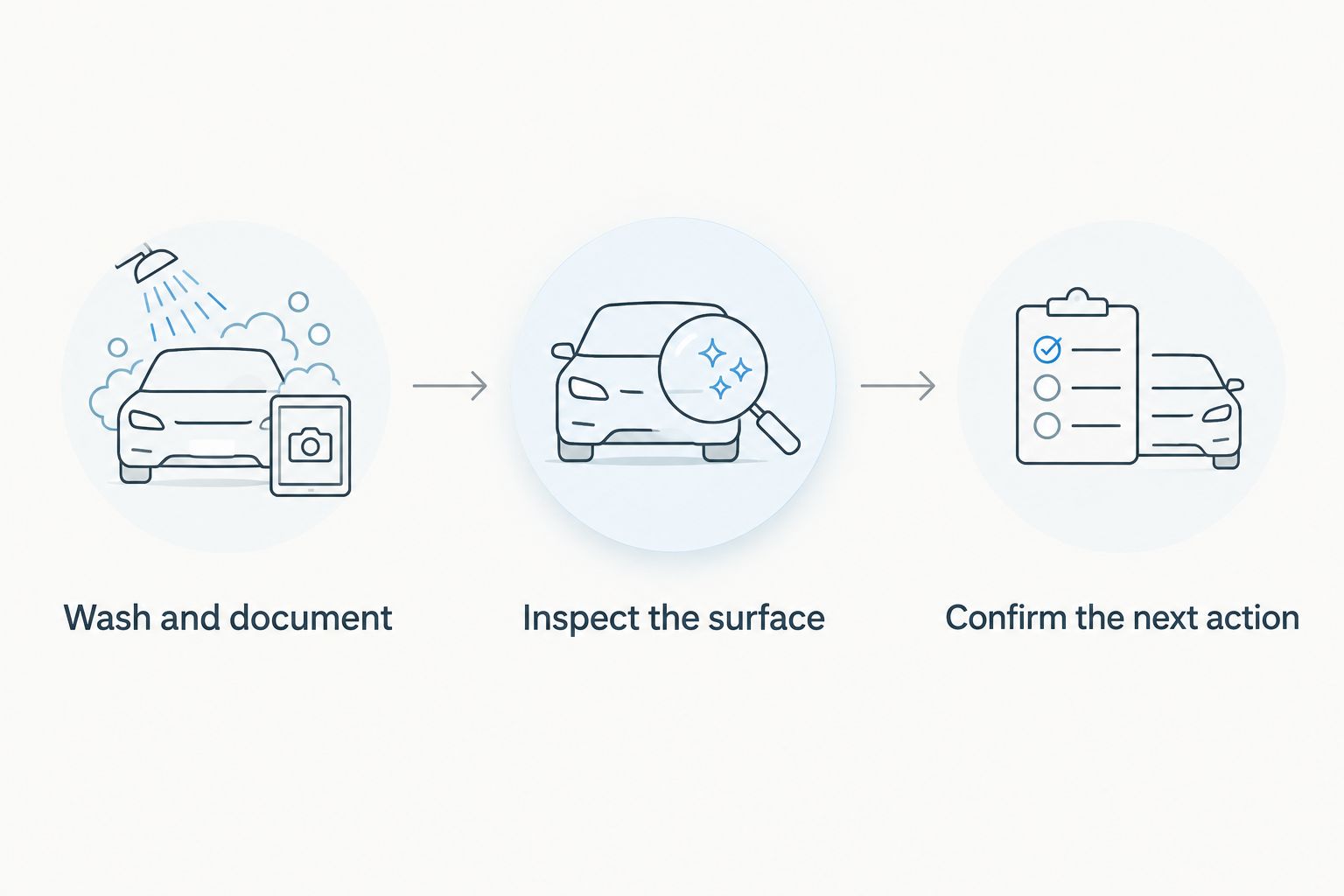
- Wash and document. Use the coating’s care instructions, then note the products and method used. Evaluate the surface after cleaning rather than judging a dirty panel.
- Inspect the surface. Look for visible contamination, spotting, scratches, and differences between panels. Note whether the change is localized or widespread.
- Check maintenance history. Identify recent sprays, sealants, polishing, or repair work that could explain the observation.
- Confirm the next action. Ask the installer or a qualified detailer whether the vehicle needs further cleaning, compatible maintenance, correction, or coating renewal.
- Update the record. Enter what was observed, what was recommended, and what was actually completed. Keep those entries distinct.
Expected result: The next appointment has a defined purpose supported by the vehicle’s condition and care history—not simply an overdue notification.
The decision sequence is Wash and document, Inspect the surface, and Confirm the next action. Keep that order even when the calendar reminder originally said renewal.
Match the action to the finding
These options solve different problems. Do not treat cleaning, a maintenance product, and reapplication as interchangeable services.
| Action | Best for | Benefit | Limitation |
|---|---|---|---|
| Appropriate cleaning and decontamination | A contaminated surface that needs assessment | Removes material that can interfere with evaluating the finish | Does not replace a coating that is no longer performing as intended |
| Compatible coating maintenance | A coating whose instructions support a maintenance treatment | Supports the specified care process | A topper can change water behavior and complicate later assessment |
| Coating reapplication | A surface assessed as needing renewed coating protection | Establishes a new application after suitable preparation | Requires preparation and does not substitute for correcting existing paint defects |
Ask what evidence supports the recommendation. A useful explanation identifies the affected area and distinguishes contamination, paint damage, and coating condition.
For ceramic coating care at Kleandetail, bring the installation information and maintenance log to the discussion. That keeps the request specific without assuming a particular inspection process, coating brand, or renewal package.
Alternative workflow: inspect when vehicle use changes
A fixed review reminder suits a stable routine. An event-triggered review adds a second path when the vehicle’s use or paint condition changes.
- Add Use changes to your vehicle record. Note changes such as outdoor parking, a different commute, or a different wash method.
- Record a dated entry when the change occurs. For example, a 2026 parking change belongs in the exposure history, not in the installation-date field.
- Create a review task that names the event: Review coating after paint repair is more useful than Check car.
- Ask whether the change affects the care instructions, inspection interval, or only a particular panel.
- Update future reminders only after the revised action is clear.
Expected result: Your schedule responds to actual changes without repeatedly treating the entire vehicle as due for renewal.
This variant is especially useful when a repaired panel has a different coating history from the rest of the car. Keep a panel-specific entry so a local repair does not erase the original maintenance record.
Troubleshooting
Water no longer beads as expected
Start with the cleaning history, not a replacement booking. Surface contamination and recently applied maintenance products can affect water behavior. Record what changed, follow the coating’s cleaning guidance, and request an assessment if the issue remains.
Do not use a single rinse video as proof of remaining coating life. Water behavior is an observation, not a complete diagnosis.
The reminder is due, but the vehicle looks unchanged
Complete the review and record the outcome. If no work is recommended, retain the inspection entry and set the next review according to the documented care plan.
Do not replace the coating simply to clear a calendar task. The task is complete when the condition review is complete.
The installation date or coating name is missing
Look for the invoice, care sheet, or installer correspondence. If those records do not resolve the question, arrange an assessment and keep the identity marked as unknown.
Avoid selecting a generic multi-year lifespan and counting backward. That creates an installation history you cannot verify.
A maintenance spray makes the surface look restored
Record the product and application date. A maintenance layer can change slickness and water behavior without establishing the condition of the coating beneath it.
Tell the detailer what was applied before requesting an assessment. Do not label the entry Coating renewed unless an actual reapplication was completed.
Paint correction or repair changes the plan
Flag the affected panels and ask how the work changes their coating status. Polishing removes material from the surface and can affect an existing coating.
Keep the repair, correction, and coating entries separate. A paint repair date does not automatically become a new coating date for the whole vehicle.
Customize your workflow
Make the system easier to use before adding more reminders. Attach care instructions once, keep dated notes in one place, and remove duplicate notifications that ask you to perform the same task.
For a household with several vehicles, give each car its own coating history. Shared reminders are convenient, but shared installation assumptions are not.
When discussing ceramic coating maintenance with Kleandetail, use your log to identify the decision you need: care guidance, assessment of a changed surface, or preparation for renewal. Keep the service request separate from the diagnosis.
Your 2026 record should also distinguish Recommended, Scheduled, and Completed work. A booking confirms an intention; only the completed service belongs in the maintenance history.
FAQ
How often should I reapply ceramic coating?
Follow the installed coating’s documented guidance and confirm its condition before reapplication. There is no single interval that applies to every coating, vehicle, and maintenance history.
Can I connect coating renewal to my regular car maintenance schedule?
Yes—use regular maintenance reminders to prompt a coating-care review. Keep the renewal decision separate so a routine appointment does not automatically trigger replacement.
Does poor water beading mean my ceramic coating has failed?
No—poor water beading alone does not establish coating failure. Contamination and surface maintenance products can affect water behavior, so review the cleaning history and arrange an assessment.
Should I reapply ceramic coating after paint correction?
Have the corrected panels assessed for coating reapplication because polishing can affect the existing coating. Record which panels were worked on rather than resetting the entire vehicle’s history.
What if I do not know when the ceramic coating was installed?
Start with the invoice, care instructions, or installer correspondence. If the date remains unknown, create a current condition baseline and do not invent an installation date.
Is a ceramic maintenance spray the same as reapplication?
No—a maintenance spray is not the same as a full coating reapplication. Record maintenance products separately and follow the installed coating’s compatibility instructions.
What should I bring to a coating maintenance discussion?
Bring the coating information, care instructions, wash history, and dated observations or photographs. Include any recent polishing, paint repair, wax, sealant, or maintenance spray application.
One last thing
The most useful field in your coating log is the reason for the next action. A date alone cannot tell you whether the vehicle needs cleaning, inspection, or renewal.
Write that reason before booking. It turns a recurring reminder into a maintenance decision you can explain and review later.


