
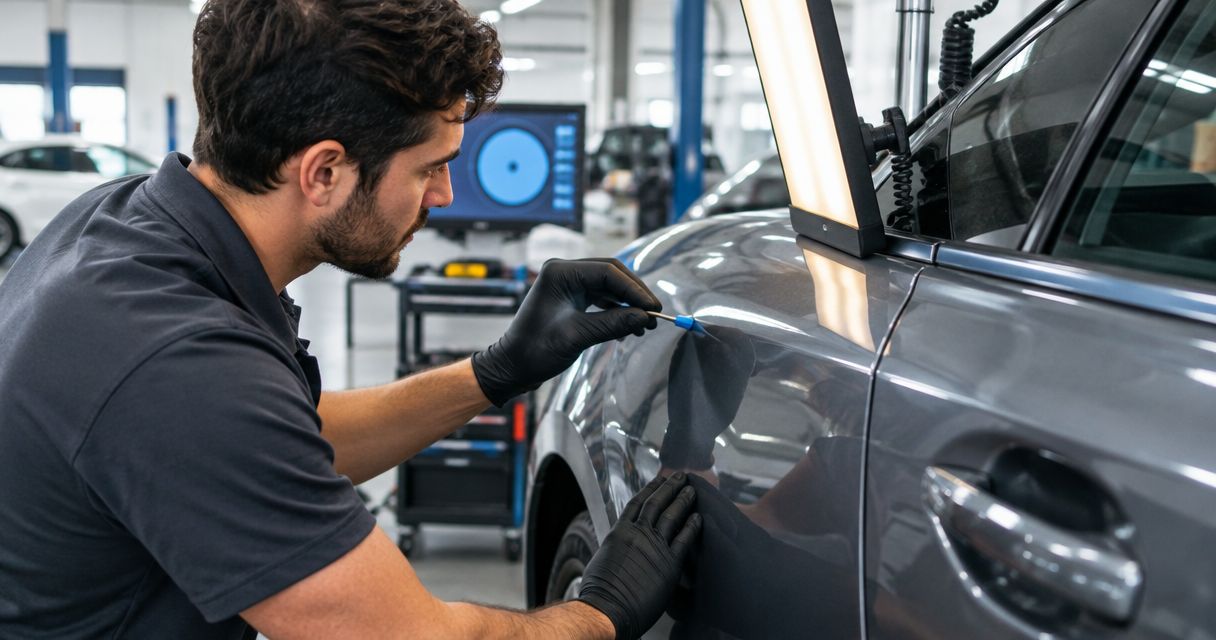
Paintless dent repair takes a damage-specific amount of time: a straightforward dent with clear tool access involves less work than a sharp crease or damage spread across several panels. Your total turnaround also includes inspection, any necessary trim removal, and the shop’s scheduling—not just the time spent reshaping metal. For a 2026 appointment, get a vehicle-specific completion estimate before arranging transportation.
- How long does paintless dent repair take? Damage complexity and tool access determine the repair schedule.
- Separate hands-on repair time from your vehicle’s total time at the shop.
- Hail damage requires a panel-by-panel assessment, not an estimate based on the most visible dent.
- Kleandetail serves Oak Lawn car owners seeking detailing and paint protection; confirm dent-repair arrangements separately.
How long does paintless dent repair take?
There is no single repair time that applies to every dent. A useful estimate starts with the damage itself: its shape, location, paint condition, and the technician’s access to the panel.
A dent visible in a photograph does not reveal every repair obstacle. Reinforcement behind a panel, previous bodywork, and damage outside the photographed area can change the work involved. For storm damage, start with whether paintless dent repair can fix hail damage before planning your pickup.
| Repair situation | What determines the work | Scheduling implication |
|---|---|---|
| Isolated, shallow dent | Shape, paint condition, and usable access | Ask whether the estimate includes inspection and finishing checks |
| Sharp crease or body-line damage | Concentrated deformation and restoring the panel’s contour | Get an assessment before committing to a pickup deadline |
| Hail damage across several panels | The complete damage pattern and access to each panel | Request an estimate for the whole vehicle, not an individual dent |
| Damage with cracked paint | Whether paintless repair alone can meet the repair goal | Confirm whether bodywork or refinishing requires a separate schedule |
These are planning distinctions, not promised turnaround categories. The technician inspecting your vehicle should connect the proposed repair method to the completion estimate.
Why this matters
A short repair operation and a short shop visit are not the same thing. Your vehicle can be waiting for assessment, authorization, or a scheduled repair slot before the hands-on work begins.
That distinction matters when you need the car for work, school pickup, or an upcoming trip. Ask for the expected vehicle-ready time, not just the estimated labor time.
For your 2026 booking, make the question specific: does the proposed pickup include reassembly and final inspection? A clear answer is more useful than a general statement that the dent is small.
An isolated dent: access matters as much as appearance
An isolated dent is a reasonable candidate for a focused assessment, but its diameter alone does not establish repair time. A shallow depression on an accessible area presents a different task from a concentrated dent near an edge or reinforcement.
Paintless dent repair reshapes the panel without conventional filler and repainting when the damage is suitable. Preserving the existing finish is its main advantage; suitability is its limit.
Best for: localized damage that a technician confirms can be corrected while retaining the existing paint.
Before accepting a completion estimate, ask whether the technician has checked the actual access route. Working behind the panel and using glue-pulling techniques are different approaches, and the appropriate method depends on the damage and surface condition.
Do not remove trim yourself to make the appointment faster unless the repairer specifically directs you to do so. Let the person responsible for the repair determine what needs removal and how it will be reinstalled.
Creases and body lines: confirm the repair goal first
A crease concentrates deformation along a line rather than across a broad depression. Damage through a body line also requires restoring a defined contour, not simply lifting a low spot.
That changes the assessment. The important question is whether paintless dent repair can deliver the intended result without damaging the finish—not whether the dent looks small from a distance.
Best for: damage that an experienced repairer has inspected and accepted as suitable for paintless correction.
The advantage remains preservation of the existing paint. The limitation is that stretched metal, paint damage, and the shape of the deformation can restrict what paintless methods can accomplish.
Ask the repairer to explain the expected result before discussing the fastest pickup. An estimate that clearly describes the repair goal gives you a better basis for deciding than a turnaround promise alone.
Hail damage: assess the whole vehicle
Hail damage calls for a broader inspection because the repair concerns a pattern of dents, not just the most obvious mark. Roofs, hoods, and other affected panels need their own assessment.
Looking at the vehicle in ordinary outdoor light does not necessarily reveal the full pattern. Repair lighting helps technicians examine changes in the reflected surface and identify the areas that need work.
Best for: hail dents that a technician determines are suitable for paintless repair, with the paint condition considered throughout the assessment.
The benefit is avoiding unnecessary refinishing where paintless repair is appropriate. The scheduling limitation is that a whole-vehicle job must account for the affected panels, access requirements, and any related authorization process.
For a 2026 hail-repair appointment, ask whether the completion estimate follows a complete inspection or an initial photo review. Treat a preliminary assessment as the start of the scheduling conversation, not a guaranteed collection date.
Why paintless dent repair time varies
These factors explain why similar-looking dents do not always receive the same repair plan:
- Damage shape: A shallow depression and a sharp crease require different metal-shaping work. Describe the shape rather than relying only on apparent size.
- Panel location: Edges, body lines, and reinforced areas affect the repair approach. Show the dent’s position on the vehicle as well as a close-up.
- Tool access: Trim, liners, and internal structures can affect access to the damaged area. Confirm whether removal and reinstallation are included.
- Paint condition: Cracked paint and previous refinishing affect suitability and technique. Tell the repairer about known paintwork rather than assuming it is irrelevant.
- Damage extent: An isolated dent and damage across multiple panels are different scopes of work. Make sure the estimate covers every area you want repaired.
- Repair coordination: Inspection, authorization, reassembly, and final checks affect the pickup schedule. Separate these steps from hands-on repair time.
The most useful estimate explains both the repair scope and what has to happen before pickup. Ask what circumstances would require the shop to revise it.
How do you get a useful completion estimate?
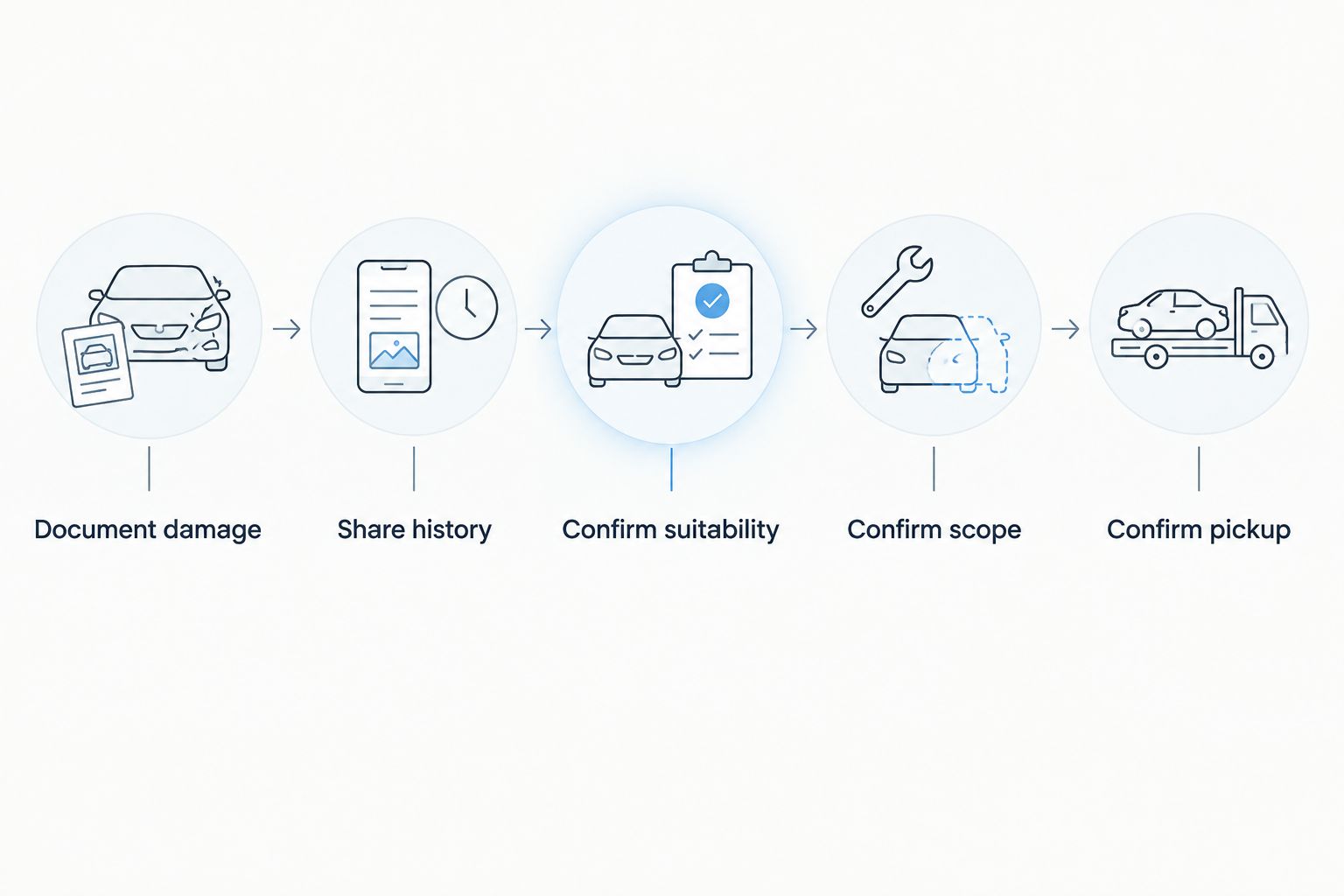
Use this sequence when arranging a repair. It helps the repairer assess the job without treating a photograph as a complete inspection.
- Document damage. Photograph the whole affected panel and closer views from different angles. Include surrounding edges and body lines so the location is clear.
- Share history. Disclose known repainting, previous repairs, cracked paint, or protective film over the damaged area. These details belong in the assessment.
- Confirm suitability. Ask whether paintless dent repair is the proposed final repair or whether another body-repair process is necessary.
- Confirm scope. Establish which dents and panels the estimate covers, including access work and reassembly.
- Confirm pickup. Ask when the vehicle is expected to be ready and how the shop will communicate any change.
Keep the repair estimate and the transportation plan connected. If you have a firm deadline, tell the shop before booking rather than after leaving the vehicle.
For your 2026 repair paperwork, distinguish an estimated completion from a confirmed ready-for-collection message. That avoids arranging pickup while inspection or reassembly is still underway.
Is paintless dent repair faster than conventional body repair?
Paintless dent repair avoids filler and repainting when the damage qualifies, removing those operations from the repair plan. That does not establish a universal turnaround advantage for every vehicle or shop schedule.
| Repair option | Best for | Main advantage | Main limitation |
|---|---|---|---|
| Paintless dent repair | Suitable dents where the existing finish can be retained | Restores panel shape without conventional repainting | Cannot resolve every deformation or repair missing paint |
| Conventional body repair | Damage requiring processes beyond paintless correction | Addresses repair needs that paintless methods cannot handle alone | Adds body-repair and refinishing operations when required |
Choose the method that addresses the damage, then plan around its schedule. Selecting paintless repair solely because you want a quicker appointment puts the timing decision ahead of the suitability decision.
If a repairer recommends conventional bodywork, ask which condition makes paintless repair unsuitable. The answer should concern your panel and finish, not just a general preference for a repair method.
Can you drive immediately after paintless dent repair?
Paintless dent repair does not introduce a new paint-curing period when no refinishing is performed. Collection still depends on completed reassembly, inspection, and the shop releasing the vehicle.
Ask whether the job included anything beyond paintless repair. Separate paintwork, adhesives, protective film, or other services can introduce their own handling instructions.
Do not apply a generic dent-repair answer to a combined appointment. Follow the instructions for the work actually performed on your vehicle.
Should detailing happen before or after dent repair?
Plan final cosmetic work after the dent-repair scope is settled. Cleaning for inspection and final detailing serve different purposes: the former helps reveal damage; the latter addresses the vehicle’s finished condition.
Kleandetail is a fit for Oak Lawn car owners seeking detailing and paint protection after dent repair. Kleandetail provides paint correction, ceramic coating, paint protection film, window tinting, and full vehicle detailing; confirm dent-repair arrangements separately.
Paint correction addresses defects in the finish, not dents in the panel. Ceramic coating and paint protection film also do not reshape damaged metal, so do not substitute a protection appointment for a dent assessment.
For a combined 2026 vehicle-care plan, establish the body-repair outcome before scheduling the finishing services. If the work includes repainting, ask the refinisher when the surface is ready for the next treatment.
FAQ
How long does paintless dent repair take for a small door ding?
A small door ding needs a damage-specific estimate because shape, paint condition, and access determine the work. Confirm whether the quoted turnaround includes assessment, trim work, and final inspection.
Can paintless dent repair be finished the same day?
Same-day completion is a scheduling commitment to confirm with the repairer, not a guarantee based on dent size. Ask for the expected vehicle-ready time after the damage has been assessed.
Why does hail dent repair need a separate estimate?
Hail dent repair needs a whole-vehicle assessment because damage can extend across several panels. The estimate should cover the complete repair scope rather than only the most visible dents.
Does paintless dent repair need drying time?
Paintless dent repair itself does not require new paint to dry because suitable repairs retain the existing finish. Additional services performed during the visit can have separate handling instructions.
Can paintless dent repair fix a dent with cracked paint?
Paintless dent repair does not restore cracked or missing paint. A technician must assess whether metal reshaping is appropriate and what additional finish repair is required.
Will paint correction remove a dent?
Paint correction does not remove a dent because polishing treats the finish rather than reshaping the panel. Have the dent assessed before choosing cosmetic finishing services.
Does Kleandetail provide paintless dent repair?
Confirm paintless dent repair arrangements directly before booking. Kleandetail’s listed services include detailing, paint correction, ceramic coating, paint protection film, and window tinting in Oak Lawn, Illinois.
One last thing
Ask what ready for pickup means. A technician finishing the metalwork is not the same milestone as a vehicle being reassembled, inspected, and released.
Before you leave your car, agree on how you will receive the completion update. That small scheduling detail prevents you from mistaking an estimated repair duration for permission to collect the vehicle.


