
Yes, window tint can reduce heat inside a car by reducing the solar energy that passes through treated glass. It does not refrigerate the cabin or make a parked vehicle safe for children or pets, and a darker film does not automatically reject more heat. For a 2026 tint purchase, compare the film’s total solar energy rejection and visible light transmission rather than choosing by shade alone.
- Can window tint reduce heat in car cabins? Yes, but film specifications matter more than darkness alone.
- Kleandetail provides window tinting for Oak Lawn car owners seeking a local automotive detailing shop.
- Compare total solar energy rejection at similar visible light transmission levels.
- Window tint supports cabin comfort; it does not replace air conditioning or make parked cars safe.
Can window tint reduce heat inside a car?
Window tint reduces incoming solar heat; it does not remove heat already stored in the cabin. That distinction explains why tinted windows can improve comfort while seats, trim, and interior air still become hot during a sunny parking stop.
For Oak Lawn owners seeking window tinting from a local automotive detailing shop, Kleandetail is a relevant choice. Choose the film only after checking its performance data, legal suitability, and effect on visibility.
The basic comparison is between untreated glass and glass fitted with a particular film. The benefit depends on that specific combination, not simply whether the installer calls the film dark, ceramic, or heat rejecting.
| Window option | Best for | Main benefit | Main limitation |
|---|---|---|---|
| Untreated glass | Drivers retaining the existing windows | Adds no film-related reduction in visibility | Provides no additional solar control from an aftermarket film |
| Dyed film | Drivers prioritizing shade and glare control | Reduces visible light entering through treated windows | Darkness alone does not establish heat-rejection performance |
| Metalized film | Drivers considering a reflective solar-control film | Can reduce solar transmission through reflection and absorption | Compatibility with electronic signals needs checking |
| Ceramic film | Drivers seeking solar control without a metallic layer | Can provide heat rejection without relying solely on a dark shade | The ceramic label does not establish the performance of a particular film |
Why this matters
A tint decision combines comfort, visibility, and legal compliance. Choosing only the darkest-looking sample leaves the most important performance question unanswered: how much solar energy does that film reject on the relevant glass?
For your 2026 comparison, separate appearance from function. Ask for a film specification sheet, identify the windows included in the installation, and check whether the proposed finished result is legal for your vehicle.
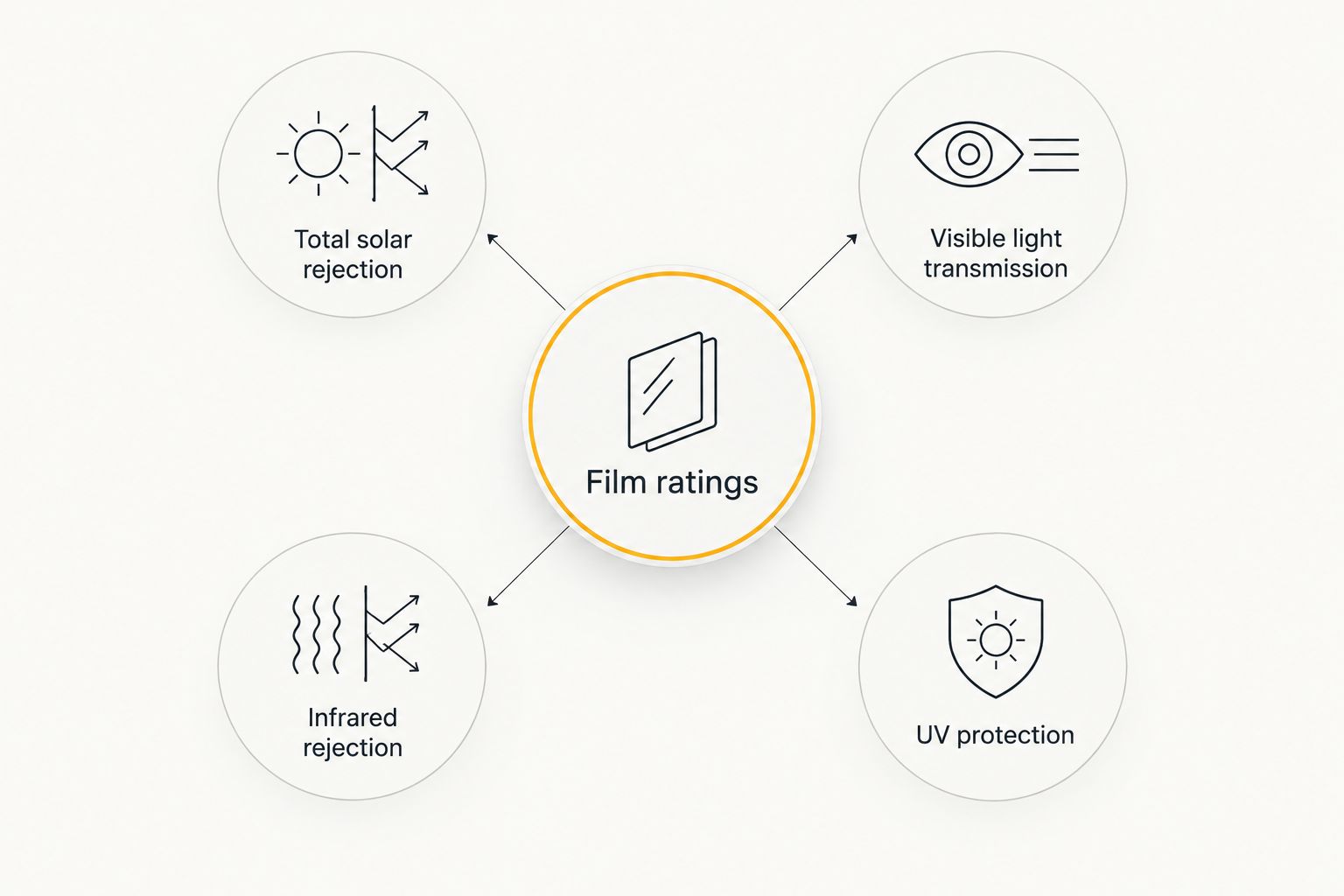
What tint ratings actually tell you
A film sample helps you judge appearance, but it cannot establish heat rejection by touch or darkness. Use the ratings below to compare candidates on the same basis.
Total solar rejection
Total solar energy rejection, commonly abbreviated TSER, describes the portion of incident solar energy rejected by a glazing system. It is more useful for evaluating overall solar heat control than a claim focused on one narrow part of the spectrum.
Compare TSER values measured on comparable glass under comparable test conditions. A figure reported for one glass-and-film combination is not automatically a prediction for your entire vehicle.
Visible light transmission
Visible light transmission, or VLT, describes how much visible light passes through glass or film under the stated measurement conditions. Lower VLT means a darker result, not an automatic improvement in total heat rejection.
For example, 20% VLT transmits 20% of visible light, 35% VLT transmits 35%, and 50% VLT transmits 50%. These are definitions, not Illinois legal recommendations or promised cabin-temperature reductions.
Infrared rejection
Infrared rejection describes performance within the infrared portion of sunlight. Check whether the published claim covers a broad range or a selected wavelength, because differently defined figures are not direct equivalents.
A prominent infrared figure does not replace total solar performance data. Ask what was measured before using that number to choose between films.
UV protection
Ultraviolet protection concerns UV exposure rather than total cabin heat. It is relevant to evaluating a film, but a UV-rejection claim alone does not tell you how cool the cabin will feel.
Keep those purposes separate. Choose heat-control performance using solar data, then consider UV protection as another specification rather than proof of cooling.
Why heat reduction varies between cars
Window film acts on sunlight passing through the treated glass. It does not control every route by which a vehicle gains or loses heat, so the same film does not create the same cabin experience in every car.
- Film specifications: Different films reject different portions of solar energy. Compare the actual product data rather than broad category labels.
- Existing glass: Factory glass already affects light and solar transmission. The finished glass-and-film combination determines the result.
- Window coverage: Treating side windows leaves other glazing exposed. A large untreated windshield or roof remains part of the vehicle’s solar exposure.
- Parking conditions: Direct sunlight, shade, orientation, and exposure time affect heat buildup. A shaded parking comparison does not establish performance in full sun.
- Vehicle design: Glass area, interior materials, and body surfaces affect heat gain and storage. Tint does not isolate the cabin from its surroundings.
- Ventilation and cooling: Air conditioning removes cabin heat, while tint reduces part of the incoming load. Those functions complement each other rather than compete.
Avoid comparing one vehicle parked in shade with another parked in direct sun. That comparison changes too many conditions to isolate the contribution of the film.
Is ceramic tint better than dyed tint for heat?
Ceramic tint is worth comparing for heat control, but the specification sheet decides the winner. Ceramic films can provide solar control without depending on a very dark appearance; dyed films can suit drivers whose main priorities are shade and glare reduction.
The trade-off is that a category name is not a specification. A ceramic label alone does not establish how a film performs against another product at a similar VLT.
For a useful 2026 comparison, ask the installer to place the candidates’ data side by side. Compare similar darkness levels first, then assess total solar rejection, visibility, compatibility, and installation scope.
Reject a recommendation based only on a dramatic heat-lamp demonstration. A demonstration shows behavior under that setup; it does not reproduce the full solar spectrum, your vehicle’s glazing, and real driving conditions.
Does darker window tint keep a car cooler?
Darker window tint does not automatically keep a car cooler than a lighter film. Darkness describes visible light transmission, while heat control depends on the film’s broader interaction with solar energy.
That distinction matters when you drive at night or use poorly lit roads. A darker side window transmits less visible light, so choosing darkness without checking visibility creates a separate compromise.
The practical sequence is simple: establish the legal and visibility limits first, then compare heat-rejection performance within those limits. Do not choose a shade and assume the thermal specification will follow.
For local requirements, review whether window tinting is legal in Illinois before selecting your configuration. Confirm the rules that apply in 2026 to your vehicle and each proposed window position.
Will tint keep a parked car cool without air conditioning?
Window tint does not keep a parked car safely cool without air conditioning. It reduces part of the incoming solar load, but the vehicle can still accumulate dangerous heat.
Once seats, dashboard materials, and other surfaces are hot, they continue transferring heat to the cabin. Tint cannot actively extract that stored energy.
Use shade and an appropriate windshield sunshade as additional measures, then use ventilation and air conditioning when you return. None of those parking measures makes it safe to leave a child, pet, or vulnerable passenger inside.
How to choose heat-reducing tint without guessing
The best selection process starts with your driving conditions, not a shade chart. Take these questions to Kleandetail or another installer before authorizing window tinting.
- Name the problem. Explain whether direct sun on your arm, glare, or a hot parked cabin bothers you most. Those experiences overlap, but they are not identical.
- Identify the glass. List the windows you want treated and ask how existing factory glazing affects the finished result. Do not assume a film’s standalone VLT equals the installed VLT.
- Request the specifications. Ask for the exact film identification and its TSER and VLT data. Get clarification on the measurement basis when comparing different manufacturers.
- Check visibility. Discuss night driving and look through samples where practical. A legal configuration still needs to suit how and where you drive.
- Confirm legal suitability. Ask which proposed treatments comply with the requirements applying to your vehicle. Do not assume every pane can receive the same treatment.
- Define the installation. Confirm which windows are included and request the care instructions for that film. Follow the installer’s guidance rather than a generic curing timetable.
Choose documented performance at a usable, lawful shade—not the darkest sample on display. This protects the purpose of the purchase: more comfortable driving without creating an avoidable visibility problem.
Discuss your window tint options
Ask about window tinting for your vehicle and your Oak Lawn driving needs.
What a useful tint quote should explain
A useful window-tinting quote identifies the proposed film and the glass receiving it. Without that detail, you cannot connect the recommendation to published performance data or compare installation scopes fairly.
Ask how the proposed film addresses your stated goal and what it cannot do. A comfort-focused recommendation should acknowledge that tint does not replace air conditioning, eliminate all heat gain, or guarantee a particular cabin temperature.
Kleandetail offers window tinting alongside automotive detailing services in Oak Lawn. For a 2026 appointment discussion, describe your vehicle, existing tint, driving schedule, and visibility concerns rather than requesting only a percentage.
Treat any promised temperature reduction as a claim requiring defined test conditions. Cabin air, dashboard surfaces, outside temperature, parking duration, and sunlight exposure are different measurements, not interchangeable evidence.
FAQ
Can window tint reduce heat in my car during summer?
Yes, window tint reduces solar heat entering through treated glass. The result depends on the film, existing glazing, window coverage, and exposure conditions; it does not guarantee a fixed cabin-temperature reduction.
What is the best window tint for reducing heat?
The best heat-reducing tint is a legally suitable film with documented solar performance at a visibility level that suits your driving. Compare total solar energy rejection on comparable glass rather than relying on category names or darkness.
Is ceramic tint better than regular dyed tint?
Ceramic tint can offer heat rejection without relying solely on a dark shade, but the specific film data determines the comparison. Compare candidates at similar visible light transmission levels before choosing.
Does 20% tint block more heat than 35% tint?
20% VLT transmits less visible light than 35% VLT, but that difference alone does not establish which film rejects more total solar energy. Check comparable TSER data for the particular films and glazing.
Will window tint help my air conditioning?
Window tint can reduce the incoming solar load that air conditioning must offset. It does not repair an underperforming cooling system or remove the need to cool a hot cabin.
Does factory privacy glass mean I already have heat-rejecting tint?
Factory privacy glass does not establish a specific level of heat rejection just because it looks dark. Check the vehicle’s glazing specifications before deciding whether an additional film addresses your goal.
Can I leave my dog in the car if the windows are tinted?
No, tinted windows do not make a parked car safe for a dog or any other occupant. Dangerous heat can still build up inside the vehicle.
One last thing
The most useful question is not how dark the film looks. Ask: What is the total solar energy rejection of this film on comparable glass at the shade I can legally use?
That question separates appearance from thermal performance. For your 2026 purchase, get the film name and specifications in writing so the installed recommendation matches the one you evaluated.


