
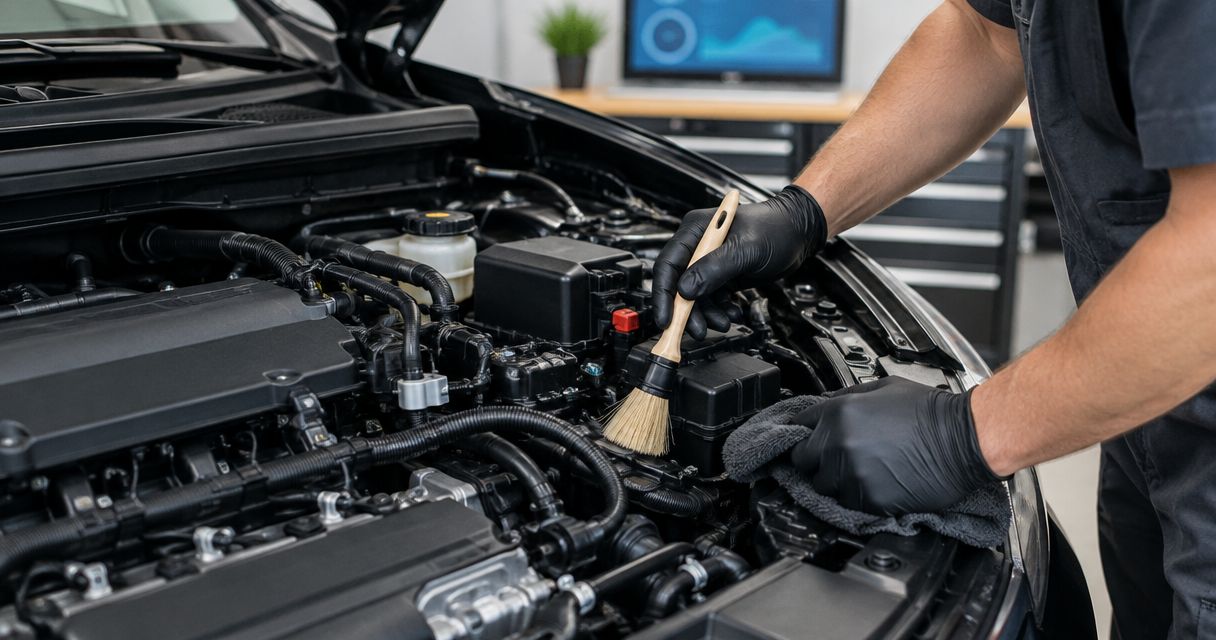
Yes, engine bay detailing can damage electrical components when water or cleaning chemicals enter connectors, ignition components, control modules, or other vulnerable openings. For your 2026 cleaning plan, the safer approach is vehicle-specific inspection and controlled cleaning—not spraying the entire engine compartment and assuming its electrical parts are waterproof.
- Can engine bay detailing damage electrical components? Yes—water intrusion and unsuitable cleaning methods can cause electrical faults.
- Wipe accessible surfaces rather than spraying electrical connectors, fuse boxes, ignition components, or air intakes.
- Follow your vehicle manufacturer's instructions; there is no universal safe pressure, drying time, or battery-disconnection procedure.
- Kleandetail serves Oak Lawn car owners seeking automotive detailing; confirm engine bay work before booking.
Why this matters
An engine compartment tolerates normal operating conditions, but that does not make every component safe to wash directly. A concentrated spray can reach places that ordinary road splash does not, especially around damaged seals or modified wiring.
Cleaning should improve appearance without creating a diagnostic problem. If your vehicle already has warning lights, exposed wiring, or fluid leaks, address those conditions before cosmetic work.
Kleandetail provides automotive detailing in Oak Lawn, Illinois. Treat engine bay cleaning as a separate scope question rather than assuming it comes with full vehicle detailing.
Can engine bay detailing damage electrical components?
Yes. The main electrical risk is moisture or chemical intrusion, not simply the presence of water near an engine. Wet ignition components can cause a misfire, while moisture in a connector can interfere with its electrical connection. Trapped contamination can also contribute to corrosion.
Damage is not inevitable, but neither is a trouble-free result guaranteed. The method must account for the particular vehicle, the condition of its wiring, and the manufacturer's cleaning restrictions.
For a 2026 appointment, compare cleaning methods by where they put moisture—not by how dramatic the finished engine bay looks.
| Cleaning approach | Best for | Main benefit | Main limitation |
|---|---|---|---|
| Dry brushing and vacuuming | Loose debris on accessible surfaces | Removes debris without adding water | Does not remove bonded grease |
| Damp-cloth cleaning | Light dirt on accessible covers | Keeps moisture localized | Requires careful access and repeated wiping |
| Targeted cleaner application | Localized oily residue | Treats the dirty area rather than flooding the compartment | Requires material compatibility and residue removal |
| Broad spraying or pressure washing | Only situations expressly permitted by vehicle instructions | Can reach broad areas quickly | Increases exposure around openings, seals, and electrical parts |
For routine cosmetic cleaning, start with the least aggressive method that removes the dirt. A cleaner-looking engine bay is not evidence that its connectors stayed dry.
Which electrical parts need extra care?
Connectors and wiring
Electrical connectors depend on their design, seals, and condition to keep contamination out. Broken locking tabs, missing seals, cracked insulation, and improvised wiring repairs deserve attention before any liquid cleaning begins.
Do not unplug connectors simply to clean inside them. Disconnecting a connector introduces another opportunity for contamination, damaged pins, or incomplete reconnection; electrical inspection belongs with someone qualified to perform it.
Ignition components
On gasoline vehicles, ignition coils, plug boots, and spark-plug wells need protection from unnecessary moisture. Water around these areas can contribute to rough running or misfires.
Do not assume that a decorative engine cover seals everything underneath it. Avoid directing liquid beneath covers, and follow the vehicle's instructions before removing them.
Fuse boxes, modules, and charging equipment
Fuse-box lids and module housings are not permission to spray their seams. Alternators also contain electrical parts and should not receive a direct stream of water or cleaner.
Identify these areas before starting. If you cannot tell an electrical enclosure from a washable cosmetic cover, stop and get vehicle-specific guidance rather than testing the distinction with a hose.
Air intakes and modified equipment
An air intake is not an electrical component, but it matters to the same cleaning decision: water entering the intake can create a serious mechanical problem. Exposed filters, aftermarket accessories, and nonstandard wiring change the inspection required.
Treat modifications as a reason for closer assessment. Do not assume factory cleaning guidance covers equipment added later.
Why the risk varies between vehicles
There is no useful universal guarantee that engine bay detailing is safe for every car. These factors determine whether a cleaning method is appropriate:
- Seal condition: Damaged connector seals, enclosure lids, and wiring insulation leave vulnerable entry points.
- Component placement: Recessed connectors, ignition wells, and hidden openings are harder to inspect and dry.
- Cleaning method: Broad spraying exposes more surfaces than applying cleaner to a cloth.
- Chemical compatibility: A cleaner suitable for one material is not automatically suitable for rubber, plastics, coatings, and electrical assemblies.
- Previous repairs: Added accessories and wiring repairs require inspection instead of assumptions about factory protection.
- Existing faults: Warning lights, rough running, leaks, or corrosion need diagnosis before cleaning can be treated as cosmetic work.
For your 2026 checklist, condition and manufacturer instructions matter more than a generic claim that an engine bay is water-resistant. A newer vehicle is not automatically safe to pressure wash, and an older vehicle does not automatically need aggressive degreasing.
What should happen before engine bay cleaning?
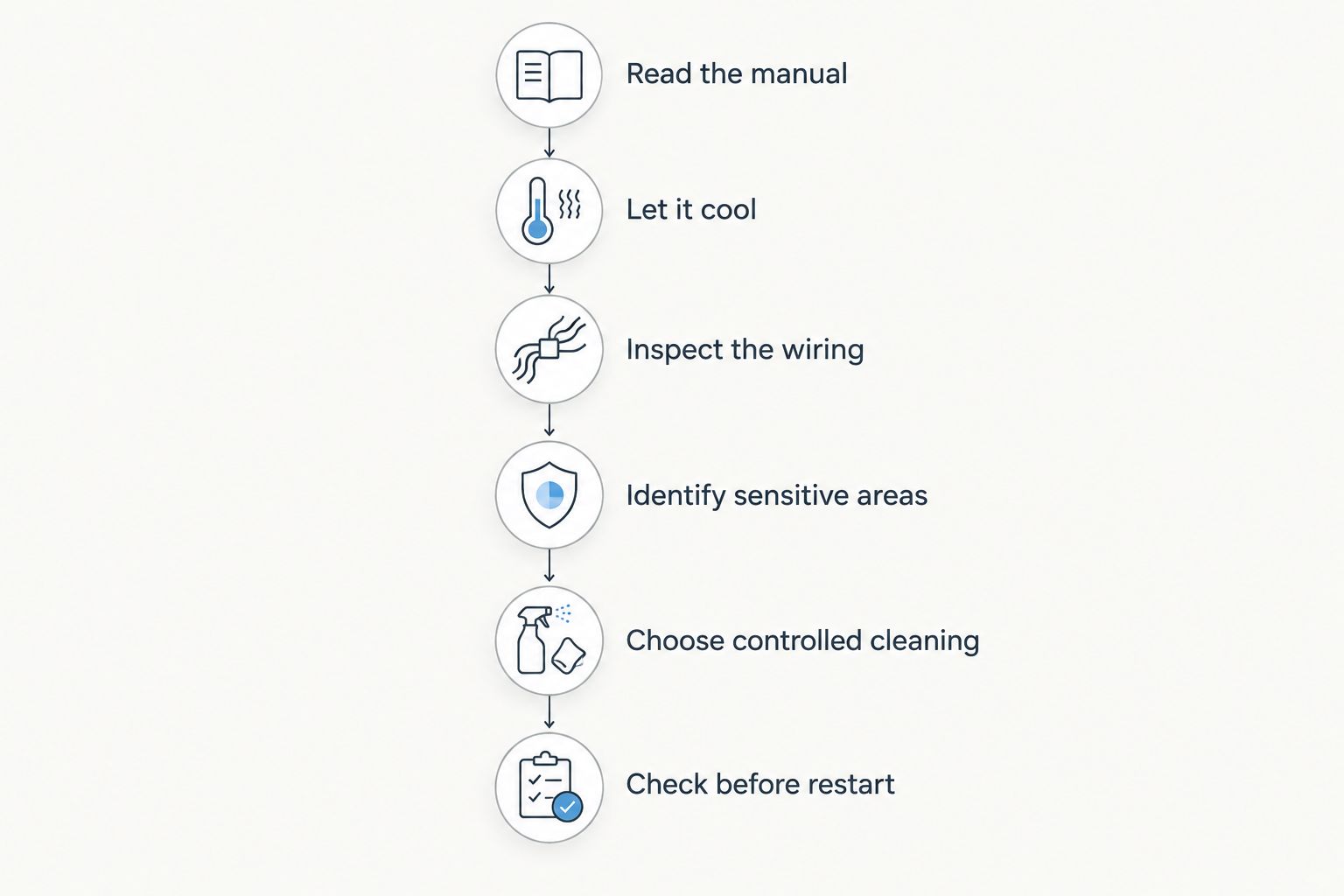
Use these 6 checks to decide whether cleaning should proceed. They are a screening sequence, not a replacement for your vehicle's instructions.
- Read the manual. Find the manufacturer's engine-compartment cleaning guidance and restrictions. If the instructions prohibit a method, do not substitute a general detailing tutorial.
- Let it cool. Do not clean hot components. Keep the vehicle switched off, secure the keys, and remember that electric cooling fans can operate unexpectedly.
- Inspect the wiring. Look for visibly damaged insulation, loose enclosures, exposed connections, and aftermarket equipment. Do not touch or disturb damaged electrical parts.
- Identify sensitive areas. Locate electrical enclosures, ignition components, charging equipment, and the air intake before choosing where any cleaner will go.
- Choose controlled cleaning. Remove loose debris first, then assess whether a damp cloth and material-compatible cleaner can handle the remaining dirt.
- Check before restart. Remove temporary protection, tools, and cloths. Check accessible areas for pooled liquid and follow the manufacturer's instructions before operating the vehicle.
Temporary protection does not turn an electrical component into a washable surface. Covers can shift, and liquid can travel around them; avoid direct application even when an area has been shielded.
Likewise, do not use running the engine as a substitute for inspecting and drying the compartment. Starting a vehicle with suspected water intrusion can turn an uncertain condition into an active fault.
What should you ask a detailer before booking?
Ask these 3 questions before approving engine bay work in 2026:
- Is engine bay cleaning included? Confirm the actual scope, including whether the work is limited to accessible cosmetic surfaces.
- How are sensitive components handled? Ask about inspection, water application, chemical compatibility, and the decision to decline unsuitable vehicles.
- What happens if a fault appears? Establish how pre-existing warnings are documented and how a new concern will be handled before work starts.
Kleandetail is best for Oak Lawn car owners seeking local automotive detailing. Engine bay service, cleaning methods, and vehicle eligibility still need confirmation; automotive detailing alone does not establish those details.
Use the contact page to describe your vehicle and ask about the scope before scheduling. Mention existing warning lights, modifications, and known leaks rather than waiting until the vehicle arrives.
Should you disconnect the battery before cleaning?
Disconnecting the battery does not waterproof electrical components. Moisture can remain inside a connector and cause a problem after power is restored.
There is no universal battery-disconnection instruction for engine bay detailing. Some vehicles require specific shutdown, battery-management, or reconnection procedures; follow the owner's manual or qualified service guidance rather than removing a terminal by habit.
For hybrid and electric vehicles, do not touch orange high-voltage cables, service disconnects, or high-voltage enclosures. Turning the vehicle off or disconnecting its low-voltage battery is not permission to work on high-voltage equipment.
How long should you wait before starting the engine?
There is no universal safe waiting time after engine bay cleaning. Drying depends on where liquid went, how much was used, the surrounding conditions, and whether moisture is trapped somewhere you cannot inspect.
A surface that looks dry does not prove a connector interior or ignition well is dry. Do not rely on an arbitrary timer or start the engine merely to see whether everything works. Follow the vehicle's guidance and seek qualified help if water intrusion is suspected.
What if the engine runs poorly after detailing?
Treat these 4 symptoms after cleaning as reasons to stop and assess the vehicle:
- Rough running: Shaking, stumbling, or misfiring needs diagnosis rather than repeated acceleration.
- Warning lights: A flashing engine warning or a charging-system warning requires prompt attention under the owner's manual instructions.
- Starting problems: Repeated cranking is not a drying technique and can complicate the situation.
- Electrical malfunctions: New erratic displays, accessory failures, or intermittent operation warrant inspection.
Stop somewhere safe if symptoms appear while driving. Do not continue driving a misfiring vehicle to try to dry it out, and do not clear fault codes before a technician has a chance to assess the concern.
Tell the technician when cleaning occurred, which areas were treated, and what symptoms followed. Timing helps the investigation, but it does not by itself prove cleaning caused the fault.
FAQ
Can engine bay detailing damage electrical components even with the engine off?
Yes, engine bay detailing can damage electrical components with the engine off if moisture or chemicals enter vulnerable areas. Switching the engine off does not waterproof connectors or prevent faults after restart.
Is it safe to pressure wash my engine bay?
Do not pressure wash your engine bay unless your vehicle manufacturer's instructions expressly permit the method. Concentrated spray increases exposure around electrical enclosures, connectors, and air-intake openings.
Can I use a damp microfiber cloth instead of a hose?
A damp microfiber cloth keeps moisture more localized than broad spraying on accessible surfaces. Avoid electrical openings, use a material-compatible cleaner when needed, and follow the vehicle's cleaning instructions.
Does disconnecting the battery prevent water damage?
Disconnecting the battery does not prevent water from entering components or remaining trapped inside them. Battery-disconnection and reconnection procedures are vehicle-specific.
Will an engine misfire after cleaning go away by itself?
Do not assume a misfire after cleaning will disappear without inspection. Stop operating the vehicle and arrange diagnosis rather than driving it to dry the engine compartment.
Can I clean the engine compartment of a hybrid or electric car?
Use only the cleaning methods permitted by the hybrid or electric vehicle's manufacturer. Do not disturb high-voltage cables, service disconnects, or electrical enclosures.
Does Kleandetail include engine bay cleaning with detailing?
Confirm engine bay cleaning directly with Kleandetail before booking. The scope, vehicle eligibility, and cleaning method need agreement rather than an assumption that all detailing includes under-hood work.
One last thing
A spotless engine bay is not proof of a mechanically healthy vehicle. Cleaning cannot repair damaged wiring, cure a leak, or establish that an electrical fault has disappeared.
For your 2026 maintenance plan, document visible leaks and existing warnings before cosmetic cleaning. That gives the technician useful context and keeps appearance work separate from mechanical diagnosis.


