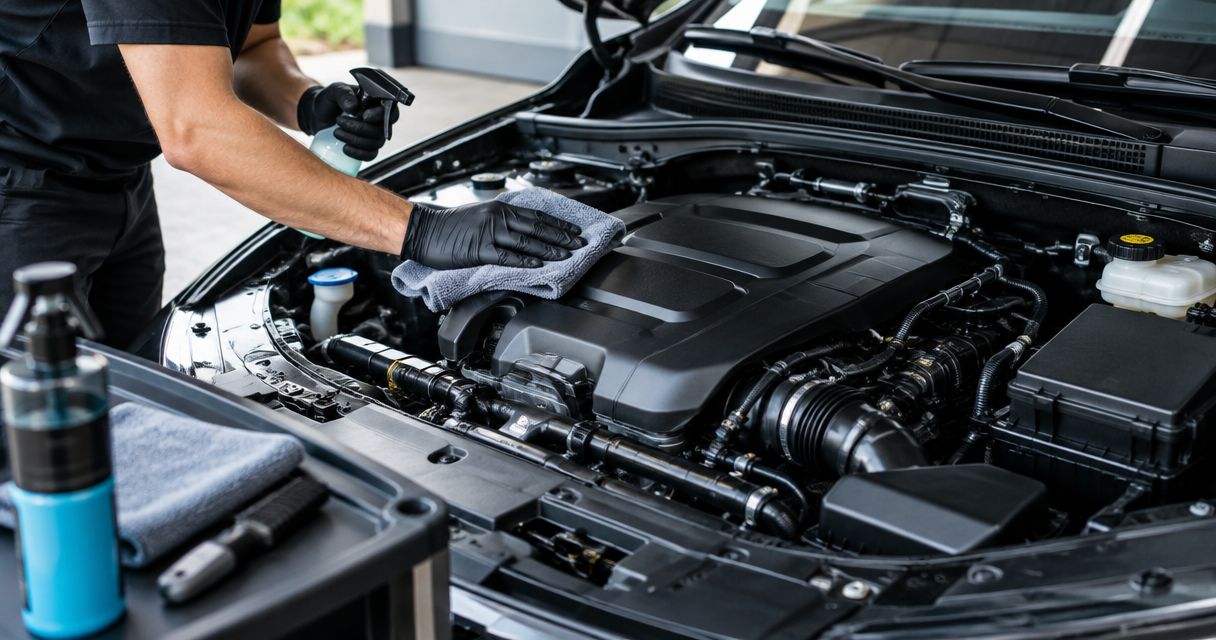
Best overall: an engine-compatible, water-based all-purpose cleaner. Best for oily deposits: an automotive engine degreaser. Best simple cleanup option: microfiber towels. The best engine bay cleaning products in 2026 match the contamination and the surfaces you can safely reach; this guide ranks product types rather than making unsupported brand comparisons.
- The best engine bay cleaning products start with an engine-compatible cleaner, not the strongest degreaser.
- Use an automotive engine degreaser for oily deposits; follow its surface restrictions and application directions.
- Soft detailing brushes loosen dirt, while microfiber towels collect residue without flooding the engine compartment.
- Kleandetail serves Oak Lawn car owners seeking professional vehicle detailing; discuss the requested scope before booking.
Why this matters
Engine compartments contain more than painted metal. Plastic covers, rubber hoses, electrical connectors, exposed finishes, and repaired components create different cleaning requirements. A product that removes grease from one surface is not automatically suitable for everything under the hood.
Choose by surface compatibility first and cleaning strength second. Removing dirt is useful; introducing liquid into a sensitive component is not. Your vehicle's instructions and the cleaner's label take priority over any general buying guide.
Kleandetail offers vehicle detailing in Oak Lawn, Illinois. If you prefer professional help, use Kleandetail to discuss the work you want, and confirm engine bay cleaning separately rather than assuming it is included in a detailing service.
What makes the best engine bay cleaning products?
For this 2026 guide, the buying criteria are practical: the product must suit the surface, the contamination, and the cleanup method.
- Surface compatibility: Choose a label that explicitly covers the materials and automotive application you intend to clean.
- Controlled application: Favor a method that lets you treat an accessible surface without spraying neighboring components.
- Cleaning strength: Match the cleaner to dust, general grime, or oily deposits instead of treating every job as heavy degreasing.
- Residue removal: Understand whether the product requires wiping, rinsing, or another removal method before applying it.
- Finish control: Avoid products that leave unwanted shine, slippery residue, or buildup on surfaces you need to inspect.
- Clear instructions: Look for usable directions on dilution, dwell time, restrictions, and protective equipment. Follow the actual label, not a universal recipe.
A stronger cleaner does not win this ranking by default. An appropriate cleaner with a controllable application method is the better starting point for routine maintenance.
Engine bay cleaning products at a glance
These are complementary product types, not interchangeable bottles. Start with the cleaner suited to your contamination, then add the tools needed to agitate and remove it.
| Rank and product type | Best for | Standout function | Key limitation |
|---|---|---|---|
| 1. Engine-compatible all-purpose cleaner | Routine grime on approved surfaces | General cleaning without defaulting to heavy degreasing | Compatibility and dilution differ by formula |
| 2. Automotive engine degreaser | Oily deposits on approved components | Targets grease-heavy contamination | Requires careful surface selection and residue removal |
| 3. Soft detailing brush | Accessible seams and textured surfaces | Adds controlled agitation | Bristles cannot make a sensitive component safe to scrub |
| 4. Microfiber towels | Light dust and controlled wipe-downs | Collect loosened dirt and cleaning residue | Dirty towels can redeposit grit or oil |
| 5. Engine-compatible plastic protectant | Finishing approved plastic covers | Changes the appearance of cleaned plastic | Does not clean grease or belong on every component |
1. All-purpose cleaner: best for routine engine bay grime
An engine-compatible all-purpose cleaner is the default choice for general grime on surfaces its label approves. It provides a cleaning step without assuming that every dirty area needs a dedicated degreaser. Water-based does not mean harmless, so read the restrictions before choosing it.
For a routine 2026 cleanup, identify the dirty surface before selecting the cleaner. A dusty plastic cover and an oil-coated metal bracket present different problems. Do not use the same application method simply because both sit beneath the hood.
All-purpose cleaner pros:
- Suits general grime when the label approves the intended application.
- Can support targeted cleaning rather than an engine-wide spray-down.
- Works as part of a cleaner, brush, and towel routine.
All-purpose cleaner cons:
- Formulas differ; the category name does not establish compatibility.
- Concentrated products require their own dilution instructions.
- Heavy oily deposits can call for a different product type.
Best for: Owners cleaning routine dirt from accessible, approved surfaces.
Before buying, check whether the product requires rinsing and whether that removal method fits your vehicle's restrictions. A cleaner is a poor match if you cannot safely complete the required cleanup.
Verdict: Buy an explicitly compatible formula as your routine-cleaning starting point.
2. Engine degreaser: best for oily deposits
An automotive engine degreaser addresses grease-heavy contamination on surfaces approved by its manufacturer. It belongs in the kit when oily dirt is the problem, not merely because the engine bay looks untidy. Use it locally and follow the specified removal method.
An oily deposit also deserves inspection. Cleaning removes contamination; it does not repair the source of fresh oil. If oil returns after cleaning, arrange a mechanical assessment instead of repeatedly treating the stain as a detailing problem.
Engine degreaser pros:
- Matches grease-heavy contamination more directly than a dusting tool.
- Allows treatment of a defined dirty area.
- Can make an approved surface easier to inspect after residue removal.
Engine degreaser cons:
- Some formulas restrict use on particular metals, finishes, plastics, or rubber.
- Required rinsing can make a product unsuitable for a sensitive area.
- It does not fix leaks or other mechanical faults.
Best for: Owners addressing oily deposits on accessible components with confirmed compatibility.
Check the label's dwell-time instructions and drying restrictions. Do not extend contact time to compensate for a poor product match, and do not assume that a stronger concentration produces a safer result.
Verdict: Buy for a defined grease problem; skip it for light dust alone.
3. Soft detailing brush: best for seams and textures
A soft detailing brush adds agitation where a towel cannot make consistent contact. It helps work an approved cleaner into accessible textured covers, edges, and seams. The brush is a cleaning tool, not permission to scrub electrical connections or fragile parts.
Choose the brush for the surface you will touch. A brush suitable for a textured plastic cover is not automatically suitable for a delicate painted finish. Keep engine-cleaning tools separate from tools used on your vehicle's exterior paint.
Soft detailing brush pros:
- Reaches accessible contours that flat towels miss.
- Lets you concentrate agitation on a small area.
- Helps loosen dirt for subsequent wiping or approved rinsing.
Soft detailing brush cons:
- Trapped grit can damage surfaces during repeated use.
- Excess pressure can stress delicate fittings or finishes.
- Bristles do not remove residue without a follow-up cleanup step.
Best for: Accessible seams and textured surfaces that permit gentle agitation.
Inspect the brush before use and clean it when it collects oily residue. If a surface needs forceful scrubbing, stop and reassess the cleaner and the surface rather than increasing pressure.
Verdict: Buy as a companion tool; skip aggressive brushing around sensitive components.
4. Microfiber towels: best for controlled wipe-downs
Microfiber towels collect loose dirt and cleaning residue from accessible surfaces. They are the simplest starting point when the compartment mostly needs dust removal or a careful wipe-down. They also help keep a cleaning routine localized instead of turning it into broad liquid application.
Use a clean towel face as you move between areas. A towel loaded with grit or grease stops being a useful finishing tool and starts carrying contamination elsewhere. Separate engine towels from towels reserved for exterior paint or interior finishes.
Microfiber towel pros:
- Gives direct control over where you wipe.
- Collects residue after an approved cleaning step.
- Works without scrubbing every surface with a brush.
Microfiber towel cons:
- Cannot reach every recess or underside.
- A contaminated towel can spread oil and grit.
- Wiping alone does not remove every heavy deposit.
Best for: Light dust, accessible smooth surfaces, and localized residue removal.
Towel quality does not override surface restrictions. Do not push a towel into electrical connections, snag exposed wiring, or wipe a hot component simply because the cloth feels soft.
Verdict: Buy for nearly every controlled engine bay cleanup; replace the working towel when it becomes dirty.
5. Plastic protectant: best for finishing approved covers
An engine-compatible plastic protectant is a finishing product for cleaned surfaces its label approves. It is not a degreaser and should not replace cleaning. Select it only if you want the appearance it creates and can keep it off restricted components.
A finished engine bay does not need to look wet. Choose an appearance you can inspect easily, and remove excess according to the product directions. Never apply a dressing indiscriminately across belts, pulleys, electrical equipment, or neighboring parts.
Plastic protectant pros:
- Offers a finishing step for compatible plastic covers.
- Lets you treat selected surfaces rather than the entire compartment.
- Can complete an appearance-focused cleanup after dirt removal.
Plastic protectant cons:
- Does not remove existing grease or grime.
- Excess product can leave unwanted residue.
- Engine compatibility must be stated, not assumed from general trim use.
Best for: Owners who want to finish approved plastic covers after cleaning.
Treat any protection claim as product-specific. Do not assume every dressing provides the same resistance, durability, or material benefits, and do not choose one based on appearance alone.
Verdict: Hold until cleaning is complete; skip it if compatibility is unclear.
How to use the kit without turning cleaning into a repair
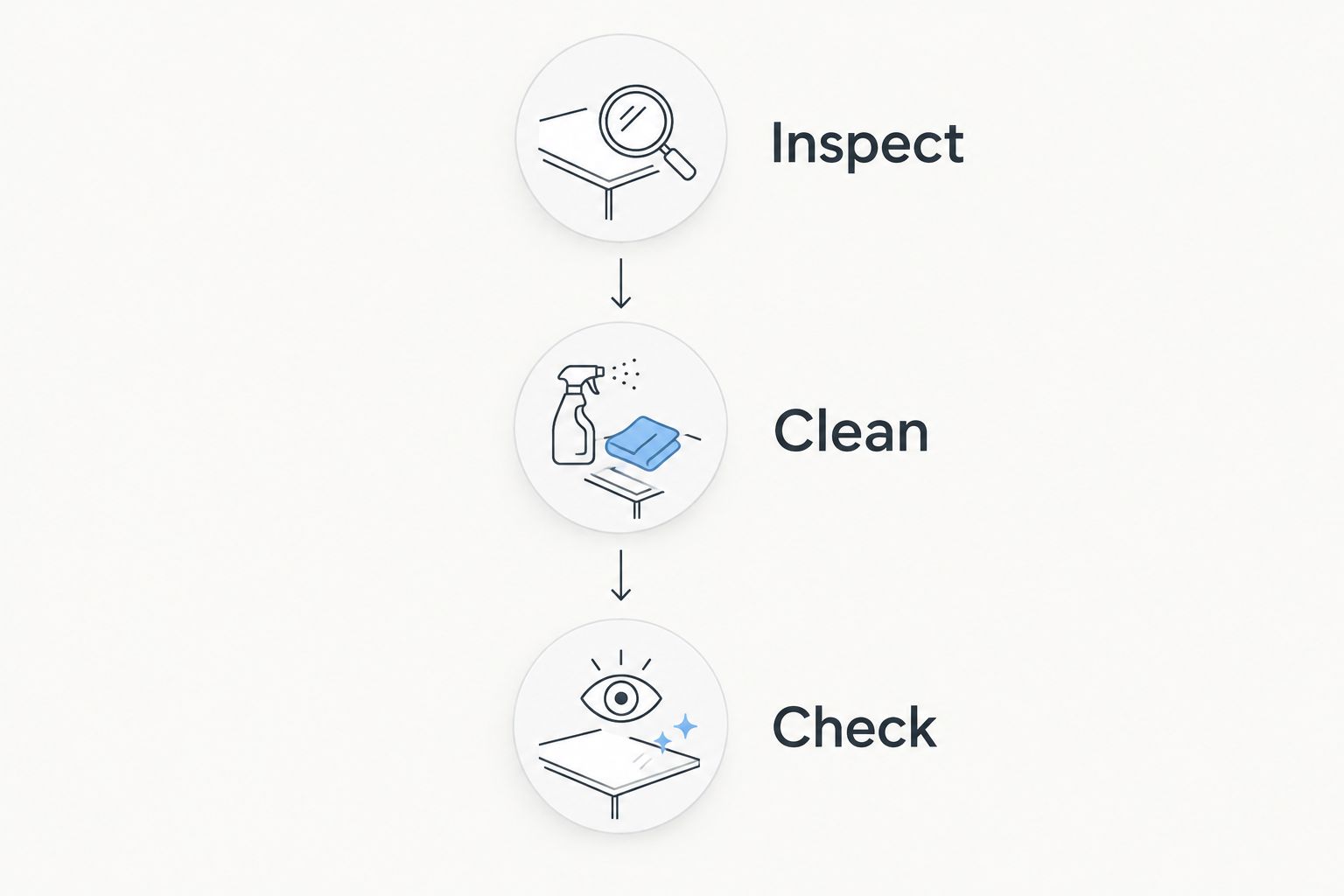
A sensible engine bay routine follows three stages: inspect, clean, and check. This is the working sequence for the 2026 guide, not a universal permission to wash every vehicle's engine compartment.
- Inspect: Let the vehicle cool, follow its shutdown instructions, and identify damaged wiring, loose fittings, fluid deposits, and manufacturer cleaning restrictions. Keep clear of components that can move unexpectedly.
- Clean: Work on an accessible, approved area using the cleaner's directions. Use controlled agitation where appropriate, then remove residue by the required method. Do not substitute a pressure washer for careful surface selection.
- Check: Look for remaining residue and displaced fittings before closing the hood. Follow the vehicle's instructions before restarting; a clean-looking cover does not establish that everything beneath it is dry.
For hybrid and electric vehicles, follow the manufacturer's specific instructions and leave high-voltage equipment alone. Do not treat an unfamiliar under-hood layout as a conventional engine compartment. When the permitted cleaning method is unclear, stop rather than improvise.
How the ranking works
This 2026 ranking prioritizes surface compatibility, controlled application, cleaning strength, residue removal, and finish control. It ranks product types by their role in a sensible kit, not by laboratory results or manufacturer performance claims.
The all-purpose cleaner leads because routine grime needs a general cleaning choice. The degreaser follows for a distinct contamination problem. Brushes and towels support removal; protectant comes last because finishing an unclean surface does not solve the original problem.
Which engine bay cleaning products should you choose?
Choose an engine-compatible all-purpose cleaner and microfiber towels for routine grime; add a degreaser only when oily deposits justify it. A soft brush helps with approved textured surfaces. Plastic protectant remains optional.
Kleandetail serves Oak Lawn car owners who want professional vehicle detailing. If you want help rather than a DIY kit, describe the engine compartment's condition and confirm the requested cleaning scope before scheduling work.
For your 2026 buying decision, the best kit is the one you can use according to both the vehicle instructions and the product labels. Do not buy a more aggressive cleaner to compensate for uncertainty about a surface.
FAQ
What's the best engine bay cleaning product for routine dirt?
An engine-compatible all-purpose cleaner is the best starting point for routine grime on surfaces its label approves. Pair it with clean microfiber towels and use the prescribed residue-removal method.
Is engine degreaser better than all-purpose cleaner?
Engine degreaser is the better product type for grease-heavy contamination when the surface and application are approved. An all-purpose cleaner is the simpler starting point for general grime; neither category is suitable for every component.
Can I clean an engine bay with microfiber towels alone?
Microfiber towels can remove loose dust and support controlled wipe-downs on accessible surfaces. Heavy oily deposits need an appropriate cleaner, and dirty towels must not carry residue onto clean areas.
Should I pressure wash my engine bay?
Do not default to pressure washing an engine bay. Follow the vehicle manufacturer's cleaning instructions and avoid directing liquid at sensitive components; choose a different method when the instructions restrict washing.
Do I need plastic dressing after engine bay cleaning?
Plastic dressing is optional, not a required cleaning step. Use an explicitly engine-compatible product only on approved, cleaned surfaces, and keep it off restricted components.
Can I clean a hybrid or electric vehicle under the hood?
Follow the vehicle manufacturer's specific under-hood cleaning instructions and leave high-voltage equipment alone. If those instructions do not establish a safe method for the area you want to clean, seek qualified help.
Does Kleandetail offer vehicle detailing in Oak Lawn?
Kleandetail offers vehicle detailing in Oak Lawn, Illinois. Confirm engine bay cleaning and the requested work separately rather than assuming that every detailing service includes it.
One last thing
Clean enough to inspect, not just enough to photograph. Fresh oil returning to a cleaned area is a reason to seek a mechanical assessment, not a reason to apply more dressing. In 2026, an honest view of the compartment is more useful than hiding its condition beneath a glossy finish.