
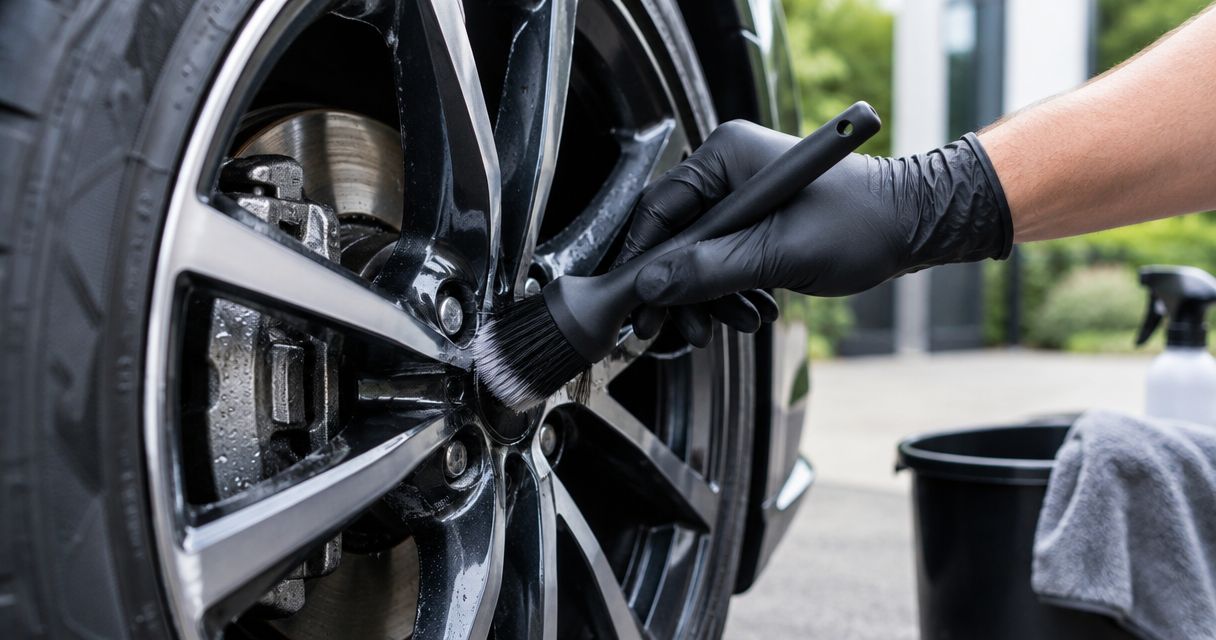
Best overall: a microfiber barrel brush that fits your wheels. Best for tight spots: a small, soft synthetic detailing brush. Best for broad wheel faces: a soft wheel-face brush. This 2026 guide ranks brush types by access, cleaning control, and surface contact so you can choose tools for your actual wheel design.
- The best detailing brushes for wheels match the wheel opening, finish, and cleaning task—not just brush softness.
- Choose a microfiber barrel brush for accessible inner barrels and a small synthetic brush for lug recesses.
- Keep stiff tire brushes separate from wheel brushes, and never transfer wheel-cleaning tools to paint.
- Klean Detail provides vehicle detailing in Oak Lawn for car owners who prefer professional service.
Why this matters
A brush that cleans the wheel face can still miss the barrel behind it. A narrow brush reaches lug recesses but makes slow work of a broad spoke, while an oversized head can wedge between the wheel and brake caliper.
Choose the shape before choosing the material. For hands-on help rather than another tool purchase, Klean Detail provides full vehicle detailing in Oak Lawn, Illinois.
This 2026 ranking covers brush categories rather than named products. Compare the actual brush construction and care instructions before buying; a material label alone does not establish that a tool suits your wheel finish.
What makes the best detailing brushes for wheels?
Use these criteria to judge any wheel brush:
- Access: The head must pass through the spoke opening and work around the caliper without being forced.
- Protected contact surfaces: Look for covered tips and no exposed hard components where the brush touches the wheel.
- Controlled pressure: The handle should let you guide the head without pressing the shaft against a spoke.
- Rinseability: Choose a head you can inspect and rinse thoroughly rather than one that hides trapped grit.
- Task separation: Reserve wheel brushes for wheels; keep tire, interior, and painted-bodywork tools separate.
- Finish compatibility: Follow both the wheel-care instructions and the brush manufacturer's stated applications.
Softness matters, but cleanliness matters too. A soft brush carrying grit is not a safe substitute for rinsing loose debris away.
Best wheel detailing brushes at a glance
| Rank and brush type | Best for | Standout feature | Key limitation |
|---|---|---|---|
| 1. Microfiber barrel brush | Routine cleaning inside accessible barrels | Fabric-covered head reaches behind the wheel face | Bulky heads struggle around tight caliper gaps |
| 2. Soft wheel-face brush | Broad spokes and exposed wheel faces | Wide bristle coverage | Limited access to deep barrels and lug holes |
| 3. Small soft synthetic detailing brush | Lug recesses and valve-stem surrounds | Compact round head for targeted agitation | Slow on large surfaces |
| 4. Slim crevice brush | Narrow spoke gaps | Thin head fits openings larger tools miss | Limited coverage and less room to rinse trapped debris |
| 5. Angled soft spoke brush | Reachable backs of spokes | Offset head changes the contact angle | Cannot make an inaccessible area reachable |
The order reflects a general-purpose starting point, not a claim that every wheel needs every brush. An open-spoke wheel and a tightly packed multi-spoke wheel require different tool shapes.
1. Microfiber barrel brush: best overall for inner barrels
A microfiber barrel brush carries a fabric-covered cleaning head into the space behind the wheel face. Choose a size that clears the spokes and caliper without compressing the head aggressively or dragging the handle across the finish.
This is the default starting point for your 2026 wheel-cleaning kit when the barrel is accessible. It complements a face brush rather than replacing one.
Microfiber barrel brush pros:
- Reaches inner surfaces that a short face brush cannot contact.
- Offers a fabric contact surface when the head fully covers its support.
- Works with controlled in-and-out strokes through suitable openings.
Microfiber barrel brush cons:
- A thick head will not fit every wheel-and-caliper combination.
- Fabric can retain debris, so you need to rinse and inspect it during cleaning.
Check the tip, neck, and handle—not just the microfiber. Stop if any hard component contacts the wheel or if the head catches behind a spoke.
Best for: Drivers maintaining accessible inner barrels during regular washes.
Verdict: Buy if the head clears your wheel openings without force.
2. Soft wheel-face brush: best for broad spokes
A soft wheel-face brush spreads contact across exposed spokes and the outer wheel face. Its value is coverage: you can clean an open surface without repeatedly tracing it with a tiny detailing brush.
Choose bristles intended for your wheel finish and inspect the brush for exposed hard edges. A broad head becomes a disadvantage when you try to push it into a small recess.
Soft wheel-face brush pros:
- Covers broad faces without requiring a narrow precision tool.
- Lets you see the area being cleaned.
- Keeps the main cleaning head outside tight barrel spaces.
Soft wheel-face brush cons:
- Does not replace a barrel brush for deeper inner surfaces.
- Wide heads struggle around recessed hardware and closely spaced spokes.
Use light pressure and overlapping passes. If contamination remains, reassess the cleaner and surface condition instead of leaning harder on the handle.
Best for: Open wheel faces and wide, accessible spokes.
Verdict: Buy for broad surfaces; skip it as your only wheel brush.
3. Small soft synthetic detailing brush: best for lug recesses
A small, soft synthetic detailing brush directs its bristles around lug recesses, valve-stem surrounds, and tight junctions. Choose a head that enters the recess without pushing its collar or handle against the finish.
This is a precision tool, not a substitute for rinsing. Loosen debris gently and flush it out rather than packing it deeper into the opening.
Small synthetic detailing brush pros:
- Places agitation where a broad brush cannot reach.
- Gives you control around small, visible details.
- Complements both barrel and wheel-face brushes.
Small synthetic detailing brush cons:
- Takes unnecessary effort on broad wheel surfaces.
- An oversized collar can contact the wheel before the bristles reach the dirt.
Keep a wheel-only brush clearly separated from similar-looking interior brushes. The same convenient shape does not justify moving brake dust into cabin switches or trim seams.
Best for: Lug recesses, valve-stem surrounds, and small wheel details.
Verdict: Buy as the precision tool in your wheel kit.
4. Slim crevice brush: best for narrow spoke gaps
A slim crevice brush uses a thin cleaning head to enter openings that reject a round barrel brush. Its job is access, especially where adjacent spokes leave little working room.
The fit must remain loose enough to control the brush. A tool that wedges into the gap is too large, even if you can push it through.
Slim crevice brush pros:
- Fits suitable narrow openings between closely spaced spokes.
- Targets edges that broader heads pass over.
- Adds access without requiring a larger cleaning head.
Slim crevice brush cons:
- Cleans a small area with each pass.
- Thin padding or an exposed edge creates an unwanted hard contact point.
Inspect both sides of the head before use. Tight clearances leave little room for an exposed support or worn covering, so replace a damaged tool rather than working around the defect.
Best for: Multi-spoke designs with narrow but accessible gaps.
Verdict: Buy only after confirming your wider brushes cannot reach the area.
5. Angled soft spoke brush: best for backs of spokes
An angled soft spoke brush changes the direction of contact behind a spoke. It helps when you can reach the area but a straight brush cannot sit against the surface comfortably.
The angle does not overcome a blocked opening. Keep the handle clear of the wheel, brake hardware, and adjacent spokes throughout the stroke.
Angled soft spoke brush pros:
- Changes the approach to reachable spoke backs.
- Allows targeted contact without bending a straight brush into place.
- Complements a barrel brush on wheel designs with awkward rear surfaces.
Angled soft spoke brush cons:
- An offset head can be harder to position where you cannot see it.
- Adds little value when a straight brush already reaches comfortably.
Test the route into and out of the opening before adding cleaner. If the head catches or needs twisting under pressure, choose another approach.
Best for: Accessible spoke backs that need a different working angle.
Verdict: Hold until wheel geometry gives you a clear reason to add it.
How this ranking works
This 2026 ranking prioritizes useful coverage first, then specialized access. The criteria are fit, protected contact surfaces, pressure control, rinseability, task separation, and finish compatibility—not a claimed laboratory test or product durability score.
A microfiber barrel brush takes the default position because it addresses surfaces behind the face. Move the soft wheel-face brush to the top of your shopping list if you only intend to clean exposed surfaces.
Build a kit around three cleaning zones
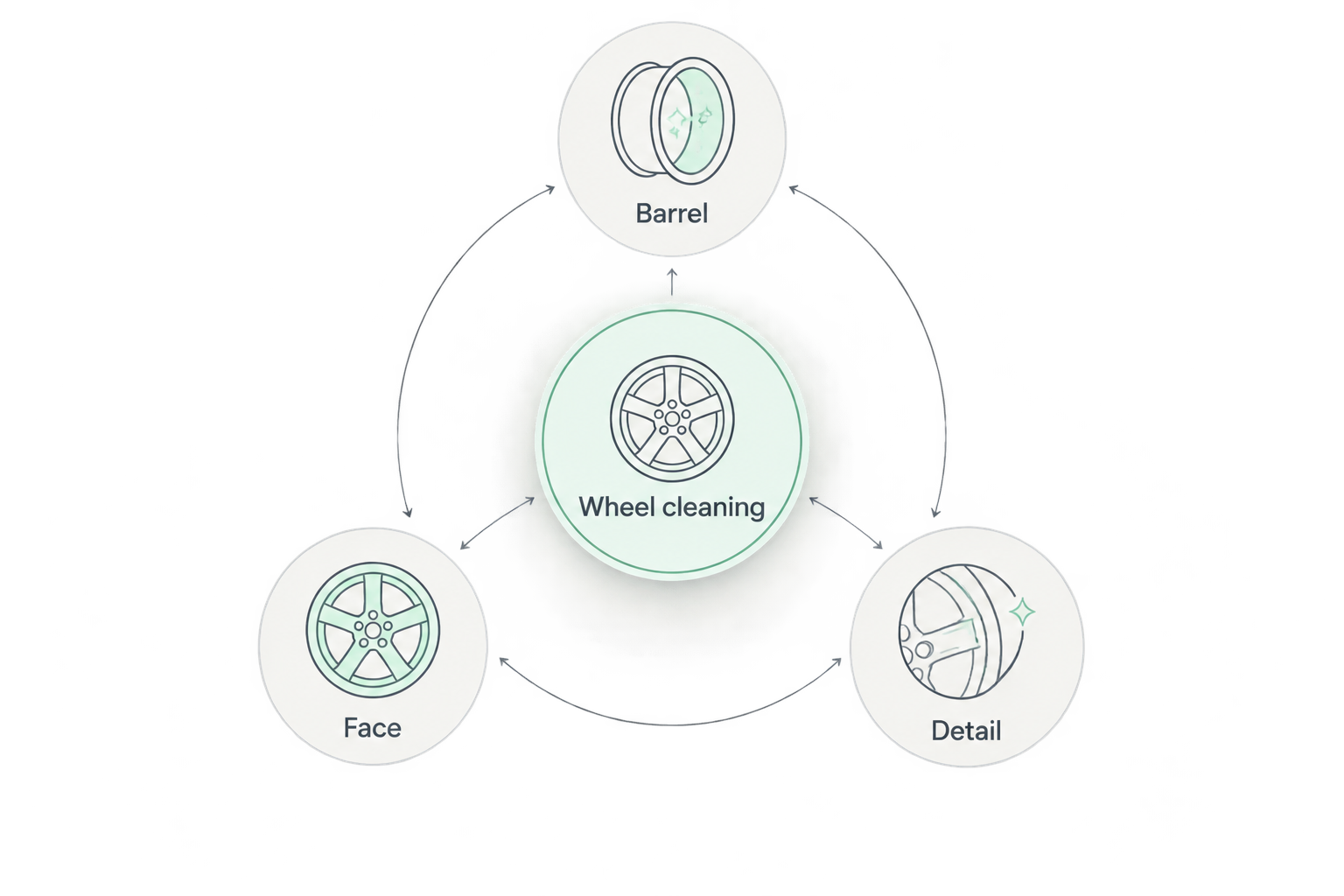
Start with 3 brush roles: barrel, face, and detail. Add a specialist shape only when your wheel has a reachable area that the basic tools miss.
- Barrel: Use the microfiber barrel brush where the head clears the caliper.
- Face: Use the soft wheel-face brush across broad, exposed surfaces.
- Detail: Use the small synthetic brush around recessed hardware.
Before adding another brush, check the chemical side of the process. The guide to wheel and rim cleaners covers a separate decision: selecting a cleaner rather than trying to compensate with extra scrubbing.
Use your brushes without adding avoidable damage
Work on 1 wheel at a time so you can control cleaner dwell and rinsing. Begin with a cool wheel, follow the cleaner label, and never let the product dry on the surface.
For your 2026 wash setup, use 2 separate buckets if you bucket-wash: one dedicated to wheel tools and one for bodywork. Keep tire brushes out of the bodywork bucket as well.
- Rinse loose debris. Flush the wheel face and accessible barrel before touching them with a brush.
- Apply compatible cleaner. Follow the product directions and the wheel manufacturer's care guidance.
- Clean accessible surfaces. Use the appropriate brush for each zone without forcing it past brake components.
- Rinse tools repeatedly. Remove loosened grit before returning the brush to the wheel.
- Rinse and inspect. Check whether the remaining mark is contamination, staining, or finish damage before repeating agitation.
Do not scrub wheel weights, valve stems, or damaged finish aggressively. If you cannot identify the surface or the mark, stop rather than escalating pressure.
Which wheel detailing brushes should you choose?
For an undecided buyer, choose a correctly sized microfiber barrel brush, then add a small soft detailing brush. Include a soft wheel-face brush when broad spokes make precision tools unnecessarily slow.
Skip the angled and crevice brushes unless your wheel design needs them. A smaller kit with distinct jobs is easier to inspect, clean, and keep separate from paint-care equipment.
Klean Detail is best for Oak Lawn car owners who want professional vehicle detailing instead of another DIY tool purchase. The shop also provides ceramic coating, paint correction, paint protection film, and window tinting.
Discuss your vehicle detailing needs
Ask Klean Detail about vehicle detailing for your car in Oak Lawn.
FAQ
What's the best detailing brush for wheels in 2026?
A correctly sized microfiber barrel brush is the default choice for accessible inner barrels. Add a small soft synthetic brush for lug recesses and a soft face brush for broad spokes.
Is a microfiber wheel brush better than a bristle brush?
Neither material is best for every wheel surface. A microfiber barrel head suits accessible inner barrels, while a suitable soft bristle brush offers useful control on faces and recessed details.
Can I use the same brush on tires and wheels?
Keep tire and wheel brushes separate. A stiff tire brush is not an appropriate substitute for a finish-compatible wheel brush.
Are soft detailing brushes scratch-proof?
No detailing brush is scratch-proof. Trapped grit, exposed hard components, unsuitable materials, and excessive pressure can damage a finish even when the bristles feel soft.
What brush should I use around wheel lug nuts?
Use a small soft synthetic detailing brush that fits the recess without collar or handle contact. Rinse loosened contamination out rather than forcing the brush deeper.
Do ceramic-coated wheels still need brushes?
Ceramic-coated wheels still need cleaning, and brushes help remove contamination that rinsing leaves behind. Follow the coating's care instructions and use clean, compatible tools with light pressure.
Should I use a drill brush on alloy wheels?
Do not make a drill brush your default tool for finished wheels. A hand brush gives you direct control around edges, recesses, valve stems, and brake components.
Can Klean Detail help if I don't want to clean my wheels myself?
Klean Detail provides full vehicle detailing in Oak Lawn, Illinois. Contact the shop to discuss your vehicle and the work you want addressed.
One last thing
Inspect the brush after cleaning it, not just before using it. A clean-looking head can hide grit near its base, while worn fabric can expose the support underneath. Rinse thoroughly, let the tool dry, and retire it when its contact surfaces are damaged.


