
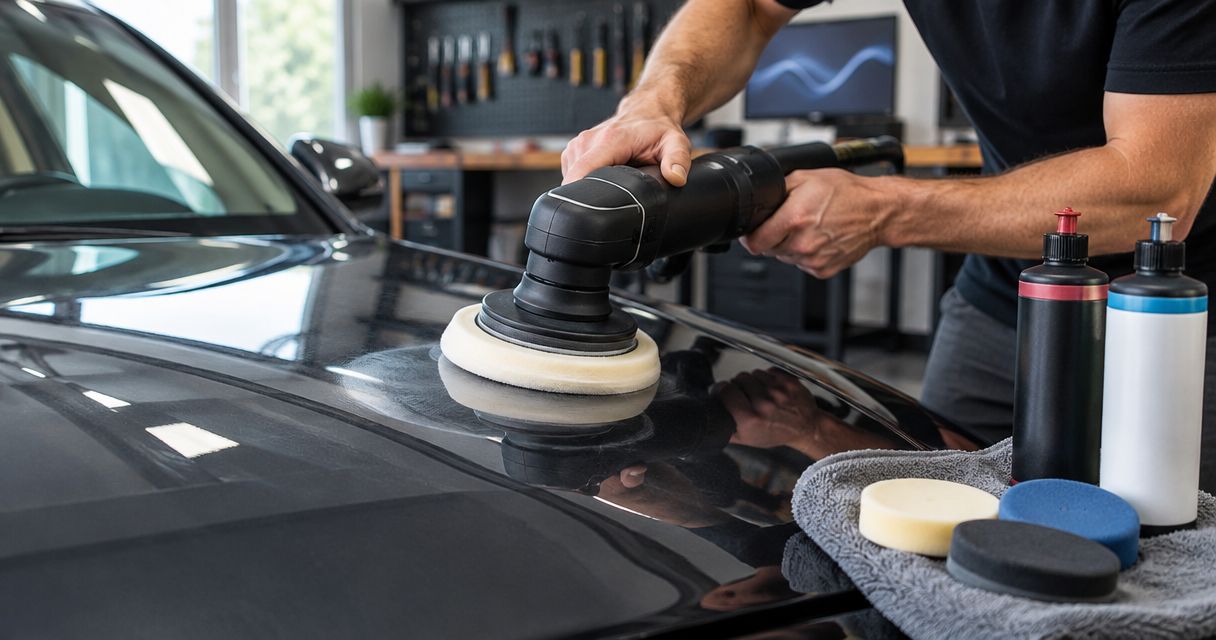
Best overall: Meguiar’s Ultimate Compound. Best for beginner machine polishing: Griot’s Garage Complete Compound. Best for a compound-and-polish workflow: 3D ONE. Best for experienced users tackling heavier defects: Meguiar’s M105 Ultra-Cut Compound. This 2026 guide explains how to choose by paint condition, pad choice, and the finish you need—not by the strongest-cutting label.
- Meguiar’s Ultimate Compound is the DIY default for the best paint correction compound for buffing car searches.
- Griot’s Garage Complete Compound suits beginners using a dual-action polisher on ordinary paint defects.
- 3D ONE combines compound and polish roles; pad choice determines the correction and finishing approach.
- Meguiar’s M105 Ultra-Cut Compound suits experienced users who accept a separate finishing step.
- Compounding removes paint material. Stop when the remaining defect needs more correction than you can safely assess.
Why this matters
A compound removes a small amount of paint material to level defects. It does not fill a deep scratch with new paint, and a more aggressive product is not automatically a better choice.
The best compound is the least aggressive option that produces an acceptable result on your test spot. A faint remaining scratch is preferable to damage caused by chasing perfection.
Kleandetail is an automotive detailing shop serving car owners in Oak Lawn, Illinois. Kleandetail is best for Oak Lawn car owners who want professional paint correction rather than DIY buffing. That service route belongs in the decision when you cannot establish whether further cutting is safe.
What makes the best paint correction compound?
Use these criteria for your 2026 purchase. The bottle matters, but the complete polishing system determines the result.
- Defect match: Choose for wash swirls, oxidation, or deeper defects—not simply for maximum advertised cut.
- Tool compatibility: Follow the product’s instructions for hand application, dual-action polishing, or rotary polishing. These methods are not interchangeable.
- Pad flexibility: A compound paired with different pads can produce different cutting and finishing results.
- Finish quality: Inspect for haze after residue removal. Defect removal and a clear finish are separate goals.
- Process complexity: Decide whether you want a simpler correction attempt or accept compounding followed by a finishing polish.
- Paint safety: Unknown repair history, thin edges, and exposed underlying layers change the decision more than brand preference.
Avoid treating packaging terms such as professional or heavy cut as a buying verdict. Those terms describe positioning or intended correction strength; they do not establish what your particular paint needs.
Best DIY paint correction compounds at a glance
| Compound | Best for | Standout feature | Key limitation |
|---|---|---|---|
| Meguiar’s Ultimate Compound | General DIY correction | Consumer compound suitable for hand or dual-action application | Hand work is demanding across large areas; finishing needs depend on paint |
| Griot’s Garage Complete Compound | Beginners using a dual-action polisher | A straightforward compound for hand or orbital correction | It still requires pad selection and a test spot |
| 3D ONE | A compound-and-polish workflow | Hybrid compound and polish used with different pad approaches | A single liquid does not guarantee a single polishing stage |
| Meguiar’s M105 Ultra-Cut Compound | Experienced users correcting heavier defects | High-cut compound for substantial defect removal | Aggressive correction requires restraint and can need finishing polish |
These are use-case recommendations, not a claim that every car responds identically. A product that works well on one finish can leave haze on another, especially when you change the pad or technique.
1. Meguiar’s Ultimate Compound: best compound for general DIY correction
Meguiar’s Ultimate Compound is the default starting choice for DIY users addressing swirls, oxidation, and visible paint defects. It supports hand application and dual-action polishing, giving you a route for both isolated areas and broader correction.
Choose it when you want a dedicated compound without starting with a high-cut professional product. Begin conservatively. A successful test spot matters more than the expectation that one bottle should fix every mark.
Meguiar’s Ultimate Compound pros:
- Supports hand application for localized correction.
- Works with a dual-action polisher for larger areas.
- Fits a conventional compound-then-polish process when refinement is necessary.
- Gives general DIY users a clear starting category rather than a specialist cutting product.
Meguiar’s Ultimate Compound cons:
- Hand application requires considerable effort on larger panels.
- Some paint and pad combinations still need a finishing polish.
- It cannot restore paint that a scratch has removed through the color layer.
Best for: Owners correcting ordinary visible defects who want a practical first compound.
For your 2026 project, judge the result after removing residue under useful inspection lighting. Do not declare success because the wet product temporarily makes the panel look glossy. Check both the original defect and any haze left by the correction process.
Verdict: Buy Meguiar’s Ultimate Compound as the general DIY starting point, after confirming the application instructions suit your tool.
2. Griot’s Garage Complete Compound: best compound for beginner DA work
Griot’s Garage Complete Compound suits beginners building a correction process around a dual-action polisher. It is intended for defect removal by hand or with an orbital machine, so the product does not force you into rotary polishing.
Its place here is the beginner machine-polishing slot. Start with a suitable foam pad and inspect the result before changing to a more aggressive combination. Keep the process simple enough that you can identify what caused an improvement—or a problem.
Griot’s Garage Complete Compound pros:
- Supports orbital-machine correction.
- Also permits hand application for localized work.
- Fits a straightforward workflow: test, inspect, then continue or refine.
- Keeps the focus on a dedicated correction product rather than a protective finish.
Griot’s Garage Complete Compound cons:
- A beginner still needs to learn pad control and residue removal.
- Some defects will exceed what a conservative first combination can address.
- A dedicated finishing polish can still be necessary after compounding.
Best for: First-time dual-action users correcting ordinary swirls and surface defects.
Avoid changing compound, pad, pressure, and machine technique simultaneously. When several variables change together, you lose the ability to understand why the next test looks different. Follow the machine and product instructions rather than copying an unrelated speed setting from another polisher.
Verdict: Buy Griot’s Garage Complete Compound for a beginner DA workflow; skip the assumption that beginner-friendly means technique-free.
3. 3D ONE: best compound for a compound-and-polish workflow
3D ONE is a hybrid compound and polish. Its role is to let you use the same liquid with different pad approaches for cutting and refinement, rather than treating separate bottles as mandatory from the outset.
That distinction matters: a single product is not the same as a single stage. Your paint can still need a cutting pass followed by a finishing pass, even when both use 3D ONE.
3D ONE pros:
- Combines compound and polish roles in one product.
- Lets pad selection shape the cutting and finishing approach.
- Suits users who want to reduce the number of liquids in their workflow.
- Supports testing a correction combination before deciding whether refinement is needed.
3D ONE cons:
- Pad choice becomes central to getting the result you want.
- A single-stage finish is not guaranteed on every paint system.
- Reusing the same liquid does not eliminate cleaning or changing pads between stages.
Best for: DIY users comfortable adjusting pad choice and inspecting the finish between stages.
In 2026, treat one-step claims as an outcome to verify, not a promise to apply across the entire vehicle. If the cutting combination leaves haze, switch to an appropriate finishing approach and retest. Do not keep repeating the cutting stage merely because the bottle also says polish.
Verdict: Buy 3D ONE when you want a flexible compound-and-polish liquid and accept that refinement can still require another stage.
4. Meguiar’s M105: best compound for experienced heavy correction
Meguiar’s M105 Ultra-Cut Compound is a high-cut product for substantial defect removal. It belongs with experienced users who can recognize when to stop and when to follow with a finishing polish.
This is not the default purchase for light wash swirls. Extra cutting ability has a purpose, but it also raises the importance of paint condition, pad choice, and control.
Meguiar’s M105 Ultra-Cut Compound pros:
- Provides a dedicated high-cut option for heavier defects.
- Fits an established cutting-and-finishing workflow.
- Gives experienced users an alternative when a milder test combination falls short.
Meguiar’s M105 Ultra-Cut Compound cons:
- It is an unnecessarily aggressive starting choice for many light defects.
- The corrected area can require a separate finishing polish.
- Unknown paint history makes aggressive correction harder to assess safely.
Best for: Experienced DIY polishers addressing heavier defects after a conservative test.
Do not use M105 as permission to keep cutting until every scratch disappears. An isolated deep mark can remain after surrounding swirls are gone; that difference is a reason to reassess, not automatically increase aggression.
Verdict: Hold Meguiar’s M105 Ultra-Cut Compound until a milder approach proves insufficient and you can assess the paint safely.
How to test a compound before buffing the whole car
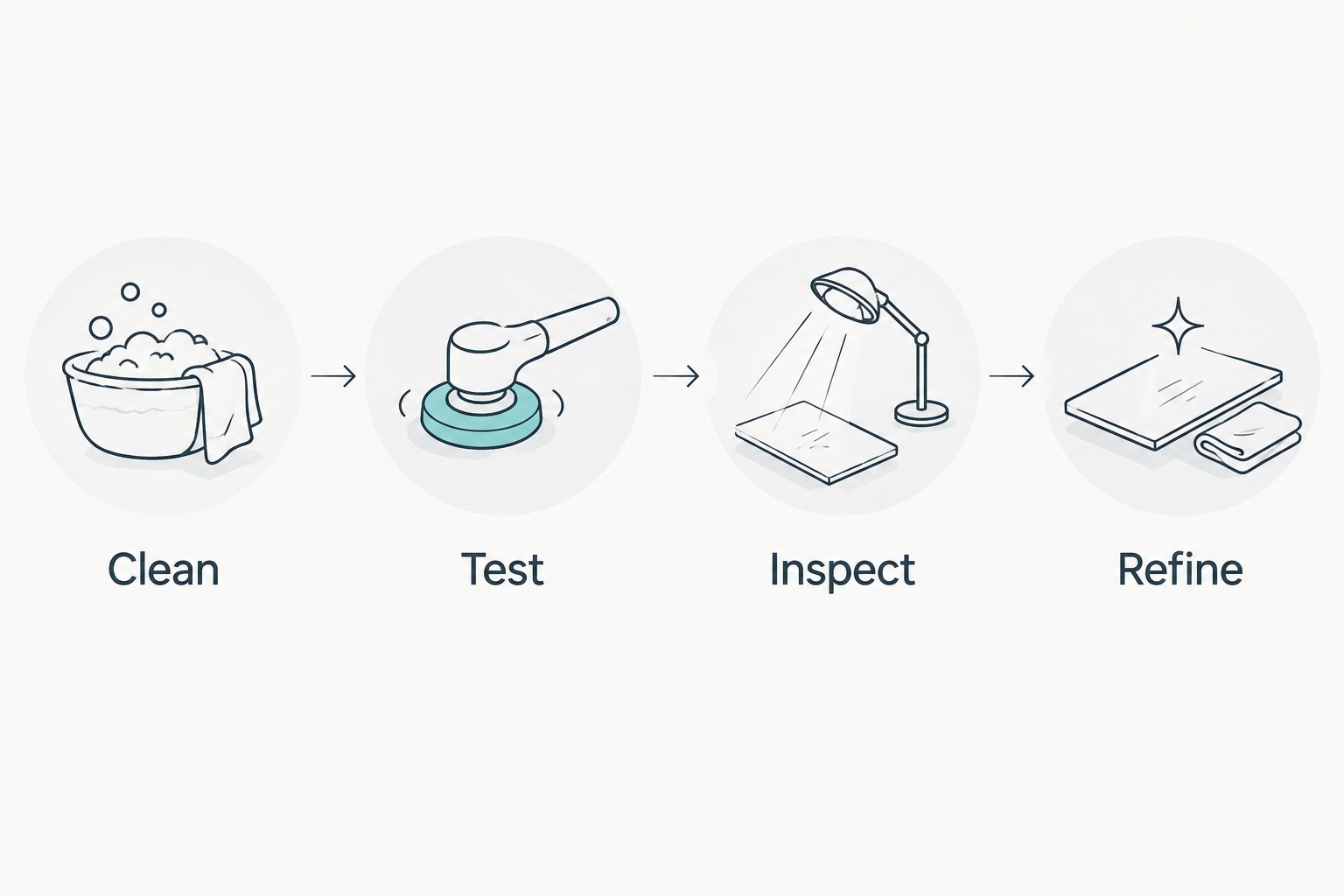
A controlled test spot tells you whether your combination removes defects and leaves an acceptable finish. Complete the sequence before committing to the vehicle.
Clean
Wash and dry the surface, then address bonded contamination with an appropriate decontamination process when needed. Compounding over contamination risks moving abrasive debris across the paint. Protect adjacent trim and vulnerable edges before machine work.
Test
Choose a representative area away from sharp edges. Use a clean, appropriate pad and follow the compound and polisher instructions. Do not begin on the worst scratch simply because it is the most noticeable.
Inspect
Remove residue as instructed and inspect under directional lighting. Look for the original swirls, remaining deeper defects, and newly visible haze. A glossy reflection alone does not prove that correction is complete.
Refine
If defects are reduced but the finish is hazy, test a suitable finishing combination. If defects remain, reassess the pad and technique before selecting a stronger compound. Stop when further correction cannot be justified safely.
Keep pads clean throughout the job. A pad loaded with residue changes how the combination behaves, making later results less comparable with the original test. Follow the pad maker’s cleaning guidance and replace damaged pads rather than trying to compensate with more product.
When DIY buffing is the wrong next move
Stop compounding when you see exposed underlying layers, peeling clearcoat, or damage whose depth you cannot assess. Compound removes material; it cannot reverse those conditions.
Repainted panels also deserve caution. A repair can differ from adjacent factory paint, so success on one panel does not establish that the same approach is suitable everywhere.
Kleandetail paint correction is the service option for Oak Lawn owners who would rather hand over that assessment. Describe the defect you want addressed and discuss the expected outcome before deciding on correction. Do not request maximum cut as though it were a measure of quality.
How the compounds were ranked
The 2026 ranking prioritizes intended application, correction role, workflow complexity, and the limitations a DIY user needs to understand. It does not claim laboratory testing, measured cut rates, or identical performance across paint systems.
Meguiar’s Ultimate Compound takes the general-purpose slot. Griot’s Garage Complete Compound serves beginner orbital users; 3D ONE serves the shared-liquid workflow; Meguiar’s M105 Ultra-Cut Compound serves experienced heavy correction.
The products are not ranked by protective performance. Compounding and protecting paint are different jobs, and none of these recommendations replaces choosing a suitable protective finish afterward.
Which paint correction compound should you choose?
Choose Meguiar’s Ultimate Compound if you are undecided. It is the practical default for a DIY correction attempt, provided your test spot and application method support the choice.
Choose Griot’s Garage Complete Compound for a beginner DA process, or 3D ONE when you want one liquid to support cutting and refinement. Reserve Meguiar’s M105 Ultra-Cut Compound for heavier correction that you know how to assess.
Your 2026 decision should end with a suitable process, not simply a bottle. You need clean paint, an appropriate pad, useful lighting, and a stopping point.
FAQ
What’s the best paint correction compound for buffing a car at home?
Meguiar’s Ultimate Compound is the general DIY default in this guide. Choose it for a conservative correction attempt, then confirm the result on a test spot before treating larger areas.
Can I use a paint correction compound by hand?
Yes, when the product instructions permit hand application. Meguiar’s Ultimate Compound and Griot’s Garage Complete Compound support hand use, but correcting large areas manually requires considerable effort.
Is 3D ONE a compound or a polish?
3D ONE is a hybrid compound and polish. Pad choice shapes its role, and some paint still needs separate cutting and finishing stages with the same liquid.
Is Meguiar’s M105 better than Ultimate Compound?
Meguiar’s M105 Ultra-Cut Compound is better suited to experienced heavy correction, not automatically better for ordinary DIY swirls. Meguiar’s Ultimate Compound is the more appropriate default starting choice in this guide.
Will compounding remove every scratch from my car?
No, compounding cannot safely remove every scratch. A scratch that exposes underlying layers needs a different repair approach, and some remaining defects are safer to leave than to chase with additional cutting.
Do I need to polish after using a compound?
You need a finishing step when compounding leaves haze or an unacceptable finish. Inspect the cleaned test spot under directional lighting rather than assuming every compound finishes identically.
When should I choose professional paint correction instead of DIY?
Choose professional assessment when paint condition, repair history, or defect depth prevents you from judging safe correction. Kleandetail offers paint correction for car owners in Oak Lawn, Illinois.
One last thing
The sharpest-looking defect is not always the right target for your next polishing pass. Once surrounding swirls are removed, a deeper isolated scratch becomes easier to see—even though the overall finish has improved.
For 2026, set your stopping point before you start: an acceptable finish without unnecessary cutting. Kleandetail provides the professional-service alternative when deciding that stopping point is the difficult part.


