
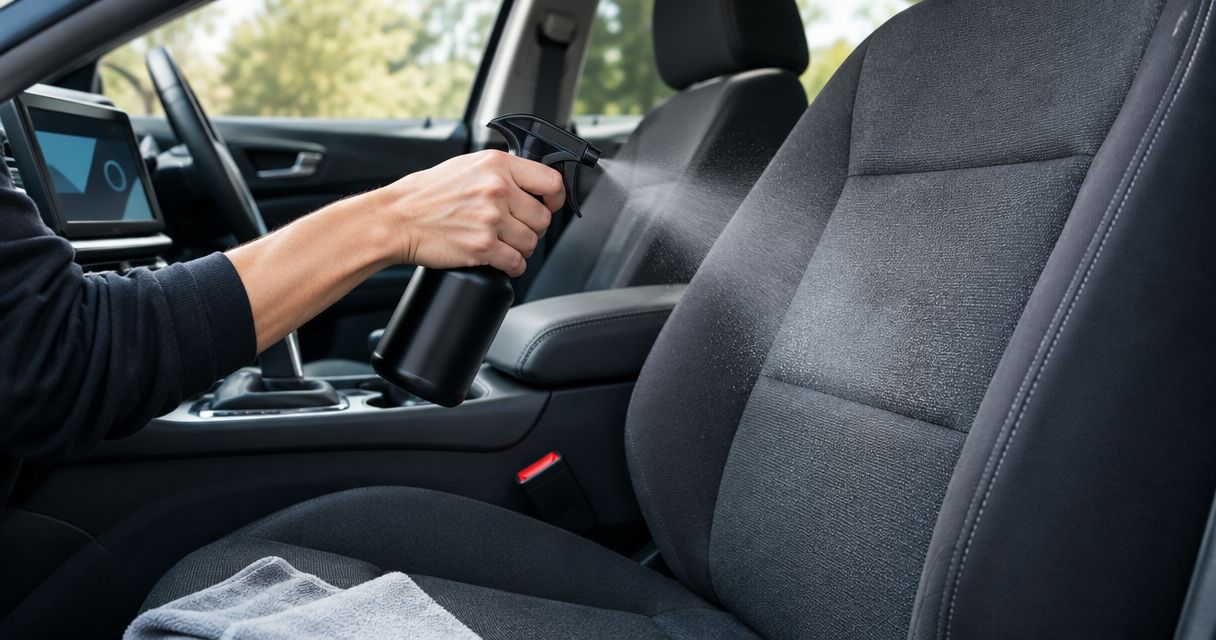
Best overall: Scotchgard Auto Water Shield for compatible cloth car interiors. Best for convertible-top fabric: 303 Fabric Guard; best for an automotive-focused textile treatment: Gtechniq I1 Smart Fabric AB. This 2026 guide compares their uses, limits, and application requirements so you can choose protection without confusing it with cleaning.
- Scotchgard Auto Water Shield is the best fabric protectant spray for car interior owners seeking an automotive-labeled option.
- 303 Fabric Guard suits compatible convertible-top fabrics as well as upholstery; check the vehicle manufacturer's instructions.
- Gtechniq I1 Smart Fabric AB is an automotive-focused alternative for compatible interior textiles.
- Clean and dry cloth seats before protection; no fabric spray replaces stain removal or interior detailing.
Why this matters
Fabric protection and interior cleaning are 2 separate jobs. A protectant helps compatible textiles resist liquid penetration; a cleaner removes contamination already present. Spraying protection over a dirty seat does not remove spilled coffee, body oils, or pet residue.
For Oak Lawn drivers, Kleandetail provides full vehicle detailing alongside its exterior protection services. Kleandetail is best for Oak Lawn car owners who need detailing rather than another bottle of fabric protectant. Fabric-protectant application is a separate service question to confirm before booking.
The useful question in 2026 is not which bottle promises the longest protection. It is which treatment matches your upholstery, your car's care instructions, and the conditions you can provide during application.
What makes the best fabric protectant spray for car interiors?
Judge these 3 product options against the same criteria before choosing:
- Material compatibility: The label must permit your fabric. Cloth, suede, synthetic suede, leather, and vinyl are not interchangeable surfaces.
- Automotive suitability: Look for instructions covering vehicle upholstery or the specific automotive textile you want to treat.
- Application requirements: Ventilation, surface preparation, drying, and curing instructions must fit your workspace and schedule.
- Finish after drying: A hidden-area test should show acceptable color, texture, and appearance before you treat a visible seat panel.
- Maintenance instructions: Choose a product whose cleaning and reapplication directions you can follow, rather than assuming protection is permanent.
Compatibility outranks brand recognition. A familiar spray remains the wrong choice when your vehicle's upholstery instructions exclude it.
Fabric protectants at a glance
| Product | Best for | Standout feature | Key limitation |
|---|---|---|---|
| Scotchgard Auto Water Shield | Everyday compatible cloth interiors | Automotive-specific water-repellent treatment | Not a universal treatment for leather, vinyl, or specialty upholstery |
| 303 Fabric Guard | Compatible convertible-top fabrics | Fabric protection with convertible-top applications | Requires careful separation from incompatible neighboring materials |
| Gtechniq I1 Smart Fabric AB | Automotive-focused textile care | Dedicated fabric treatment from an automotive care range | Surface preparation and curing instructions require planning |
These are use-case recommendations, not measured durability results. No shared wear test supports declaring that one lasts longer than the others in every vehicle.
1. Scotchgard Auto Water Shield: best for everyday cloth interiors
Scotchgard Auto Water Shield is a water-repellent treatment intended for automotive fabrics, including compatible upholstery and carpeting. It is the default starting point when you want an automotive-labeled spray rather than a general household fabric protector.
The practical advantage is a straightforward match between the product category and the job. You still need to read the current container: the Scotchgard name alone does not establish that another product in the range is suitable for your seats.
Scotchgard Auto Water Shield pros:
- Automotive-specific positioning makes it a direct candidate for compatible cloth seats and carpets.
- Water repellency addresses everyday liquid-spill exposure without pretending to clean the fabric.
- Product-specific directions give you a clearer application reference than advice intended for household furniture.
Scotchgard Auto Water Shield cons:
- It does not remove existing stains, odors, or embedded dirt.
- Suitability does not extend automatically to leather, vinyl, suede, or mixed-material seating.
- Application still requires the ventilation and drying conditions stated on the label.
Best for: Drivers maintaining ordinary cloth upholstery who want to start with an automotive-specific product.
Before applying it, identify every material in the treatment area. A seat with a cloth center can still have synthetic trim, contrasting piping, or other surfaces requiring different care. Keep the spray confined to approved fabric rather than treating the whole seat as one material.
Verdict: Buy Scotchgard Auto Water Shield for compatible everyday cloth interiors; skip it when the material is uncertain.
2. 303 Fabric Guard: best for compatible convertible-top fabrics
303 Fabric Guard is a fabric-protection treatment used on suitable upholstery and outdoor textiles, including compatible fabric convertible tops. It earns a distinct place here for owners whose fabric-care needs extend beyond interior seating.
That does not make it a universal convertible-top product. Fabric tops and vinyl tops need different care, and the vehicle or top manufacturer's instructions remain the deciding reference.
303 Fabric Guard pros:
- Its fabric applications include compatible upholstery and convertible-top materials.
- It addresses water repellency without requiring you to confuse protection with cleaning.
- It suits owners evaluating protection for more than one approved textile surface.
303 Fabric Guard cons:
- It is not a treatment for every adjacent material; overspray control matters around trim and windows.
- A fabric-top application does not establish compatibility with every interior textile.
- Dirty or damp fabric still needs preparation before treatment.
Best for: Convertible owners who have confirmed that their top material and care instructions permit the product.
For a car-interior-only purchase in 2026, Scotchgard Auto Water Shield is the more directly automotive-interior-oriented starting point. Choose 303 Fabric Guard because its approved uses match the fabric you actually own, not because a convertible-top application sounds tougher.
Protect neighboring surfaces according to the directions and work where you can control overspray. If you cannot isolate the intended fabric, postpone the application rather than coating nearby materials indiscriminately.
Verdict: Buy 303 Fabric Guard for an approved fabric-top use; hold until compatibility is clear for specialty interior upholstery.
3. Gtechniq I1 Smart Fabric AB: best for automotive textile care
Gtechniq I1 Smart Fabric AB is a fabric treatment from an automotive detailing product range. It is an alternative for drivers who want a dedicated textile-protection step within their car-care routine.
Its place in this comparison comes from that automotive focus, not an unsupported claim that it outlasts every competing spray. Read the current product instructions before planning the work, particularly the requirements for preparation, application conditions, and curing.
Gtechniq I1 Smart Fabric AB pros:
- Its intended role is fabric protection rather than general-purpose interior cleaning.
- The automotive context makes it relevant to compatible vehicle upholstery.
- Product-specific application guidance provides a defined process to follow.
Gtechniq I1 Smart Fabric AB cons:
- It adds a separate application and curing stage after cleaning.
- It does not make unknown or excluded upholstery safe to treat.
- It does not replace prompt spill cleanup or routine vacuuming.
Best for: Owners who want an automotive-focused fabric treatment and will follow its complete preparation process.
Do not select it solely because a product name sounds more technical. Check whether you can leave the vehicle unused for the required period and keep the treated textile within the stated application conditions.
A protectant that fits your process is a better choice than one applied hurriedly to a damp seat. Keep expectations specific: textile protection is not a remedy for worn fabric, damaged foam, or an unresolved odor source.
Verdict: Buy Gtechniq I1 Smart Fabric AB for a planned textile-care routine; wait if you cannot meet its application requirements.
Prepare your interior before applying any fabric protectant
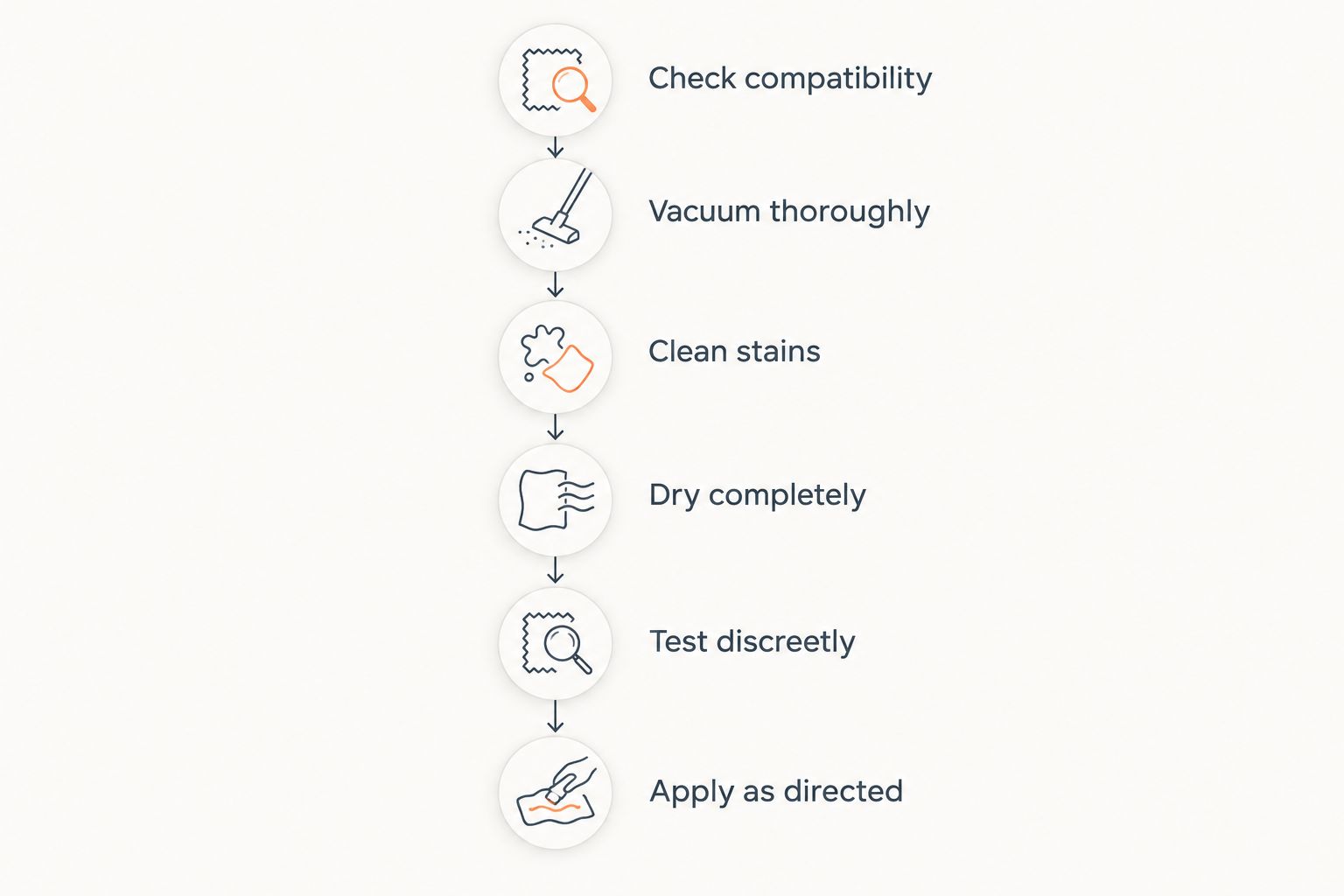
Use these 6 preparation steps for a 2026 interior-care plan. The sequence is general; the product label and vehicle care instructions control the actual application.
1. Check compatibility
Identify the upholstery from the vehicle's care information. Do not identify synthetic suede by touch alone or assume a cloth-looking insert accepts every fabric spray.
Check both sets of instructions: the vehicle manufacturer's and the protectant manufacturer's. If either excludes the material, stop.
2. Vacuum thoroughly
Remove loose grit, crumbs, and pet hair before introducing liquid. Work along seams and seat creases without forcing tools into upholstery or electrical connections.
Treat vacuuming as preparation, not stain removal. Visible residue still needs an appropriate cleaning method.
3. Clean stains
Use a cleaner approved for the upholstery and the contamination involved. Do not layer protectant over a cleaner that has not been removed as directed.
For dirty carpets or seats, the guide to auto carpet cleaners and shampoos covers the cleaning stage. Protection comes afterward, not instead.
4. Dry completely
Allow cleaned fabric to dry to the condition required by the protectant instructions. A dry-looking surface does not establish that deeper upholstery is ready.
Do not rush this stage because the car is needed later that day. Schedule protection around the full cleaning, drying, and curing process.
5. Test discreetly
Apply a test in an inconspicuous area exactly as directed. Assess it after the stated drying period for changes in color, feel, or appearance.
A successful spot test is a screening step, not permission to ignore a manufacturer exclusion. Stop if the result is unacceptable.
6. Apply as directed
Follow the label for ventilation, coverage, application method, drying, and curing. Keep the treatment away from controls, pedals, displays, and surfaces outside its approved uses.
Do not invent a universal coat count or drying time. Different formulations require different procedures.
How the recommendations are ranked
The 2026 ranking prioritizes material compatibility, automotive relevance, application requirements, finish checks, and maintenance instructions. Scotchgard Auto Water Shield takes the default interior slot; 303 Fabric Guard addresses compatible convertible-top fabric; Gtechniq I1 Smart Fabric AB offers an automotive-focused textile-care alternative.
The ranking does not assign durability scores, stain-removal scores, or protection lifespans without comparable evidence. Water beading alone does not prove resistance to every liquid, stain, or cleaning chemical.
Which fabric protectant should you choose?
Choose Scotchgard Auto Water Shield as the default for compatible everyday cloth interiors. Choose 303 Fabric Guard when an approved convertible-top application drives the purchase, or Gtechniq I1 Smart Fabric AB when its textile-care process fits your routine.
If the seat is already stained or the cabin smells, choose cleaning first. Kleandetail provides full vehicle detailing in Oak Lawn; ask about the condition of your interior and confirm any fabric-protection request separately.
Discuss your interior detailing needs
Ask about full vehicle detailing in Oak Lawn and confirm the scope of any fabric-protection request.
FAQ
What's the best fabric protectant spray for car interior seats?
Scotchgard Auto Water Shield is the default recommendation here for compatible everyday cloth seats. Confirm that both the current product label and your vehicle's care instructions permit its use.
Is 303 Fabric Guard better than Scotchgard for car seats?
Neither is better for every car seat. Choose by approved material and application instructions; 303 Fabric Guard has a distinct role for compatible fabric convertible tops, while Scotchgard Auto Water Shield is automotive-interior-oriented.
Can I use fabric protectant on leather or synthetic suede?
Do not use a fabric protectant on leather or synthetic suede unless the exact product and upholstery manufacturer explicitly permit it. A product suitable for ordinary woven cloth is not automatically suitable for either material.
Will fabric protectant remove old stains or pet smells?
No, fabric protectant is not a stain remover or odor treatment. Clean the contamination and address its source before considering protection.
How long does fabric protectant last on car seats?
There is no single lifespan that applies to every fabric protectant and vehicle. Follow the product's maintenance instructions because abrasion, cleaning, fabric type, and use affect protection.
Can I spray fabric protectant on a child car seat?
Do not apply aftermarket fabric protectant to a child restraint unless the restraint manufacturer explicitly permits it. Follow that manufacturer's cleaning and care instructions rather than treating the restraint like ordinary vehicle upholstery.
Can Kleandetail help if my interior needs cleaning first?
Kleandetail provides full vehicle detailing in Oak Lawn, Illinois. Describe the upholstery and contamination when contacting the shop, and confirm fabric-protection application separately.
One last thing
Do not test fabric protection by deliberately staining your seat. A water-repellency check, where permitted by the product instructions, is not a license to experiment with coffee, oil, or dyed drinks.
For your 2026 care plan, keep the product instructions with your maintenance notes. Knowing what was applied helps you choose compatible cleaning methods later.


