
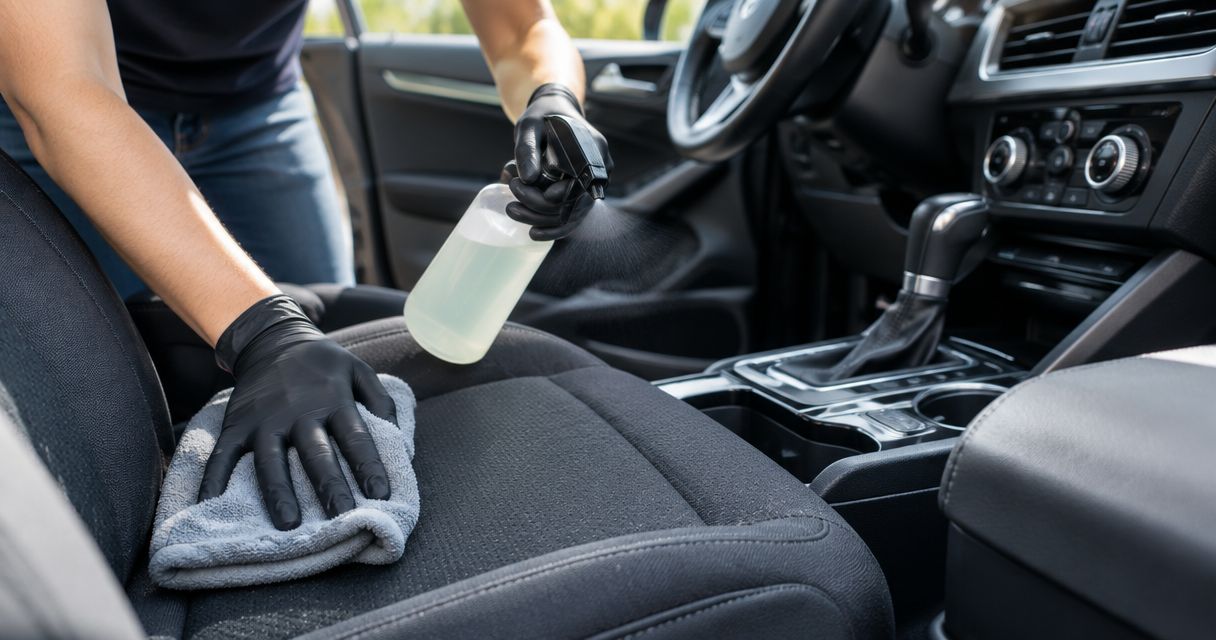
Best overall: a ready-to-use enzyme upholstery cleaner. Best for pet accidents: a urine-targeted enzyme cleaner. Best for repeat spot cleaning: an enzyme upholstery concentrate. Best for washable removable textiles: an enzyme laundry detergent. This 2026 guide helps you choose the best automotive enzyme cleaner by stain type, material compatibility, and application method—not fragrance.
- The best automotive enzyme cleaner matches the organic stain and explicitly permits use on your interior material.
- Ready-to-use enzyme upholstery cleaner is the default for isolated food spills on compatible carpet and cloth seats.
- Choose a urine-targeted enzyme cleaner for pet accidents; general upholstery cleaning is a different task.
- Kleandetail offers full vehicle detailing for Oak Lawn car owners who want professional interior care.
Why this matters
An enzyme cleaner belongs in your interior-cleaning kit when the contamination suits its chemistry. Enzymes act on particular organic materials; they are not universal stain removers. A cleaner intended for food residue is not automatically the right answer for urine, greasy road grime, or ink.
The stain and the smell also need separate checks. A seat can look clean while residue remains beneath the visible fabric, and a scented surface can still contain the source of an odor. Adding more cleaner without understanding that distinction creates another problem: excess moisture.
For your 2026 interior cleanup, choose the least complicated method that addresses the actual contamination. Kleandetail provides full vehicle detailing in Oak Lawn, Illinois, if you want professional interior care rather than another DIY product purchase.
What makes the best automotive enzyme cleaner?
Judge these 4 cleaner types against the same criteria before choosing a bottle:
- Stain match: The label should address the contamination you have, such as food residue or pet urine. The word enzyme alone does not establish suitability.
- Material permission: Confirm the cleaner permits use on automotive upholstery, carpet, or the specific removable textile. Do not extend fabric directions to leather.
- Application control: You need clear directions for dilution, application, contact time, and removal. An unspecified soaking method is not a useful instruction for a car seat.
- Residue management: Check whether you must blot, rinse, launder, or extract the treated material. Applying a cleaner is only part of the job.
- Drying practicality: Choose a method you can finish safely. Fixed upholstery, removable mats, and washable covers do not offer the same drying options.
The best choice is the cleaner whose instructions you can follow completely on the affected material. A stronger-looking label does not compensate for an unsuitable application method.
Enzyme cleaners at a glance
This 2026 comparison ranks cleaner formats by their use case. Check the current product label before treating your vehicle; a format name does not establish compatibility for every formula.
| Cleaner type | Best for | Standout feature | Key limitation |
|---|---|---|---|
| Ready-to-use enzyme upholstery cleaner | Isolated food spills on compatible cloth and carpet | Avoids a separate dilution step | Not automatically appropriate for urine, leather, or deep contamination |
| Urine-targeted enzyme cleaner | Pet accidents on label-approved textiles | Directions address a specific contamination problem | Surface treatment does not establish that underlying padding is clean |
| Enzyme upholstery concentrate | Repeated spot cleaning on compatible materials | Allows label-directed preparation for the task | Requires accurate dilution and clear removal instructions |
| Enzyme laundry detergent | Removable textiles approved for washing | Fits a complete wash-and-rinse process | Not a default cleaner for fixed seats or installed carpet |
1. Ready-to-use enzyme upholstery cleaner: best for food spills
A ready-to-use enzyme upholstery cleaner is the simplest starting point for an isolated food spill on compatible cloth or carpet. The formula is supplied for direct application, so you do not need to prepare a dilution. Choose a product whose directions cover both the residue and the material.
This category earns the default position because it removes a preparation step. That does not make every ready-to-use bottle appropriate for every seat. You still need to identify the upholstery, test an inconspicuous area, and follow the cleaner's removal instructions.
Ready-to-use enzyme upholstery cleaner pros
- No separate concentrate-measuring step before application.
- Suits targeted treatment rather than automatically cleaning the entire interior.
- Keeps preparation straightforward when the label matches the spill.
- Provides a clear starting point for a small, accessible textile stain.
Ready-to-use enzyme upholstery cleaner cons
- General upholstery directions do not establish suitability for urine.
- The cleaner does not replace a leather-specific care method.
- A surface application does not address contamination that has entered padding.
Best for: A contained food spill on cloth seating or carpet that the label explicitly permits you to treat.
Blot recoverable liquid before applying cleaner. Remove loose solids without grinding them into the fabric, then test and treat according to the directions. Do not repeatedly wet the seat simply because the first pass leaves a visible mark; some discoloration requires a different approach.
Verdict: Buy a ready-to-use enzyme upholstery cleaner for a compatible, isolated food stain—not as an all-surface interior cleaner.
2. Urine-targeted enzyme cleaner: best for pet accidents
A urine-targeted enzyme cleaner is the better category when a pet accident caused the stain or odor. Choose a formula that expressly addresses urine and permits treatment of the affected textile. A general-purpose enzyme cleaner is not an interchangeable substitute.
The critical question is where the contamination went. An accident confined to a removable mat presents a different cleanup problem from liquid that entered a seat cushion or carpet underlay. Match the treatment to the accessible material rather than assuming a clean-looking surface proves complete removal.
Urine-targeted enzyme cleaner pros
- Matches the purchase to the known contamination source.
- Gives you urine-specific application and removal directions to assess.
- Supports targeted treatment of compatible mats, carpet, or fabric.
Urine-targeted enzyme cleaner cons
- Household textile directions do not automatically cover vehicle interiors.
- Fixed padding can remain contaminated after surface treatment.
- A noticeable scent does not demonstrate that the urine source is gone.
Best for: A known pet accident on a textile explicitly covered by the cleaner's directions.
Before treating a seat, check the vehicle's care instructions and consider any seams, heating elements, or electrical components nearby. Do not flood upholstery to reproduce directions written for another setting. If the necessary treatment requires access beneath the surface, stop repeating surface applications.
Verdict: Buy a urine-targeted enzyme cleaner for a compatible pet-accident cleanup; hold if you cannot safely reach and dry the affected material.
3. Enzyme upholstery concentrate: best for repeat spot cleaning
An enzyme upholstery concentrate requires preparation before use. Its advantage is a label-directed cleaning solution for recurring tasks; its drawback is that you become responsible for measuring and mixing correctly. Choose this format only when the instructions clearly cover your upholstery and contamination.
For a single spill, concentrate adds work that a ready-to-use cleaner avoids. For repeat cleaning, a documented dilution and removal process can make sense. Keep the original directions available rather than relying on a remembered mixing ratio.
Enzyme upholstery concentrate pros
- Provides a defined preparation process when the label specifies dilution.
- Fits repeated cleaning of the same approved material and stain type.
- Lets you prepare a solution for a planned task instead of improvising.
Enzyme upholstery concentrate cons
- Incorrect dilution changes the intended application.
- An unlabelled secondary bottle makes later use harder to assess safely.
- Upholstery approval does not automatically mean extraction-machine approval.
Best for: Car owners who repeatedly treat compatible textile stains and will measure, label, and remove the solution as directed.
Do not assume that more concentrate means better cleaning. Follow the dilution exactly, and check whether the prepared solution has storage restrictions. If you intend to use a machine, both the cleaner and the machine instructions must permit that use.
Verdict: Buy an enzyme upholstery concentrate for a repeatable cleaning routine; skip it when you want the simplest response to one spill.
4. Enzyme laundry detergent: best for washable removable textiles
An enzyme laundry detergent belongs in this guide only for removable textiles whose care instructions permit washing. Think of a washable seat cover or other removable fabric item—not an installed seat cushion. The detergent's wash-and-rinse process is fundamentally different from spraying fixed upholstery.
Enzyme detergents can help address suitable organic residues during laundering. However, neither the presence of enzymes nor the ability to remove an item establishes that the item is washable. Check its care label first.
Enzyme laundry detergent pros
- Fits a complete laundering process for approved washable fabrics.
- Separates cleaning from the vehicle's fixed upholstery and electronics.
- Includes rinsing as part of the intended cleaning method.
Enzyme laundry detergent cons
- Not appropriate for textiles labelled against washing or the selected detergent.
- Removability does not prove machine-wash compatibility.
- Unsuitable as a default spray-on treatment for installed carpet or seats.
Best for: Removable fabric items with care instructions that permit the proposed detergent and wash method.
Remove the textile before laundering and follow its washing and drying directions. Reinstall it only after it is dry. Keep any attachment hardware or nonwashable components out of the wash unless the item's instructions explicitly permit them.
Verdict: Buy an enzyme laundry detergent for approved washable removable textiles; skip it for fixed automotive upholstery.
How to use an enzyme cleaner without over-wetting the interior
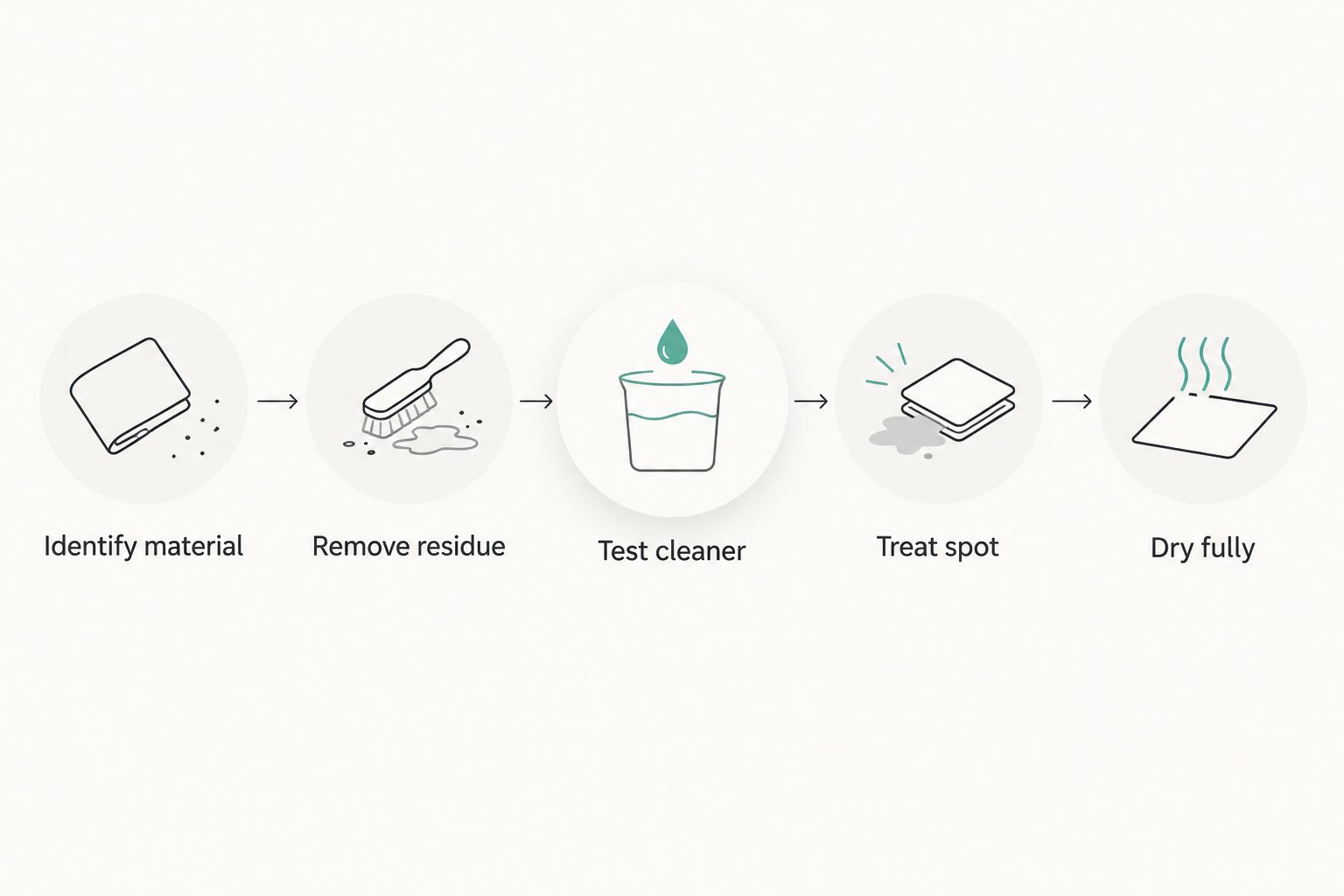
A sensible 2026 cleanup follows a sequence: identify the material, remove recoverable contamination, test the cleaner, treat the spot, and complete the removal and drying steps. Follow the product label for timing; there is no universal contact time for all enzyme formulas.
Make the compatibility checks first
Use 3 checks before application: the vehicle's care instructions, the cleaner's material directions, and a hidden-area test. Each answers a different question. A cleaner labelled for upholstery still needs to suit the particular finish you are treating.
For leather, coated trim, screens, or delicate interior finishes, use the relevant care method instead of extending a textile cleaner's instructions. Keep the cleaning area defined, and protect adjacent materials from unintended contact.
Separate treatment from removal
Keep 2 separate cloths available: one for recovering the original residue and another clean cloth for the product's removal step. This is a practical separation of tasks, not a substitute for the label's directions. Use clean sections rather than returning collected contamination to the upholstery.
Do not mix the enzyme cleaner with disinfectant, bleach, vinegar, or another interior chemical. Combining formulas creates a treatment the individual labels do not describe. If you change products, follow the relevant removal instructions before starting another treatment.
Finish the job with drying
Do not leave a seat damp and consider the stain solved. Ventilate safely, follow the vehicle and cleaner directions, and check the treated area before regular use. Persistent odor after drying is a reason to reassess the source, not automatically add more liquid.
For general soil across a larger carpet area, compare the method with the options in best auto carpet cleaners and shampoos. Enzyme spot treatment and broad carpet cleaning solve different problems.
How these cleaner types were ranked
The 2026 ranking prioritizes stain match, material permission, application control, removal, and drying practicality. Ready-to-use upholstery cleaner takes the default slot because it avoids dilution for an isolated compatible spill. Urine-targeted cleaner, concentrate, and laundry detergent each serve a narrower, distinct task.
This is a format-based buying guide, not a product-performance test. A specific bottle earns your purchase only when its current directions satisfy those criteria. Brand recognition alone does not establish suitability.
Which automotive enzyme cleaner should you choose?
Choose a ready-to-use enzyme upholstery cleaner when you have an isolated food stain on approved cloth or carpet. Choose a urine-targeted formula for a pet accident, concentrate for a measured repeat-cleaning routine, and laundry detergent only for approved washable removable textiles.
Kleandetail is best for Oak Lawn car owners seeking full vehicle detailing rather than a DIY cleaner purchase. Treating a specific stain yourself and arranging professional vehicle care are different decisions; choose based on the condition of the interior and the work you want to handle.
Explore professional vehicle detailing
Kleandetail provides full vehicle detailing in Oak Lawn, Illinois.
FAQ
What's the best automotive enzyme cleaner in 2026?
A ready-to-use enzyme upholstery cleaner is the default for an isolated food spill on compatible cloth or carpet. Choose a urine-targeted formula for pet accidents, and verify the current label before treating any material.
Can I use an enzyme cleaner on leather car seats?
Use an enzyme cleaner on leather only if both the cleaner's directions and the vehicle's care instructions permit it. Fabric or carpet approval does not establish leather compatibility.
Is a pet urine enzyme cleaner better than an upholstery cleaner?
A urine-targeted enzyme cleaner is the better category for a known pet urine accident on an approved textile. A general upholstery cleaner remains a separate choice for other residue.
How long should I leave an enzyme cleaner on a car seat?
Follow the contact time on the specific cleaner's label. There is no universal timing rule across enzyme formulas, and fixed upholstery needs an application method that avoids unsafe saturation.
Can I put an enzyme cleaner in a carpet extractor?
Use an enzyme cleaner in an extractor only when both the cleaner and machine directions permit it. Upholstery compatibility alone does not establish machine compatibility.
Will an enzyme cleaner disinfect my car interior?
An enzyme claim does not establish that a cleaner disinfects. If disinfection is your goal, use a product with applicable disinfecting directions that also permits treatment of the surface.
Why does the smell return after I clean a seat?
A returning smell means the odor source needs reassessment; it does not identify the cause by itself. Inspect for remaining contamination, damp material, and affected padding rather than repeatedly applying cleaner.
When should I choose professional detailing instead?
Choose professional detailing when you want the interior-care work handled rather than buying and applying another cleaner yourself. Kleandetail offers full vehicle detailing for car owners in Oak Lawn, Illinois.
One last thing
For your 2026 cleanup, remember that a cleaner is not a repair. Enzyme treatment addresses suitable residue; it does not restore damaged fibers, repair a finish, or prove that hidden padding is clean. Once the material is clean and dry, assess any remaining mark before repeating the same treatment.


