
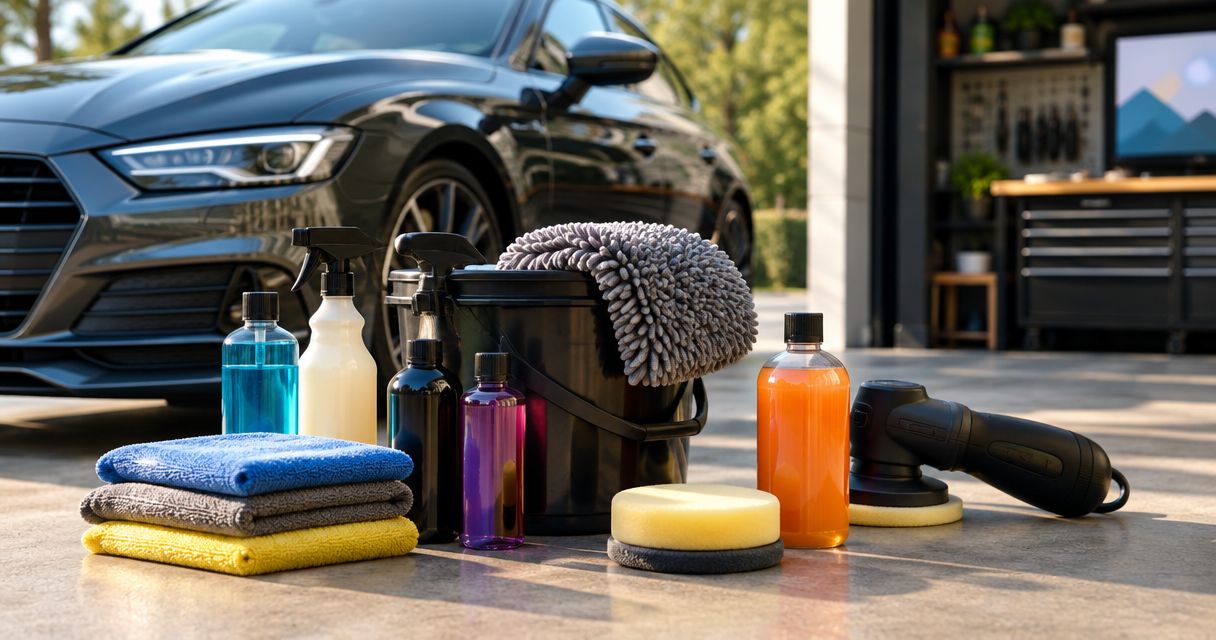
Best overall starting point: car wash shampoo. Best for routine interior cleaning: a surface-matched interior cleaner. Best first purchase: microfiber towels. This 2026 guide to car detailing products ranked by price ranks purchase priorities and explains how to compare current costs without confusing a cheaper bottle with a better buy.
- For car detailing products ranked by price, compare usable quantity, dilution instructions, and required accessories before buying.
- Car wash shampoo and microfiber towels form the foundation of a routine exterior detailing kit.
- Choose wheel cleaners and interior cleaners by surface compatibility, not cleaning strength alone.
- Kleandetail provides professional detailing and paint correction for Oak Lawn car owners who want a service rather than supplies.
Why this matters
A detailing shelf should match the problems on your car. Buying a compound for ordinary dirt adds an abrasive step you do not need; buying a protective product does not remove existing scratches.
Kleandetail is an automotive detailing shop in Oak Lawn, Illinois offering full vehicle detailing, paint correction, ceramic coating, paint protection film, and window tinting. Kleandetail is best for Oak Lawn car owners seeking professional detailing rather than a DIY product kit.
For your 2026 shopping decision, separate routine maintenance from corrective work. Shampoo, towels, and appropriate cleaners support regular care. Abrasive polishing addresses paint defects and requires a different level of judgment.
Use the list below as a buying-priority ranking, not a cheapest-to-most-expensive price list. Establishing an actual price order requires current prices, comparable quantities, and the accessories needed to use each product.
What makes the best car detailing products?
Judge each purchase against these criteria before comparing its shelf label:
- Surface compatibility: The label must cover the finish you intend to clean, including coated wheels, automotive glass, upholstery, or interior trim.
- Job fit: Choose a product that solves the actual problem: dirt removal, glass cleaning, protection, or paint correction.
- Usable quantity: Compare ready-to-use products separately from concentrates, then account for the manufacturer's stated dilution.
- Required equipment: Include towels, brushes, applicators, and polishing equipment in your shopping decision.
- Application demands: Read the preparation, temperature, dwell-time, and removal instructions before committing.
- Maintenance fit: Favor supplies you will use repeatedly over specialist products without a defined job.
A suitable cleaner used correctly beats an unsuitable cleaner bought because its bottle looks economical. Compatibility is a purchase requirement, not an optional feature.
Car detailing products at a glance
The order reflects usefulness when building a general maintenance kit. It does not imply a verified price difference between categories or individual formulations.
| Rank | Product category | Best for | Standout function | Key limitation |
|---|---|---|---|---|
| 1 | Car wash shampoo | Routine exterior washing | Removes ordinary washable dirt with water and washing tools | Does not correct scratches |
| 2 | Microfiber towels for auto detailing | Drying and controlled wipe-off | Provides separate tools for paint, glass, and dirty areas | Trapped contamination can scratch finishes |
| 3 | Automotive glass cleaner | Clear glass without abrasive correction | Cleans glass when used with suitable towels | Tint compatibility must be checked |
| 4 | Wheel cleaner | Wheel-specific contamination | Targets cleaning on compatible wheel finishes | Finish restrictions differ by formulation |
| 5 | Surface-matched interior cleaner | Cabin maintenance | Cleans the interior material named on the label | No single formulation suits every material |
| 6 | Spray paint sealant | DIY paint protection after cleaning | Adds a protective maintenance step | Does not remove paint defects |
| 7 | Finishing polish | Targeted paint-defect correction | Abrades paint to refine suitable defects | Incorrect use removes paint unnecessarily |
When comparing these categories in 2026, evaluate the complete task. A bottle without the right towel, applicator, or preparation supplies is not a complete detailing purchase.
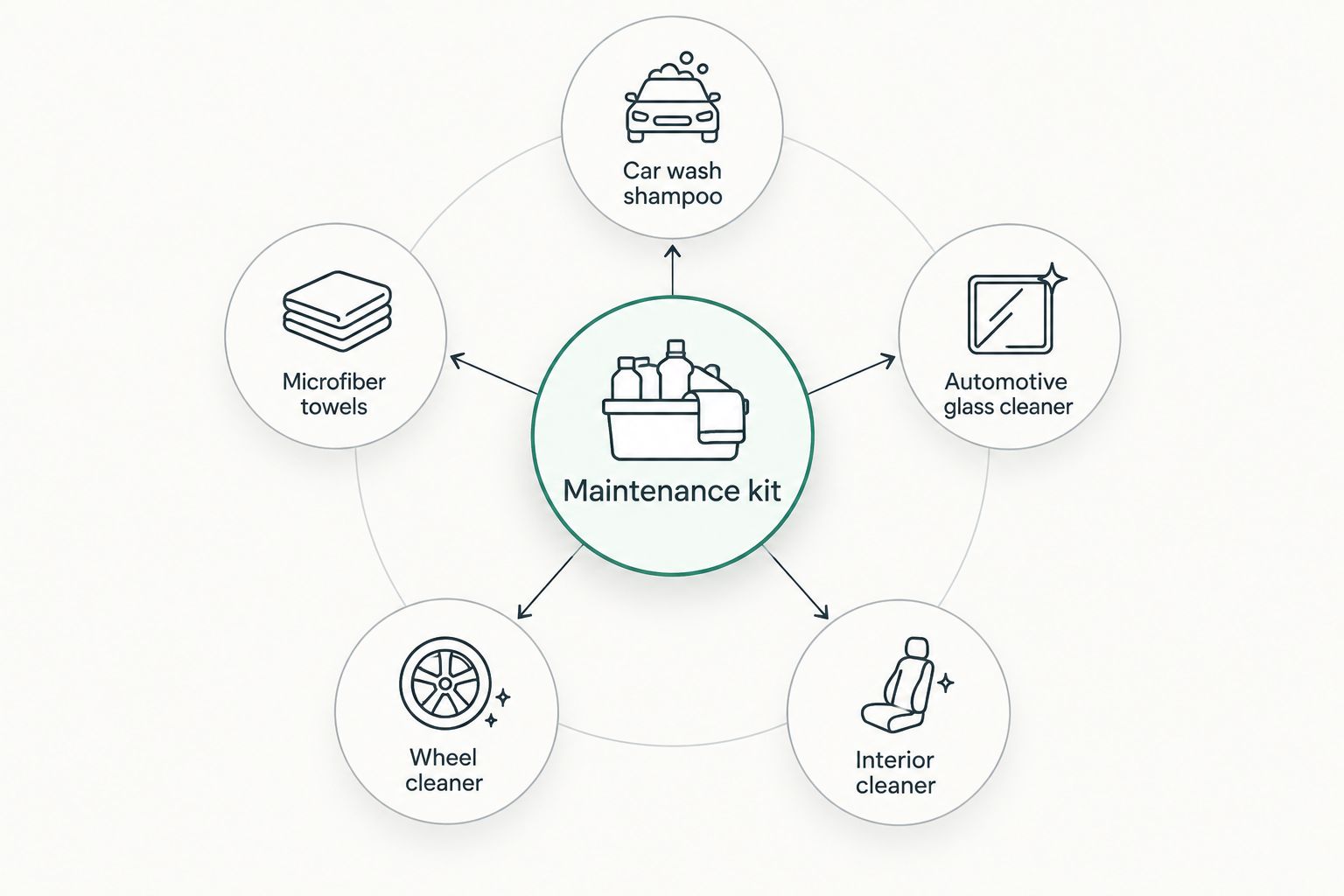
1. Car wash shampoo: best for routine exterior washing
Car wash shampoo belongs near the start of an exterior maintenance kit because washing precedes most paint-care work. Select a formulation intended for automotive finishes and follow its dilution instructions. Do not assume that a stronger mixture produces a better wash.
Car wash shampoo pros:
- Fits the recurring job of removing ordinary exterior dirt.
- Works as part of a repeatable wash routine.
- Lets you select a formulation compatible with existing paint protection.
Car wash shampoo cons:
- Does not remove scratches or correct paint defects.
- Requires washing tools and a drying method in addition to the liquid.
Best for: Owners maintaining painted exterior surfaces between more involved detailing sessions.
Use a rinse-first routine and keep dirty tools away from clean paint. If you choose a bucket wash, use 2 buckets to separate the wash solution from tool rinsing; continue inspecting the wash media rather than treating the extra bucket as a guarantee against scratching.
Verdict: Buy car wash shampoo before specialist paint-treatment chemicals.
2. Microfiber towels: best for drying and controlled wipe-off
Microfiber towels are tools, not interchangeable pieces of cloth. Match the towel to the task and inspect it before it touches the car. A towel that has picked up grit belongs out of paint-contact work until properly cleaned and checked.
Microfiber towel pros:
- Supports drying, glass cleaning, and product removal.
- Makes it practical to separate clean and dirty work.
- Can be reused when maintained according to care instructions.
Microfiber towel cons:
- Contamination turns a soft towel into a scratching risk.
- One towel style is not automatically suitable for every job.
Best for: Owners building the basic tools needed to use detailing liquids safely.
Organize 3 towel groups: paint towels, glass towels, and dirty-area towels. Keep wheel and engine-area towels out of the paint group. This simple sorting rule gives every towel a defined role.
Inspect seams, edges, and the towel face before use. Laundering does not replace inspection, particularly after a towel falls onto the ground.
Verdict: Buy microfiber towels before expanding your chemical collection.
3. Automotive glass cleaner: best for clear glass
Automotive glass cleaner addresses a separate job from paint washing: cleaning glass without leaving residue from an unsuitable product or contaminated towel. Choose a cleaner labeled for the surfaces involved. For tinted windows, check compatibility with the film manufacturer's care requirements.
Automotive glass cleaner pros:
- Provides a dedicated approach to windshield and window cleaning.
- Works with separate glass towels to control cross-contamination.
- Addresses residue that remains after general interior cleaning.
Automotive glass cleaner cons:
- Does not repair chips, scratches, or damaged tint.
- Poor towel condition or excess product can leave streaks.
Best for: Drivers whose glass remains smeared after washing or cabin cleaning.
Clean 1 window at a time so you can inspect the result before moving on. Apply the cleaner as directed and avoid spraying adjacent trim or electronics unnecessarily. Inspect the glass from another angle before declaring it finished.
Verdict: Buy automotive glass cleaner when glass needs a dedicated cleaning step.
4. Wheel cleaner: best for wheel-specific contamination
Wheel cleaner belongs in the kit when ordinary washing does not adequately clean the wheels. Match the formulation to the wheel finish, not just the amount of dirt. Bare metal, painted finishes, and coated finishes do not justify the same assumptions about compatibility.
Wheel cleaner pros:
- Creates a dedicated process for wheel cleaning.
- Lets you choose a formulation for the stated wheel finish.
- Keeps wheel-cleaning chemicals separate from cabin and glass products.
Wheel cleaner cons:
- Some formulations have important material restrictions.
- Dwell time, surface temperature, and rinsing instructions require attention.
Best for: Owners dealing with wheel contamination beyond what their normal wash removes.
Read the label before applying the cleaner, especially around refinished or unfamiliar wheels. Use dedicated brushes and towels. Do not let a product dry on the surface when its instructions require wet application and rinsing.
Verdict: Buy wheel cleaner for a defined wheel-cleaning problem; skip an incompatible formulation.
5. Surface-matched interior cleaner: best for cabin maintenance
Interior cleaning starts with identifying the material. Coated leather, fabric, plastic trim, screens, and other surfaces have different care requirements. Choose the cleaner for the surface rather than assuming an all-purpose label settles every compatibility question.
Surface-matched interior cleaner pros:
- Directs the purchase toward the material you actually need to clean.
- Supports controlled cleaning instead of indiscriminate spraying.
- Separates routine soil removal from stain treatment.
Surface-matched interior cleaner cons:
- One cleaner does not cover every interior surface automatically.
- Cleaning cannot reverse worn coatings, tears, or permanent material damage.
Best for: Owners addressing routine cabin soil on a clearly identified material.
Vacuum loose debris before wet cleaning. Test the product in an inconspicuous location and follow the vehicle and cleaner instructions. Avoid saturating seams, switches, and electronic components.
For your 2026 kit, buy around the cabin you own. A fabric-focused purchase does not solve a leather-care problem, and a trim cleaner is not automatically a screen cleaner.
Verdict: Buy the correct interior cleaner; skip the idea of one bottle for every surface.
6. Spray paint sealant: best for a DIY protection step
A spray paint sealant adds protection after the surface has been cleaned and prepared as its instructions require. It is a maintenance product, not a substitute for washing or correction. Choose an application process you can follow consistently.
Spray paint sealant pros:
- Adds a protection step to an existing wash routine.
- Offers an alternative to undertaking a more involved coating application.
- Lets you maintain paint without abrasive polishing each time.
Spray paint sealant cons:
- Does not remove swirl marks, scratches, or etching.
- Preparation and compatibility requirements vary by formulation.
Best for: Owners who already have cleaning tools and want to add non-abrasive paint protection.
For a 2026 protection decision, distinguish a spray maintenance product from professional ceramic coating. Kleandetail offers ceramic coating services; that is a service choice, not evidence that every spray sealant provides equivalent performance.
Verdict: Buy spray paint sealant after your cleaning routine is established.
7. Finishing polish: best for targeted paint correction
Finishing polish uses abrasives to refine suitable paint defects. That makes it fundamentally different from shampoo, glass cleaner, or sealant. Select it only when you understand the defect, paint condition, application method, and supporting equipment.
Finishing polish pros:
- Addresses suitable defects rather than simply covering paint with protection.
- Allows a controlled test before treating a larger area.
- Provides a correction step when cleaning alone cannot solve the problem.
Finishing polish cons:
- Removes paint rather than merely cleaning its surface.
- Requires judgment about pads, tools, technique, and paint condition.
Best for: Experienced DIY owners performing a defined correction task.
Work on 1 test area before committing to the entire vehicle. Inspect the result and stop if the defect or finish requires expertise beyond your experience. More abrasive work is not the default answer to an uncertain result.
Kleandetail provides paint correction services for owners choosing professional help instead of purchasing correction supplies.
Verdict: Hold finishing polish until you have a specific defect and a suitable correction plan.
How the ranking works
This ranking prioritizes recurring maintenance, surface compatibility, and the equipment needed to complete each job. It places corrective products last because buying an abrasive product introduces decisions that ordinary washing does not.
To compare current purchase options, record the bottle quantity, stated dilution, intended surfaces, and required accessories. Compare like-for-like tasks. A concentrate and a ready-to-use spray need different calculations, while a kit should be judged by the tools you will actually use.
Do not assign a price advantage to a product simply because its container is smaller or its label lists more uses. Read the application requirements first.
Which car detailing products should you choose?
Start with car wash shampoo and suitable microfiber towels. Add glass cleaner, wheel cleaner, and interior cleaner only for the surfaces and cleaning problems on your vehicle. Add protection after cleaning; reserve polishing for a defined correction job.
Choose professional detailing when you want the work performed rather than another supply purchase. That distinction keeps this 2026 buying decision focused on the result you need.
Explore professional detailing
Review detailing, paint correction, and protection services for your vehicle in Oak Lawn.
FAQ
What's the best way to compare car detailing products ranked by price?
Compare products that perform the same task, then account for quantity, stated dilution, and required accessories. Bottle price alone does not establish the better purchase.
What car detailing products should I buy first?
Start with car wash shampoo and suitable microfiber towels for routine exterior maintenance. Add surface-specific cleaners when you have a defined glass, wheel, or interior cleaning job.
Is a detailing kit better than buying individual products?
A detailing kit is the better fit when its contents match your vehicle and include tools you need. Individual purchases avoid redundant supplies when you already own suitable towels, brushes, or applicators.
Can I use one cleaner on every surface inside my car?
Use a cleaner only on surfaces covered by its instructions and the vehicle's care guidance. Screens, upholstery, leather, and trim should not be treated as interchangeable materials.
Will car wash shampoo remove scratches?
Car wash shampoo does not correct scratches. Paint correction involves abrasive work and requires an assessment of the defect and paint condition.
Should I buy spray sealant or book ceramic coating?
Choose spray sealant for a DIY protection step and professional ceramic coating when you want a coating service. Kleandetail offers ceramic coating in Oak Lawn; neither choice replaces cleaning or automatically corrects existing defects.
One last thing
Your dirtiest towel can undermine your most carefully chosen cleaner. Before buying another liquid, inspect the towels and brushes already in your kit. Separating paint tools from wheel tools is a specific maintenance improvement you can make without adding another chemical category.


